WTI Price Forecast: Buyers defend 21-day SMA as bullish bias holds
- WTI Oil stays firm as uncertainty over the Strait of Hormuz keeps supply concerns alive.
- The technical outlook remains constructive as WTI holds above the 21-day and 50-day SMAs.
- RSI leans mildly bullish, while the 100-day SMA stands as the key resistance to watch.

West Texas Intermediate (WTI) Oil trades modestly higher on Tuesday after two-way price swings, as headlines from the Middle East keep energy markets volatile. At the time of writing, WTI trades around $82.13, up more than 7% so far this week.
Oil prices briefly came under pressure earlier in the day after Qatar said Iran-Oman talks on reopening the Strait of Hormuz had reached an advanced stage. Pakistan’s Defense Minister Khawaja Asif also told Bloomberg that the US and Iran were close to “some sort of an arrangement.”
However, prices regained their footing as a resumption of shipping through the Strait appears unlikely in the near term. Iran says the waterway will stay closed unless the US lifts sanctions, releases frozen Iranian assets, ends military threats, removes its naval blockade and pays war reparations. Reinforcing Tehran’s stance, adviser to Iran’s Supreme Leader Mohammad Mokhber wrote on X that the Strait would remain closed until the country’s conditions are met.
Against this backdrop, a geopolitical risk premium remains embedded in Oil prices, while the technical picture also leans bullish.
Technical analysis
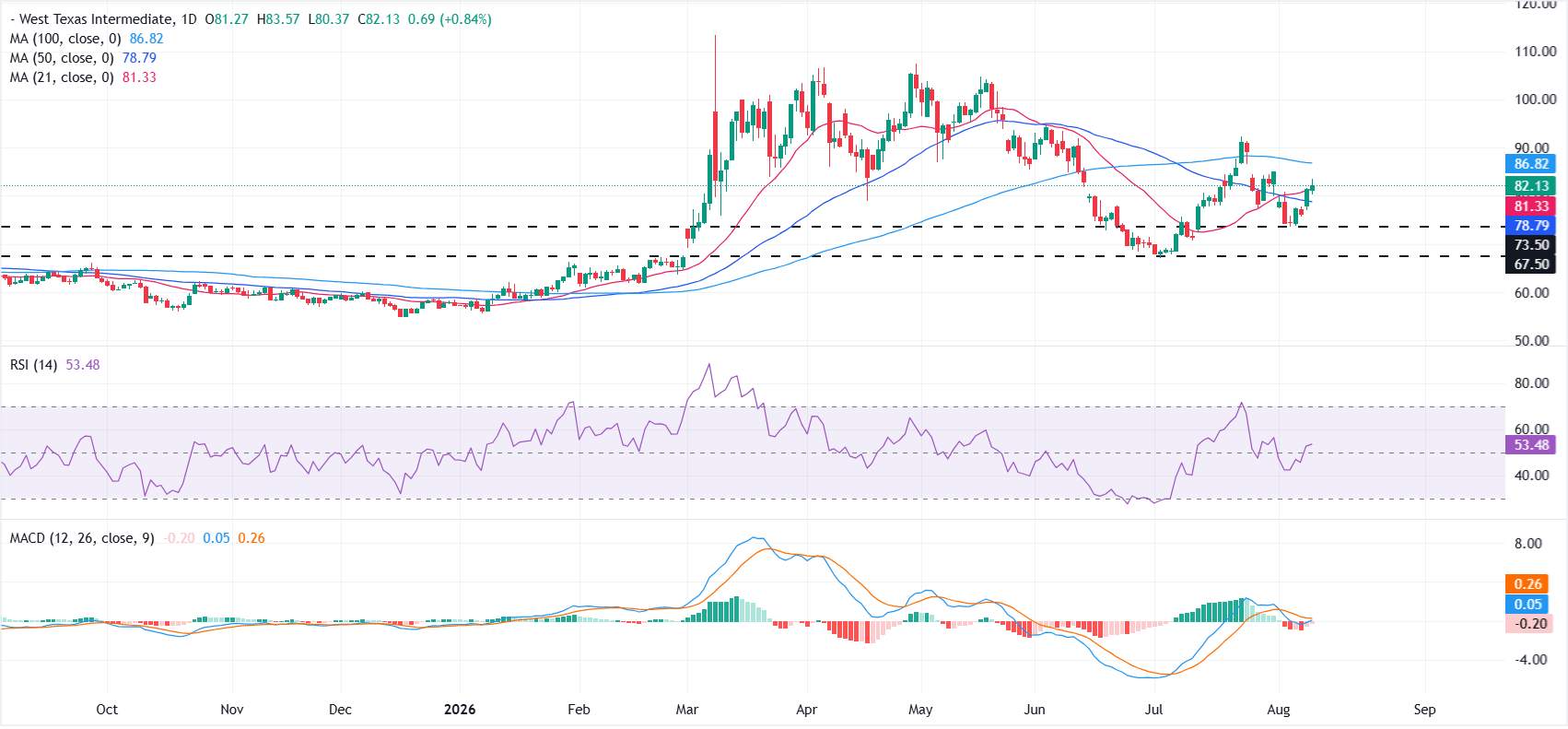
On the daily chart, WTI Oil retains a constructive near-term bias as it holds slightly above the 21-day Simple Moving Average (SMA) at $81 and comfortably above the 50-day SMA at $78.
The Relative Strength Index (RSI) at 53.49 sits in neutral territory with a modest bullish tilt, while the Moving Average Convergence Divergence (MACD) indicator is slightly negative but close to the zero line, hinting at waning downside momentum rather than entrenched selling pressure.
On the downside, the 21-day SMA at $81.33 offers immediate support, followed by the 50-day SMA at $78.79. A deeper pullback would expose the horizontal support levels at $73.50 and $67.50.
On the topside, initial resistance is located at the 100-day SMA at $86.82. A sustained break above this level could open the door to further gains and strengthen the bullish bias.
(The technical analysis of this story was written with the help of an AI tool. Know more.)
WTI Oil FAQs
WTI Oil is a type of Crude Oil sold on international markets. The WTI stands for West Texas Intermediate, one of three major types including Brent and Dubai Crude. WTI is also referred to as “light” and “sweet” because of its relatively low gravity and sulfur content respectively. It is considered a high quality Oil that is easily refined. It is sourced in the United States and distributed via the Cushing hub, which is considered “The Pipeline Crossroads of the World”. It is a benchmark for the Oil market and WTI price is frequently quoted in the media.
Like all assets, supply and demand are the key drivers of WTI Oil price. As such, global growth can be a driver of increased demand and vice versa for weak global growth. Political instability, wars, and sanctions can disrupt supply and impact prices. The decisions of OPEC, a group of major Oil-producing countries, is another key driver of price. The value of the US Dollar influences the price of WTI Crude Oil, since Oil is predominantly traded in US Dollars, thus a weaker US Dollar can make Oil more affordable and vice versa.
The weekly Oil inventory reports published by the American Petroleum Institute (API) and the Energy Information Agency (EIA) impact the price of WTI Oil. Changes in inventories reflect fluctuating supply and demand. If the data shows a drop in inventories it can indicate increased demand, pushing up Oil price. Higher inventories can reflect increased supply, pushing down prices. API’s report is published every Tuesday and EIA’s the day after. Their results are usually similar, falling within 1% of each other 75% of the time. The EIA data is considered more reliable, since it is a government agency.
OPEC (Organization of the Petroleum Exporting Countries) is a group of 12 Oil-producing nations who collectively decide production quotas for member countries at twice-yearly meetings. Their decisions often impact WTI Oil prices. When OPEC decides to lower quotas, it can tighten supply, pushing up Oil prices. When OPEC increases production, it has the opposite effect. OPEC+ refers to an expanded group that includes ten extra non-OPEC members, the most notable of which is Russia.
Author

Vishal Chaturvedi
FXStreet
I am a macro-focused research analyst with over four years of experience covering forex and commodities market. I enjoy breaking down complex economic trends and turning them into clear, actionable insights that help traders stay ahead of the curve.