WTI Crude falls as Iranian proposal raises hopes for renewed US-Iran negotiations
- WTI Crude falls after reports of Iran’s new proposal to the US aimed at ending the war.
- Ongoing Strait of Hormuz disruptions continue to underpin geopolitical risk premium.
- Technically, WTI’s structure remains bullish despite easing momentum from overbought levels.

West Texas Intermediate (WTI) crude Oil eases on Friday, trimming part of the strong gains registered earlier this week as renewed diplomatic efforts to end the US-Iran war lift market sentiment. At the time of writing, WTI is trading around $99, down over 3% on the day and pulling back from a seven-week high near $107.35 reached on Thursday.
The latest leg lower comes as reports suggest Iran has submitted a new proposal through Pakistani mediators in response to the latest US amendments, following Washington’s rejection of an earlier Iranian offer that proposed leaving nuclear negotiations for a later stage. While no details of the new proposal have been disclosed, the development has raised hopes that negotiations could resume.
However, uncertainty remains elevated as US President Donald Trump has maintained a hardline stance, insisting that no deal will be reached without addressing nuclear issues and vowing to continue the naval blockade of Iranian ports. CNN, citing an Iranian source, said Tehran could see talks restarting if the US lifts its blockade and Iran fully reopens the Strait of Hormuz.
Looking ahead, traders will continue to monitor developments in the US-Iran conflict, particularly any progress toward reopening the Strait of Hormuz. Until then, any meaningful decline in WTI may remain limited, as ongoing supply disruptions keep a geopolitical risk premium embedded in Oil prices.
Technical Analysis:
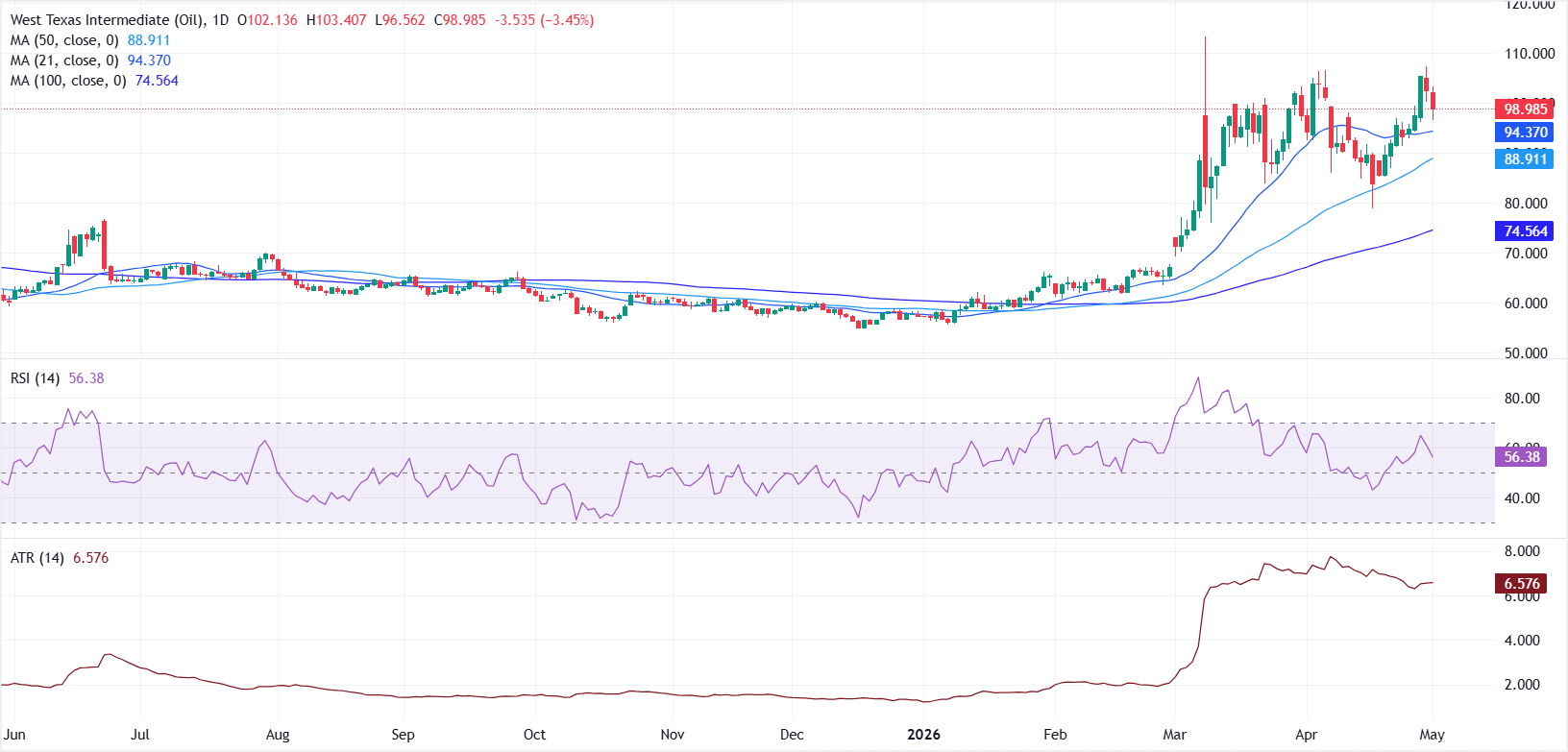
In the daily chart, WTI US Oil maintains a constructive bullish bias as price holds well above the 21-day, 50-day and 100-day Simple Moving Averages (SMAs), which all fan out in a positive configuration and reinforce an underlying uptrend structure. The Relative Strength Index around 56 has eased from earlier overbought territory, indicating that upside momentum is moderating but remains positive rather than exhausted.
On the downside, initial support is located at the 21-day SMA near $94, where a pullback could find buyers on a first test. A deeper correction would expose the 50-day SMA at $88 ahead of the more distant 100-day SMA around $74, which marks a broader trend floor. With the Average True Range (14) at about $6.57, volatility remains elevated but contained, hinting that any dip toward these supports would likely unfold within a still-bullish medium-term structure.
(The technical analysis of this story was written with the help of an AI tool.)
WTI Oil FAQs
WTI Oil is a type of Crude Oil sold on international markets. The WTI stands for West Texas Intermediate, one of three major types including Brent and Dubai Crude. WTI is also referred to as “light” and “sweet” because of its relatively low gravity and sulfur content respectively. It is considered a high quality Oil that is easily refined. It is sourced in the United States and distributed via the Cushing hub, which is considered “The Pipeline Crossroads of the World”. It is a benchmark for the Oil market and WTI price is frequently quoted in the media.
Like all assets, supply and demand are the key drivers of WTI Oil price. As such, global growth can be a driver of increased demand and vice versa for weak global growth. Political instability, wars, and sanctions can disrupt supply and impact prices. The decisions of OPEC, a group of major Oil-producing countries, is another key driver of price. The value of the US Dollar influences the price of WTI Crude Oil, since Oil is predominantly traded in US Dollars, thus a weaker US Dollar can make Oil more affordable and vice versa.
The weekly Oil inventory reports published by the American Petroleum Institute (API) and the Energy Information Agency (EIA) impact the price of WTI Oil. Changes in inventories reflect fluctuating supply and demand. If the data shows a drop in inventories it can indicate increased demand, pushing up Oil price. Higher inventories can reflect increased supply, pushing down prices. API’s report is published every Tuesday and EIA’s the day after. Their results are usually similar, falling within 1% of each other 75% of the time. The EIA data is considered more reliable, since it is a government agency.
OPEC (Organization of the Petroleum Exporting Countries) is a group of 12 Oil-producing nations who collectively decide production quotas for member countries at twice-yearly meetings. Their decisions often impact WTI Oil prices. When OPEC decides to lower quotas, it can tighten supply, pushing up Oil prices. When OPEC increases production, it has the opposite effect. OPEC+ refers to an expanded group that includes ten extra non-OPEC members, the most notable of which is Russia.
Author

Vishal Chaturvedi
FXStreet
I am a macro-focused research analyst with over four years of experience covering forex and commodities market. I enjoy breaking down complex economic trends and turning them into clear, actionable insights that help traders stay ahead of the curve.