Why is the Japanese Yen stuck near 159.25 after the first joint US-Japan intervention since 2011?

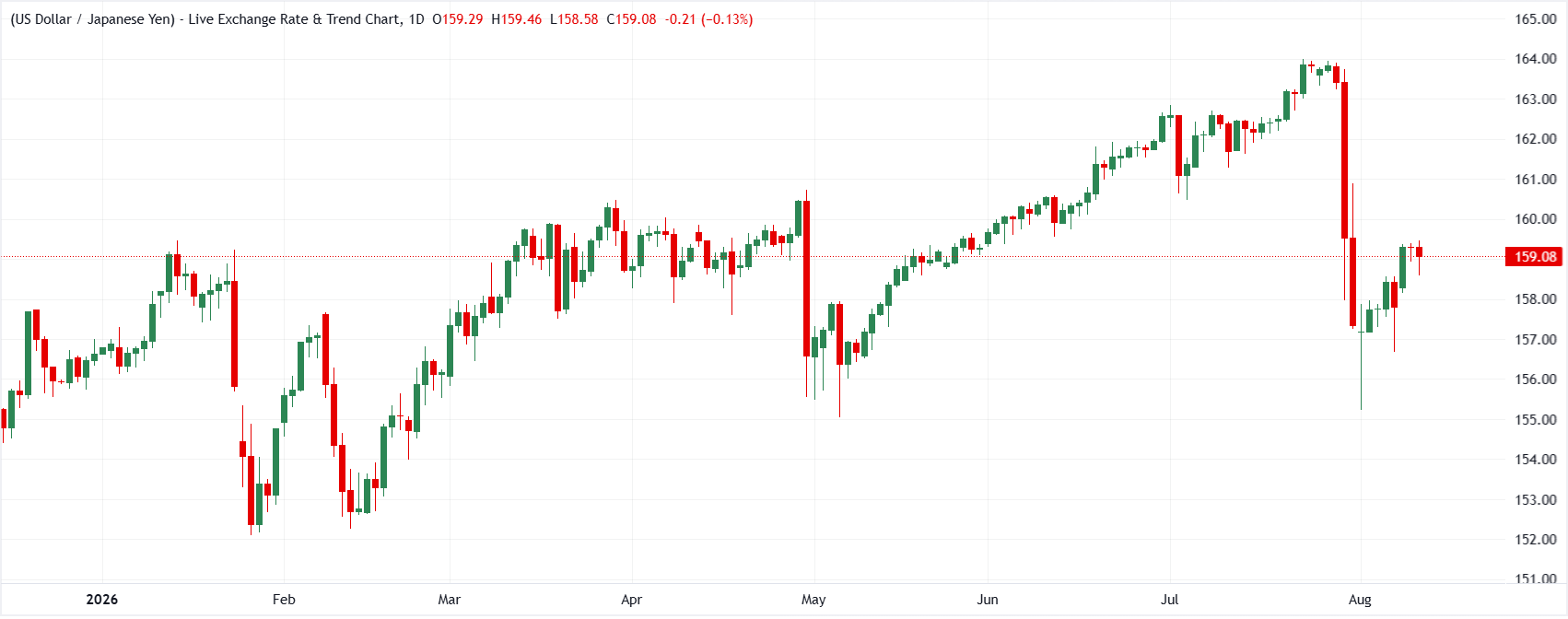
The Japanese Yen (JPY) continues to navigate complex market dynamics, consolidating near the 159.25 level against the US Dollar (USD) following a sharp upward push. While technical momentum keeps short-term upside risks alive for the currency pair, the fundamental backdrop has been reshaped by rare, coordinated foreign exchange intervention between Japanese authorities and the United States. As valuation gaps narrow from extreme lows, market participants are weighing technical range boundaries against the structural impact of joint official action.
Institutional Analysis: UOB vs. DBS Group Research
To compare how leading institutions view the outlook for the Yen, we highlight the core takeaways from UOB and DBS Group Research:
- Near-Term Technical Picture: UOB expects USD/JPY to consolidate in an intraday range of 158.95 to 159.60, with deeply overbought conditions limiting immediate upside beyond 159.60.
- Multi-Week Trading Band: UOB maintains an upside-tilted bias over a 1–3 week horizon within a broader 157.00 to 160.20 range, noting that medium-term strength remains intact as long as spot holds above its 21-day EMA.
- Official Sector Action: DBS Group Research highlights the significance of Japan's second FX market intervention of the year, emphasizing that rare joint participation by the US adds massive credibility and reduces volatility risks in the US Treasury market.
- Regional Currency Impact: DBS Group Research notes that limiting JPY weakness helps alleviate unwanted selling pressure on other undervalued Asian currencies, specifically the South Korean Won (KRW) and Chinese Renminbi (RMB).
Technical overbought conditions anchor USD/JPY in elevated range
According to Quek Ser Leang and Lee Sue Ann at UOB, Monday’s sharp USD rally has transitioned into a quiet consolidation phase near 159.25. While short-term technical indicators reflect strong underlying momentum, deeply overbought conditions make a decisive breakout above major resistance unlikely in the immediate term. Over a wider multi-week period, the pair is expected to remain contained within higher boundaries, anchored by key moving average support.
"While the bias for USD is tilted to the upside, any advance is likely part of a higher range of 157.00/160.20."
Coordinated US-Japan intervention narrows Yen undervaluation and stabilizes regional FX
Taking a broader policy perspective, Chang Wei Liang at DBS Group Research stresses that the Yen's historical undervaluation has begun to narrow following joint FX intervention by US and Japanese authorities. The involvement of the US Treasury — a rare occurrence last witnessed 15 years ago in 2011 — greatly enhances the credibility of official actions while mitigating the need for massive unilateral Treasury sales by Japan. Furthermore, by stemming excessive Yen weakness, policymakers are effectively insulating broader Asian FX markets from spillover depreciation.
- "Co-ordinated FX intervention between the US and Japan is rare, with the last joint intervention occurring 15 years ago to weaken an excessively over-valued JPY in the aftermath of the 2011 Tohoku earthquake... Indeed, both the KRW and RMB are quite undervalued according to our DEER model, and so interventions to limit JPY weakness also help alleviate unwanted selling pressure on regional currencies."
Banks expect elevated range-trading backed by strong intervention credibility
Based on the assessments from both institutions, the banks project an environment where USD/JPY remains technically supported at high levels but subject to firm official capping. UOB anticipates that short-term price action will remain bound between 157.00 and 160.20, with overbought momentum limiting aggressive gains past 159.60. Concurrently, DBS Group Research maintains that the unprecedented backdrop of joint US-Japan intervention provides a credible structural floor for the Yen, helping to stabilize both the domestic currency and broader regional Asian FX over the coming weeks.
(This article was created with the help of an Artificial Intelligence tool and reviewed by an editor. Know more.)
Author

FXStreet Insights Team
FXStreet
The FXStreet Insights Team is a group of journalists that handpicks selected market observations published by renowned experts. The content includes notes by commercial as well as additional insights by internal and external analysts.