What will the Q3 earnings season show?

Key takeaways
- S&P 500 earnings are expected to grow 23.9% YoY in Q3, the eighth consecutive period of double-digit gains.
- Earnings revisions have remained positive, extending the trend in place for nearly a year.
- 14 of the 16 Zacks sectors are on track to see earnings growth in Q3, reflecting broad-based positivity.
The overall setup remains very favorable as we look ahead to the Q3 earnings season. The expectation is that S&P 500 earnings will increase by +23.9% from the same period last year, the 8th straight quarter of double-digit earnings growth for the index.
The Tech sector remains a major growth contributor, but momentum is broad-based, with 14 of the 16 Zacks sectors on track for positive earnings growth in Q3. Importantly, the revisions trend remains positive and broad-based, highlighting a steadily improving outlook.
The quarterly chart below details actual results alongside Q3 2026 growth expectations and forward projections.
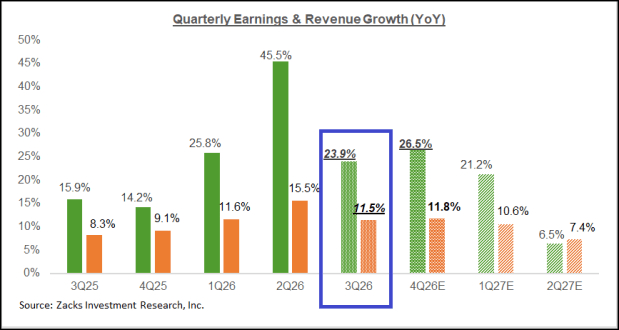
Image Source: Zacks Investment Research
As noted earlier, the revisions trend has been positive, sustaining the favorable trend in place for almost a year. The chart below shows how 2026 Q3 earnings growth expectations have evolved lately.
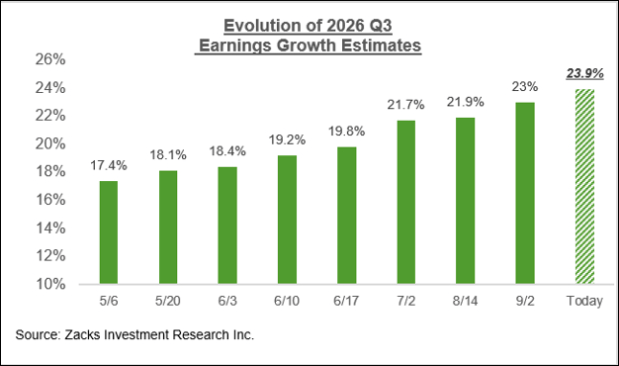
Image Source: Zacks Investment Research
This positive revisions behavior is not a new development; it extends a tailwind that has been building for nearly a year. The positive revisions were initially concentrated in Technology and, more recently, Energy following Middle East supply disruptions. However, for Q3 2026, the constructive estimate revisions have broadened significantly, rising across 8 of the 16 Zacks sectors—including Transportation, Finance, Aerospace, Industrials, Utilities, and Autos alongside Tech and Energy.
On the negative side, Q3 estimates have been under pressure for these 8 sectors since the quarter got underway – Conglomerates, Basic Materials, Consumer Staples, Consumer Discretionary, Medical, Business Services, Retail, and Construction.
It is important to note that estimates for 2026 Q4 and full-year 2027 have also been trending higher lately.
Sector focus: Broad-based strength
Q3 earnings are expected to be above the year-earlier level for 14 of the 16 Zacks sectors, with 6 sectors expected to enjoy double-digit growth. The Conglomerates and Consumer Staples sectors are the only ones expected to have lower earnings in Q3 relative to the same period last year, with Conglomerates earnings expected to be down –35.4% and Consumer Staples earnings expected to be down -0.2%.
The 6 sectors expected to enjoy double-digit earnings growth in Q3 are Aerospace (up +159.5%), Energy (+111.5%), Tech (+41.9%), Basic Materials (+29.6%), Transportation (+14.9%) and Industrial Products (+13.2%).
Q3 earnings growth for the S&P 500 index drops to +19.9% from +23.9% once the Energy sector’s contribution is excluded from the index. Excluding the Tech sector, Q3 earnings growth for the rest of the index drops to +14.4%.
The chart below shows the Q3 earnings and revenue growth expectations for the Tech sector relative to what we saw in the preceding two periods and what is expected in the following three quarters.
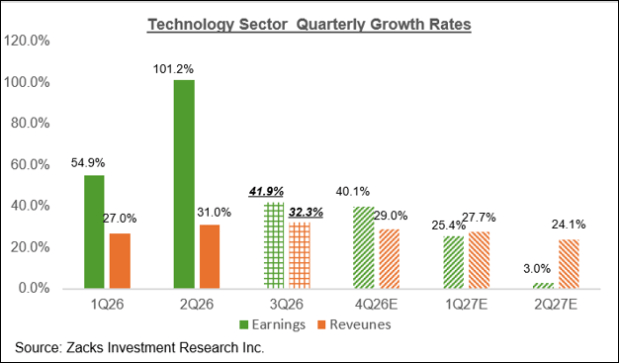
Image Source: Zacks Investment Research
Nvidia (NVDA Quick QuoteNVDA - Free Report) , Micron (MU Quick QuoteMU - Free Report) , and Alphabet (GOOGL Quick QuoteGOOGL - Free Report) have been enjoying a record earnings run in recent quarters, and that performance continues in Q3 as well.
Nvidia’s Q3 earnings are expected to increase +90% year-over-year on +91.2% higher revenues, while the year-over-year earnings and revenue growth for Micron is expected to be +938% and +349.5%, respectively. Importantly, both companies are enjoying a steadily improving outlook, with analysts consistently raising their estimates. We should keep in mind that Micron is scheduled to report quarterly results for its fiscal quarter ending in August on Wednesday, September 30th.
Unlike Nvidia and Micron, Alphabet’s Q3 earnings are expected to be up only +2.1% from the same period last year on +27.2% higher revenues.
Q3 earnings growth for the Tech sector gets cut by slightly more than half once contributions from Nvidia, Alphabet, and Micron are excluded, as the chart below shows.
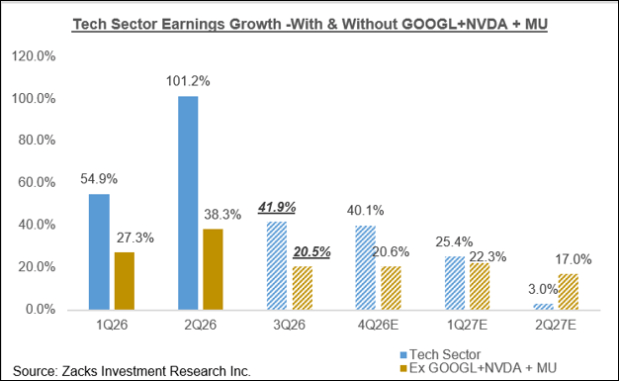
Image Source: Zacks Investment Research
Q3 earnings season scorecard
The Q3 earnings season will get the spotlight when the big banks report on October 13th, but the reporting cycle actually got underway with the September 10th quarterly releases from Oracle (ORCL Quick QuoteORCL - Free Report) and Adobe (ADBE Quick QuoteADBE - Free Report) .
The Oracle and Adobe reports were for these Tech companies’ fiscal quarters ending in August, which get counted as part of the September-quarter tally. Including Oracle and Adobe, we now have such Q3 results from 9 S&P 500 members. We have 7 additional index members on deck to report their fiscal August-quarter results this week, including Nike, Micron, Accenture, and others.
Total Q3 earnings for the 9 S&P 500 members that have reported results already are up +16.3% from the same period last year on +11% higher revenues, with 66.7% beating EPS estimates and an equal proportion beating revenue estimates.
The comparison charts below show the earnings and revenue growth rates for these companies compared to other recent periods.
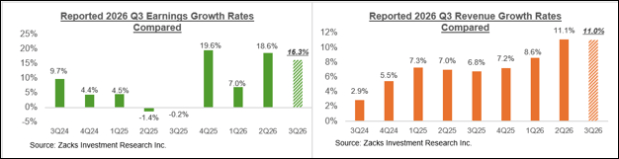
Image Source: Zacks Investment Research
The comparison charts below show the Q3 EPS and revenue beats percentages for these companies compared to other recent periods.
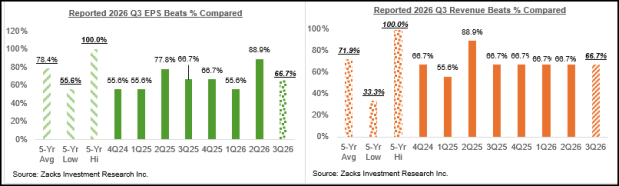
Image Source: Zacks Investment Research
The earnings big picture
The chart below shows the aggregate growth picture for the S&P 500 index on a calendar year basis.
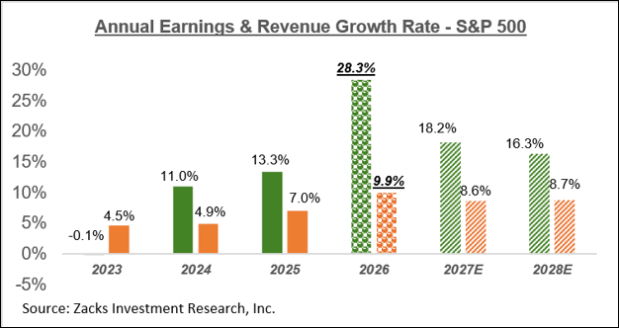
Image Source: Zacks Investment Research
Want the latest recommendations from Zacks Investment Research? Download 7 Best Stocks for the Next 30 Days. Click to get this free report
Author

Zacks
Zacks Investment Research
Zacks Investment Research provides unbiased investment research and tools to help individuals and institutional investors make confident investing decisions.