What drove the Australian Dollar below 0.7000 as the Reserve Bank of Australia hiked to 4.60%?
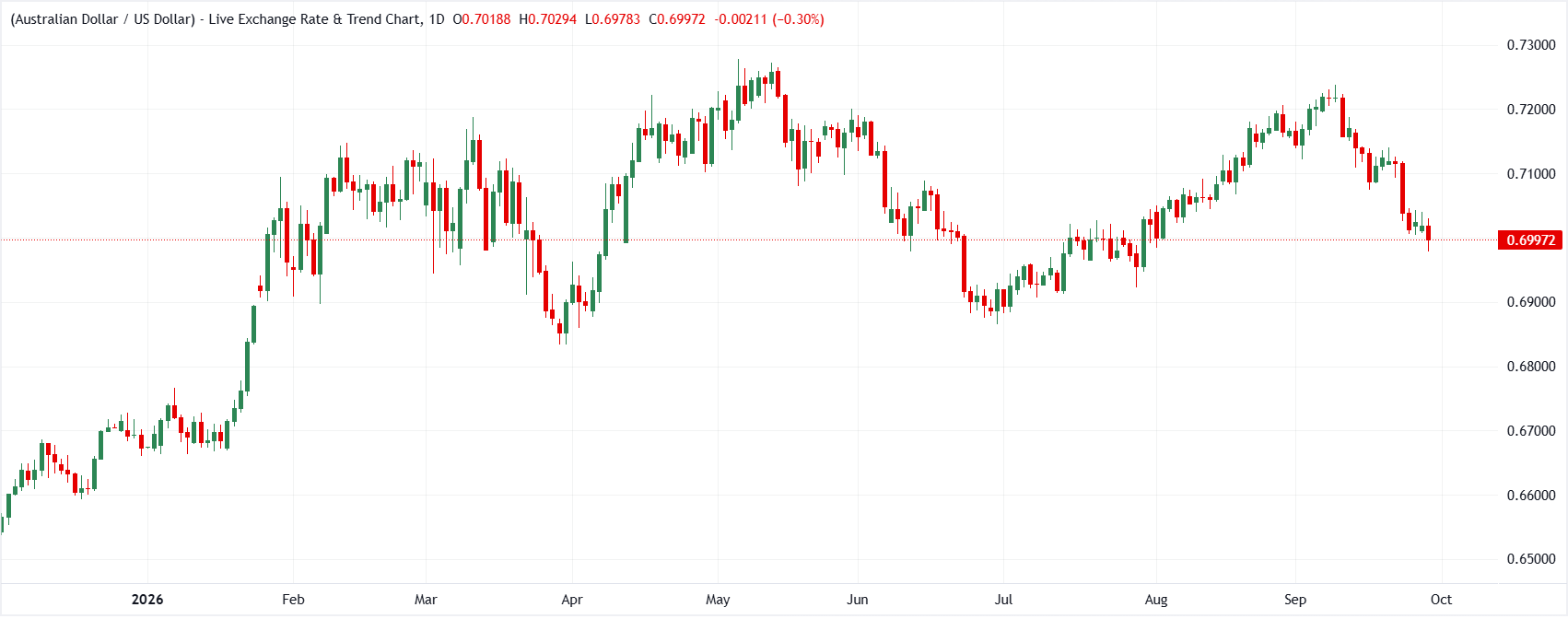
The Australian Dollar (AUD) came under immediate downside pressure following the Reserve Bank of Australia’s (RBA) decision to raise its official cash rate by 25 basis points to 4.60% — marking its fourth interest rate increase in 2026. Despite the central bank maintaining a hawkish stance in its official statement, AUD/USD broke below the key 0.7000 psychological level and tested its 200-day moving average near 0.7030. The sell-off was driven primarily by Governor Michele Bullock’s press conference remarks, which revealed that board members had actively debated holding rates steady due to domestic housing market risks and broader global growth concerns. Institutional strategists are now assessing whether this pullback represents a temporary technical setback or a broader shift in Australian Dollar trajectory.
Institutional Analysis: MUFG vs. ING
- Statement vs. press conference tone: Both institutions note that while the formal RBA policy statement retained a hawkish bias, Governor Bullock’s press conference delivered dovish surprises that drove AUD lower.
- Key AUD/USD price levels: MUFG highlights AUD/USD slipping below 0.7000 and testing its 200-day moving average near 0.7030. ING confirms the drop below 0.7000 as market participants digested the press conference headline flow.
- Policy guidance and Board deliberations: MUFG emphasizes Bullock’s uncertainty regarding whether four hikes will prove sufficiently restrictive. ING points out that policymakers explicitly considered keeping rates on hold due to housing market vulnerabilities and Middle East conflict risks.
- Year-End outlook and downside risks: ING maintains its 0.7200 year-end forecast for AUD/USD, projecting outperformance in a broader USD-bearish environment, though acknowledging heightened near-term global risks. MUFG focuses on immediate price softness as market expectations for subsequent tightening are reassessed.
Bullock’s press conference uncertainty tempers RBA tightening expectations
Lee Hardman at MUFG points out that although the RBA's official statement left the door open for further rate increases, Governor Bullock's cautious tone during the Q&A session undercut market confidence. As AUD/USD tests key technical support around the 0.7000 level and 200-day moving average, future price direction remains tightly bound to incoming inflation data and central bank guidance.
"The Australian dollar has softened overnight falling back below the 0.7000-level against the US dollar... The pair is currently testing important levels at around the 0.7000-level where the 200-day moving average is also located at close to 0.7030... The RBA reiterated that they will “continue to do what it considers necessary to bring inflation sustainably back to target, including increasing the cash rate target further if needed”... Governor Bullock did add though in the press conference that she hopes that four hikes are restrictive enough to slow inflation, but she doesn’t know."
RBA dovish signals trigger AUD sell-off, but ING retains 0.7200 year-end call
Francesco Pesole at ING highlights that the revelation of a debated rate pause introduced a dovish element to an otherwise hawkish central bank move. While acknowledging that worsening global risk sentiment poses near-term downside risks for commodity-linked currencies, ING expects solid domestic fundamentals and an eventual US Dollar retreat to drive AUD higher toward year-end.
"The Reserve Bank of Australia hiked rates as expected to 4.60% this morning. AUD’s first reaction was quite muted. The statement retained a hawkish stance, signalling upside risks to inflation and openness to hike again if needed... However, the press conference is adding a dovish taint and AUD has come under pressure, breaking below 0.700. Governor Michele Bullock said policymakers considered holding rates today, given risks to the housing market and a potentially slower global economy due to the Middle East conflict... Our call for AUD/USD at 0.720 in December has always relied heavily on the USD softening into year-end... AUD’s fundamentals remain solid, and this hike supports them further..."
While the RBA's decision to raise the Official Cash Rate to 4.60% underscores ongoing inflation challenges, Governor Bullock's cautious press conference remarks have dampened immediate rate hike expectations. MUFG highlights immediate technical vulnerabilities as AUD/USD tests its 200-day moving average near 0.7030, whereas ING views the sell-off as a near-term disruption within a broader constructive trend, maintaining a 0.7200 target by December predicated on a softer US Dollar.
(This article was created with the help of an Artificial Intelligence tool and reviewed by an editor. Know more.)
Author

FXStreet Insights Team
FXStreet
The FXStreet Insights Team is a group of journalists that handpicks selected market observations published by renowned experts. The content includes notes by commercial as well as additional insights by internal and external analysts.

















