USD/JPY Price Forecast: Tests nine-day EMA support after falling below 157.50
- USD/JPY could rise toward the 50-day EMA of 158.02.
- The 14-day Relative Strength Index at 49.84 reflects neutral momentum.
- The immediate support lies at the nine-day EMA of 157.24.

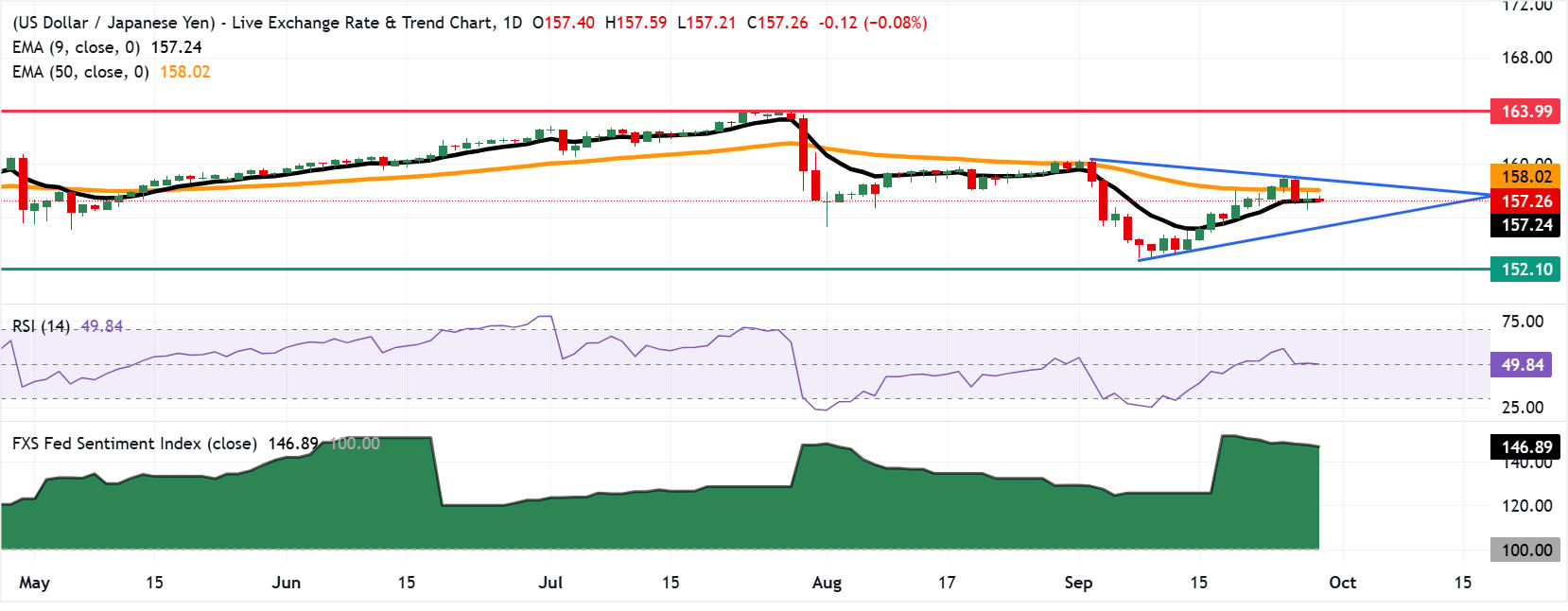
USD/JPY loses ground after posting minor gains the previous day, trading around 157.30 during the Asian hours on Tuesday. The currency pair is remaining within a symmetrical triangle, which indicates a period of market consolidation, where neither buyers nor sellers are in control.
The USD/JPY pair is retaining a mildly bearish near-term bias as it sits below the 50-day Exponential Moving Average (EMA) while holding just above the nine-day EMA. This configuration suggests the pair is consolidating under a key dynamic cap, with short-term trend support still intact.
The 14-day Relative Strength Index (RSI) at 49.84 hovers near neutral territory, hinting at balanced momentum rather than a decisive directional push, while the FXS Fed Sentiment Index at 146.89 offers a supportive backdrop but does not override the prevailing technical cap imposed by the 50-day EMA.
The USD/JPY pair could target the initial barrier at the 50-day EMA of 158.02. Further resistance lies at the upper boundary of the symmetrical triangle around 158.90. A successful break above the triangle would cause a bullish revival and support the pair to explore the region around a nearly 40-year high of 163.99, which was reached on July 23.
On the downside, the USD/JPY pair is testing the immediate support at the nine-day EMA of 157.24, followed by the lower boundary of the symmetrical triangle around 155.50. A sustained break below the triangle would expose the 11-month low of 152.10.
Yen positioning pares back as JPY net longs are cut sharply
Analysts at Rabobank highlight a notable shift in speculative positioning, reporting that "JPY net longs have decreased from 120 thousand positions to around 72 thousand." This sharp reduction in bullish Yen exposure underscores how quickly investor sentiment has cooled, even as policy developments in Japan remain in focus.
Cook flags AI and geopolitical risks as inflation drivers, keeps Dollar bulls alert
Fed’s Cook delivered a slightly more hawkish-than-usual tone, with a 7/10 FXS Speechtracker score marginally above the 6.9/10 historical average, as Cook highlighted “continued inflation pressure” in coming months from artificial intelligence and Middle East conflict while stressing that the labor market is “well positioned” to absorb further rate increases. The emphasis on broadening inflation pressures, the willingness to contemplate additional hikes, and the warning that AI-driven productivity gains will not arrive in time to offset this year’s price dynamics all reinforce a bias toward tighter policy, even as Cook acknowledges only modest medium-term disinflation from technology and potential temporary labor-market disruptions that the Fed would struggle to counter without reigniting inflation.
The FXS Fed Sentiment Index slipped by 0.63 points to 146.89, indicating a modest pullback in perceived hawkishness despite remaining deep in hawkish territory. With the index far above the neutral 100 threshold and the speech score above the established baseline, the Fed still signals a policy stance supportive of the Dollar, even if the incremental tone today is slightly less hawkish than recent peaks.
(The technical analysis of this story was written with the help of an AI tool. Know more.)
Japanese Yen FAQs
The Japanese Yen (JPY) is one of the world’s most traded currencies. Its value is broadly determined by the performance of the Japanese economy, but more specifically by the Bank of Japan’s policy, the differential between Japanese and US bond yields, or risk sentiment among traders, among other factors.
One of the Bank of Japan’s mandates is currency control, so its moves are key for the Yen. The BoJ has directly intervened in currency markets sometimes, generally to lower the value of the Yen, although it refrains from doing it often due to political concerns of its main trading partners. The BoJ ultra-loose monetary policy between 2013 and 2024 caused the Yen to depreciate against its main currency peers due to an increasing policy divergence between the Bank of Japan and other main central banks. More recently, the gradually unwinding of this ultra-loose policy has given some support to the Yen.
Over the last decade, the BoJ’s stance of sticking to ultra-loose monetary policy has led to a widening policy divergence with other central banks, particularly with the US Federal Reserve. This supported a widening of the differential between the 10-year US and Japanese bonds, which favored the US Dollar against the Japanese Yen. The BoJ decision in 2024 to gradually abandon the ultra-loose policy, coupled with interest-rate cuts in other major central banks, is narrowing this differential.
The Japanese Yen is often seen as a safe-haven investment. This means that in times of market stress, investors are more likely to put their money in the Japanese currency due to its supposed reliability and stability. Turbulent times are likely to strengthen the Yen’s value against other currencies seen as more risky to invest in.
Author

Akhtar Faruqui
FXStreet
Akhtar Faruqui is a Forex Analyst based in New Delhi, India. With a keen eye for market trends and a passion for dissecting complex financial dynamics, he is dedicated to delivering accurate and insightful Forex news and analysis.















