USD/JPY breaks four-hour 50 EMA as intervention risk surges

USD/JPY has suffered its sharpest 4-hour decline since May, raising immediate speculation that Japanese authorities may have stepped back into the foreign exchange market.
Intervention remains unconfirmed at the time of writing, but it is undeniable that the short-term structure has been damaged.
Traders are also considering whether officials conducted a rate check, which can warn yen sellers that direct action may be approaching. However, even if the move was only a warning shot or a stop-loss flush, USDJPY is now, for the first time, under its 4H-50 EMA for the first time in two months.
The timing also matters. July 2nd to 3rd was already on our radar as a possible intervention window because US liquidity is thinning ahead of the Independence Day holiday. Sudden selling can create a much larger move when fewer traders are available to absorb it.
USD/JPY’s two-month trend has cracked
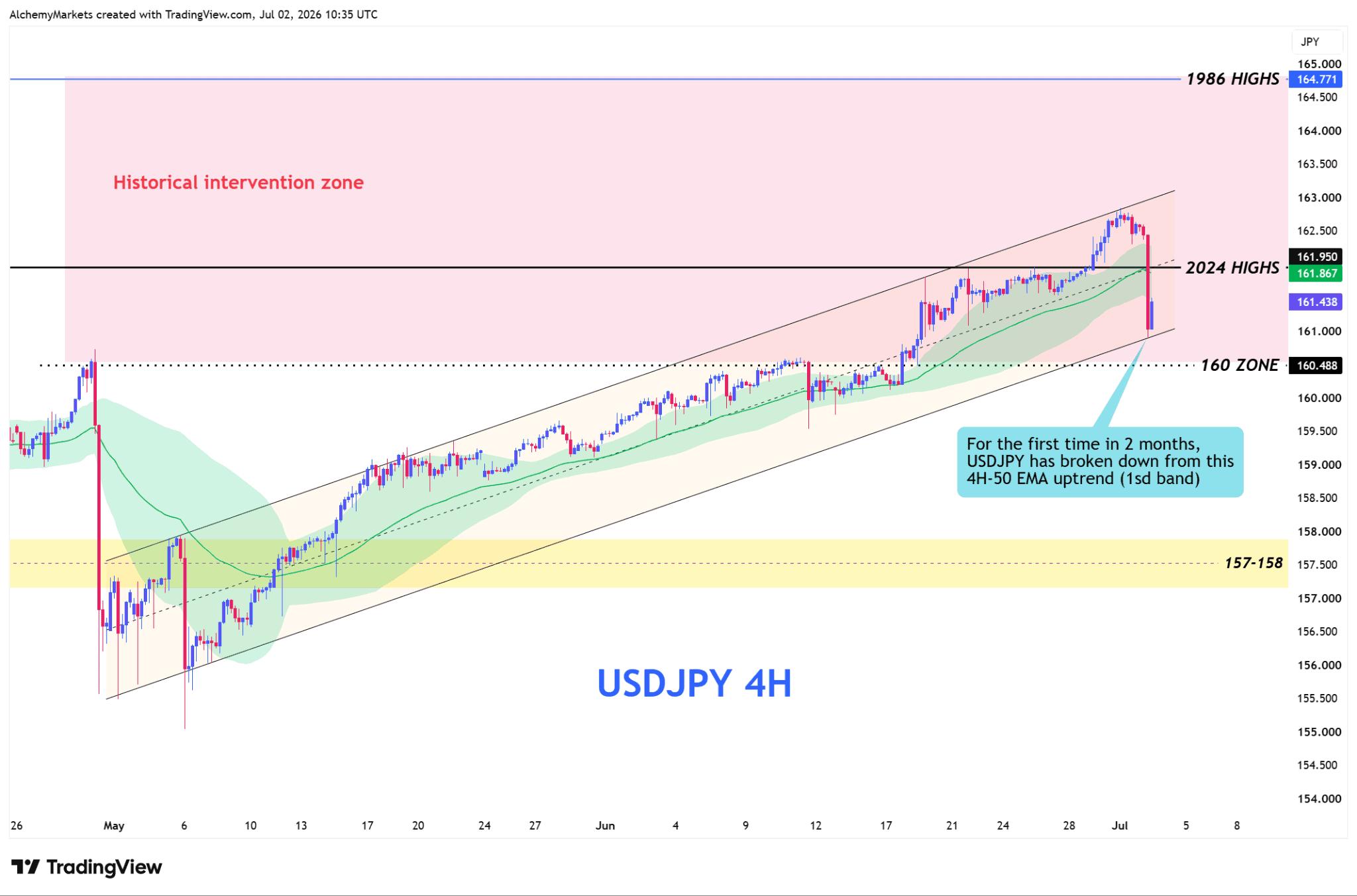
USD/JPY has spent more than two months grinding higher inside a rising channel. During that advance, the four-hour 50 EMA and its one-standard-deviation band repeatedly acted as dynamic support.
Currently, the price has found support at the lows of the rising channel, however, the 4-Hour EMA zone can now act as resistance, at around 161.80 to 162.00 area.
If USD/JPY continues to bleed lower than the rising channel, the first major support to watch is the 160 zone – if that fails, and USDJPY closes another large bearish candle, it adds to the possibility of an active intervention by Japanese authorities.
A decisive break below 160 would be more damaging. It would also threaten the wider rising channel and expose the previous base around 158.50, followed by the larger 157 to 158 support zone.
NFP could decide whether 160 survives
The June US employment report is due today at 8:30 a.m. ET, one day earlier than usual because of the US holiday schedule.
NFP indicator | Forecast | Previous |
Non-Farm Payrolls | 110,000 | 172,000 |
Unemployment rate | 4.3% | 4.3% |
Average hourly earnings, YoY | 3.5% | 3.4% |
The main scenarios are:
I. Strong NFP: A clear payroll beat, especially alongside firm wages, could lift US yields and support the dollar. This may drive USDJPY back towards 161.80 to 162.00, although another rapid climb would also increase intervention risk.
Ii. Weak NFP: A large miss, higher unemployment or weaker wages could lower US yields, strengthen the yen and push USDJPY through 160. That would give the channel breakdown stronger fundamental and technical confirmation.
Iii. Mixed NFP: Payrolls may beat while unemployment rises, or the headline may miss while wages remain firm. This creates the greatest whipsaw risk, making the first candle less reliable.
Bottom line
USD/JPY has suffered its clearest technical setback in two months, but the pair is now sitting near the lower boundary of its rising channel.
The immediate question is whether price rebounds into 161.80 to 162.00 and gets rejected, or continues lower towards the 160 marker.
NFP could trigger either outcome. The cleaner approach is to let the initial volatility settle, then judge whether USDJPY is holding below 160 or reclaiming the broken EMA resistance area.
Author

Zorrays Junaid
Alchemy Markets
Zorrays Junaid has extensive combined experience in the financial markets as a portfolio manager and trading coach. More recently, he is an Analyst with Alchemy Markets, and has contributed to DailyFX and Elliott Wave Forecast in the past.