US Dollar Index spikes as Fed flags sticky inflation and Crude Oil uncertainty
- The US Dollar Index rallied to session highs after the Fed held rates and Powell warned inflation progress has stalled.
- The FOMC voted 11-1 to hold rates, with the updated SEP raising the 2026 PCE inflation forecast to 2.7% from 2.5% in December while keeping the dot plot median at one cut this year.
- Powell said progress on inflation has been slower than hoped, citing persistent goods inflation from tariffs, and warned the Fed cannot treat energy-driven price pressures as transitory until tariff inflation has eased.

The US Dollar Index (DXY) was nearly flat on the day but saw a sharp, decisive move in the final hours, with a vertical rally following the Federal Reserve's (Fed) interest rate decision and Chair Jerome Powell's press conference that carried the index straight to its session highs.
The Federal Open Market Committee (FOMC) voted 11-1 to hold the federal funds rate at 3.50% to 3.75%, with Governor Stephen Miran the lone dissenter in favor of a 25 basis point cut. The updated Summary of Economic Projections (SEP) carried the more hawkish signal: Fed officials raised their 2026 Personal Consumption Expenditures (PCE) inflation forecast to 2.7% from December's 2.5% on both a headline and core basis, while nudging the Gross Domestic Product (GDP) growth estimate up to 2.4%. The dot plot median still points to one cut this year, but seven members now see no cuts at all in 2026, up from six in December, and the longer-run neutral rate estimate ticked up to 3.1% from 3.0%.
Powell's press conference struck a cautious tone. He acknowledged the Fed is making "some progress on inflation, not as much as we had hoped," and pointed to goods inflation still running hot from tariffs as the primary obstacle. On the Crude Oil shock from the Iran conflict, Powell said near-term inflation expectations have risen due to surging energy costs, but that it is "too soon to know the scope and duration" of the effects on the broader economy. He made clear the Fed cannot look through energy-driven inflation until it has "checked that box" on containing tariff-related goods prices first. Powell described the current rate as within a range of neutral and pushed back on characterizing the economy as stagflationary, noting the US is a net energy exporter and that some offset from higher domestic energy production could materialize over time.
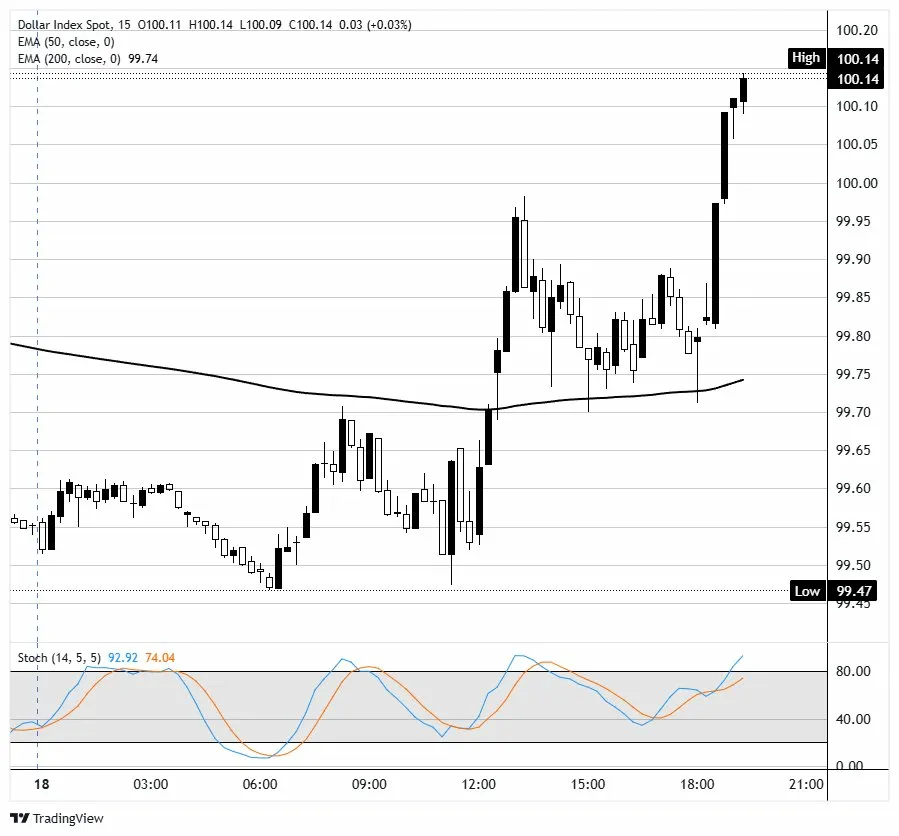
DXY 15-minute chart
Technical Analysis
In the 15-minute chart, Dollar Index Spot trades at 100.13. The near-term bias is mildly bullish as price extends above the 200-period exponential moving average, which is edging higher around 99.70 and now acts as dynamic support to the latest breakout. The sequence of higher closes from the 99.60–99.70 area into the 100.00 handle confirms improving intraday momentum, while the Stochastic oscillator pushing into overbought territory signals strong but stretched upside pressure that may invite brief pauses rather than a full reversal at this stage.
Initial intraday support emerges at the 100.00 psychological level, with a break below exposing secondary support around 99.80, ahead of the 99.70 area where the 200-period exponential average reinforces the floor. On the topside, immediate resistance is now defined at the session peak near 100.20, and a sustained move above this level would open the path toward the next upside objective around 100.40. As long as pullbacks hold above 99.80, the bulls are likely to retain control of the short-term structure.
(The technical analysis of this story was written with the help of an AI tool.)
Economic Indicator
Fed Interest Rate Decision
The Federal Reserve (Fed) deliberates on monetary policy and makes a decision on interest rates at eight pre-scheduled meetings per year. It has two mandates: to keep inflation at 2%, and to maintain full employment. Its main tool for achieving this is by setting interest rates – both at which it lends to banks and banks lend to each other. If it decides to hike rates, the US Dollar (USD) tends to strengthen as it attracts more foreign capital inflows. If it cuts rates, it tends to weaken the USD as capital drains out to countries offering higher returns. If rates are left unchanged, attention turns to the tone of the Federal Open Market Committee (FOMC) statement, and whether it is hawkish (expectant of higher future interest rates), or dovish (expectant of lower future rates).
Read more.Last release: Wed Mar 18, 2026 18:00
Frequency: Irregular
Actual: 3.75%
Consensus: 3.75%
Previous: 3.75%
Source: Federal Reserve
Author

Joshua Gibson
FXStreet
Joshua joins the FXStreet team as an Economics and Finance double major from Vancouver Island University with twelve years' experience as an independent trader focusing on technical analysis.














