The Australian Dollar reclaims a big figure and immediately loses its nerve
- AUD/USD trades near 0.7005 after tagging 0.7021, its first look above the 0.7000 handle since mid-June.
- China's second-quarter growth misses while industrial production and retail sales beat, and the optimistic read wins the day.
- The 50-day EMA caps the advance ahead of Thursday's inflation expectations and next week's employment report.
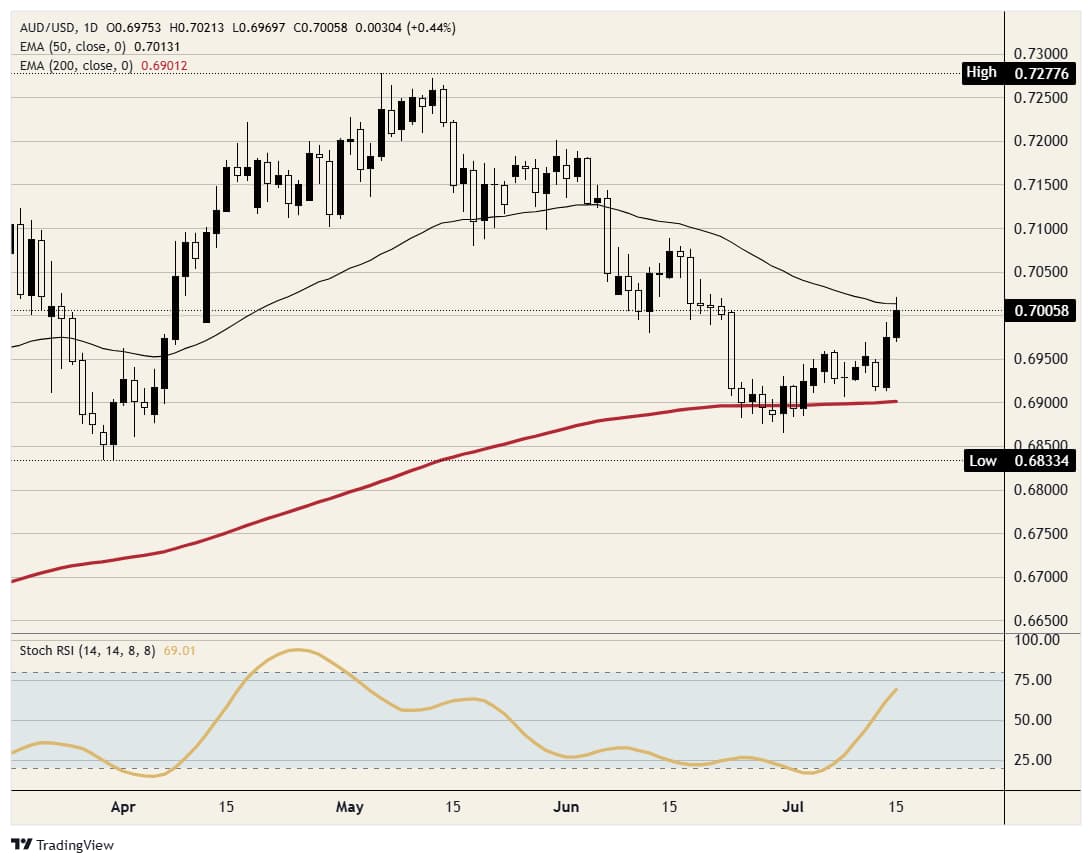
The Australian Dollar opened near 0.6975, ground higher through every session of the day, and poked above 0.7000 for the first time since mid-June before the momentum quietly left the room. The Aussie trades near 0.7005 at writing, up 0.44%, having stalled at 0.7021 and backed off the 50-day Exponential Moving Average (EMA) at 0.7016 almost to the pip. A range inside half a big figure makes this one of Wednesday's less dramatic majors; the level it played out at makes it one of the more important ones.
The round number carries a month of baggage. The Aussie slid from above 0.7050 in mid-June to a base near 0.6865 in early July, then ground its way back on a steady run of higher lows, and Wednesday's push was the first test of the declining 50-day average since the breakdown. Rejections at falling moving averages are what downtrends produce; a clean daily close through one is what ends them, and the pair sits a handful of pips shy of finding out which it gets.
Beijing serves a mixed plate
China's second-quarter Gross Domestic Product (GDP) grew 0.9% on the quarter, matching consensus but slowing from 1.3%, while the annual rate missed at 4.3% against 4.5% expected. The June activity data pulled the other way: industrial production beat at 5.3% YoY against a 4.6% consensus, and retail sales swung back to growth at 1% against expectations for a 0.1% decline. For an economy that spent the spring flirting with a consumer relapse, the retail swing is the number Australia's exporters actually care about.
The Aussie lives and dies on Chinese commodity demand, and on that score the activity beats matter more than a two-tenths growth miss. The currency held its overnight bid straight through the release and never looked back until the New York afternoon, which is about as clean a verdict as intraday price action delivers. Whether Beijing deserves top billing is another question, because the bulk of Wednesday's gain was manufactured in Washington rather than in China.
A soft-Dollar tide lifts a hesitant boat
The June American Producer Price Index (PPI) fell 0.3% MoM and slowed to 5.5% YoY against a 6.2% consensus, extending the week's run of cooler-than-feared inflation data and taking a bite out of Federal Reserve (Fed) hike pricing that stood near 70% for September earlier this month. The Fed Chair's Capitol Hill testimony at 14:00 GMT was scored neutral rather than hawkish, and the Dollar spent the New York session offered against everything with a heartbeat.
The Reserve Bank of Australia (RBA) sits at 4.35% after three hikes this year and a June hold, leaving the Aussie with positive carry against a Fed parked at 3.75%, yet the currency's high-beta character cuts both ways. Renewed American strikes on Iran, a re-declared blockade of the Strait of Hormuz and Washington floating a 20% transit toll keep global risk appetite on a leash, and the fade off 0.7021 arrived alongside a hawkish-scored Fed speech at 17:00 GMT. The Aussie rallied on the Dollar's bad day and hesitated on its own limitations.
The bar for follow-through
Thursday's consumer inflation expectations reading at 01:00 GMT, last printed at 5.5%, is the sort of number that keeps the RBA's tightening bias alive, and June American Retail Sales at 12:30 GMT carry red-band weight for the Dollar side of the ledger, with consensus at 0.2% MoM after May's 0.9%. Monday brings the People's Bank of China (PBoC) rate decision, where the benchmark sits at 3% and nothing in Wednesday's data screams urgency to move it.
The main event lands on Thursday, July 23, when June employment figures arrive against a prior report of 40.3K jobs added and a 4.4% unemployment rate, followed later that day by flash Purchasing Managers Index (PMI) surveys. A labour market that refuses to crack is the strongest argument for keeping the RBA's hike option on the table, and by extension the strongest argument the Aussie has for turning a one-day visit above 0.7000 into a change of address.
Levels and bias
Resistance: The 50-day EMA at 0.7016 is the immediate cap, validated by Wednesday's rejection from 0.7021. Above it, the 0.7050 region opens the door toward 0.7100, the next round-number objective.
Support: The 0.6950 zone is first reference on a dip, ahead of the 0.6900 base that absorbed every test through early July. The 200-day EMA sits well below near 0.6884.
Bias: Bullish while 0.6950 holds. A daily close above the 50-day EMA unlocks the path to 0.7100; a rejection here sends the Aussie back into the June range to think about what it has done.
AUD/USD daily chart
Australian Dollar FAQs
One of the most significant factors for the Australian Dollar (AUD) is the level of interest rates set by the Reserve Bank of Australia (RBA). Because Australia is a resource-rich country another key driver is the price of its biggest export, Iron Ore. The health of the Chinese economy, its largest trading partner, is a factor, as well as inflation in Australia, its growth rate and Trade Balance. Market sentiment – whether investors are taking on more risky assets (risk-on) or seeking safe-havens (risk-off) – is also a factor, with risk-on positive for AUD.
The Reserve Bank of Australia (RBA) influences the Australian Dollar (AUD) by setting the level of interest rates that Australian banks can lend to each other. This influences the level of interest rates in the economy as a whole. The main goal of the RBA is to maintain a stable inflation rate of 2-3% by adjusting interest rates up or down. Relatively high interest rates compared to other major central banks support the AUD, and the opposite for relatively low. The RBA can also use quantitative easing and tightening to influence credit conditions, with the former AUD-negative and the latter AUD-positive.
China is Australia’s largest trading partner so the health of the Chinese economy is a major influence on the value of the Australian Dollar (AUD). When the Chinese economy is doing well it purchases more raw materials, goods and services from Australia, lifting demand for the AUD, and pushing up its value. The opposite is the case when the Chinese economy is not growing as fast as expected. Positive or negative surprises in Chinese growth data, therefore, often have a direct impact on the Australian Dollar and its pairs.
Iron Ore is Australia’s largest export, accounting for $118 billion a year according to data from 2021, with China as its primary destination. The price of Iron Ore, therefore, can be a driver of the Australian Dollar. Generally, if the price of Iron Ore rises, AUD also goes up, as aggregate demand for the currency increases. The opposite is the case if the price of Iron Ore falls. Higher Iron Ore prices also tend to result in a greater likelihood of a positive Trade Balance for Australia, which is also positive of the AUD.
The Trade Balance, which is the difference between what a country earns from its exports versus what it pays for its imports, is another factor that can influence the value of the Australian Dollar. If Australia produces highly sought after exports, then its currency will gain in value purely from the surplus demand created from foreign buyers seeking to purchase its exports versus what it spends to purchase imports. Therefore, a positive net Trade Balance strengthens the AUD, with the opposite effect if the Trade Balance is negative.
Author

Joshua Gibson
FXStreet
Joshua joins the FXStreet team as an Economics and Finance double major from Vancouver Island University with twelve years' experience as an independent trader focusing on technical analysis.