|

Stocks continue to fluctuate – Which way next?

The stock market has extended its consolidation further - is this merely a pause before another advance?

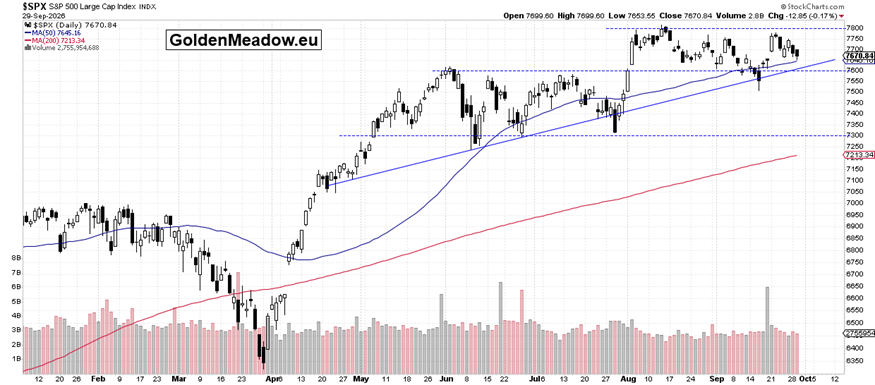
The S&P 500 index closed 0.17% lower on Tuesday, essentially extending its short-term consolidation following the rally on September 21. Today, the index is expected to open 0.4% higher as investors react to the release of the Core PCE Price Index and final GDP figures.

Recently, the investor sentiment has slightly improved, as reflected in last Wednesday’s AAII Investor Sentiment Survey, which reported that 32.7% of individual investors are bullish, while 48.1% are bearish.

The S&P 500 continues to trade within a consolidation, as shown on the daily chart.
Chart

S&P 500 futures contract: Moving sideways

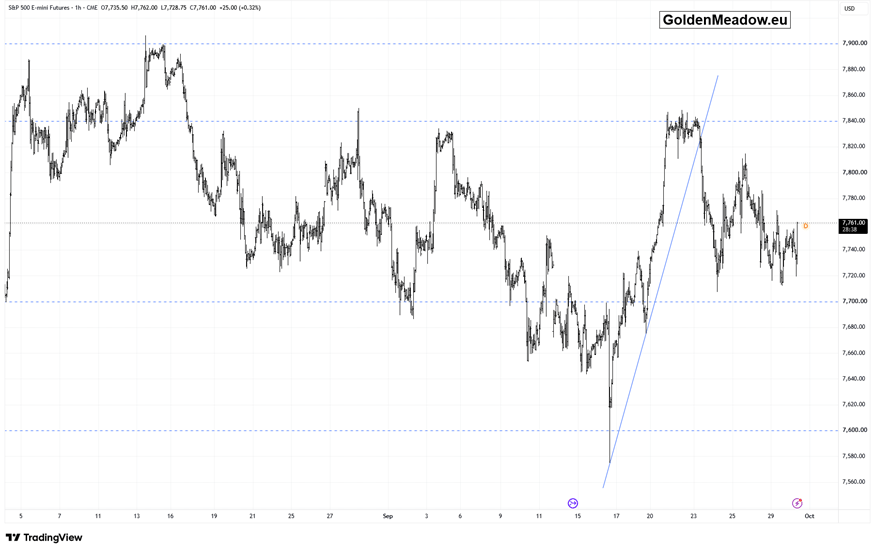
This morning, the S&P 500 futures contract is trading higher, extending its consolidation above the 7,700 level.

Resistance is now at 7,780-7,800, while support is at 7,700, among other levels.
Chart

Market outlook: Within a two-month-long consolidation range

The S&P 500 index is likely to open higher on Wednesday, continuing to consolidate following the recent rally.

The ongoing Middle East conflict, elevated oil prices, and rising bond yields remain negative factors for the market.

For now, the market still appears to be undergoing a flat correction of its advances from early August.

Here's what I think is most likely:

  • The S&P 500 index is essentially moving sideways as investors await further developments in the Middle East and additional economic data.
  • My Volatility Breakout System is currently long in the market.

What this means for your portfolio

For individual investors, this environment calls for careful position management. While the market continues to advance, the combination of low volatility, seasonal weakness signals, and stretched valuations suggests that defensive positioning may become increasingly important in the weeks ahead.


Want free follow-ups to the above article and details not available to 99%+ investors? Sign up to our free newsletter today!

Author

Paul Rejczak

Paul Rejczak

Gold Price Forecast

Paul Rejczak is a stock market strategist who has been known for the quality of his technical and fundamental analysis since the late nineties.


More from Paul Rejczak
Share:

Editor's Picks

AUD/USD keeps range near 0.6950 after Australian trade data

AUD/USD consolidates near a two-month low, trading around mid-0.6900s in the Asian session on Thursday amid a bullish US Dollar. The US PCE data tempered October Fed hike bets, though oil-driven inflation fears remain supportive of elevated US bond yields. Meanwhile, Australia's trade surplus shrank sharply in August to AUD495M, having limited impact on the Aussie Dollar and the pair.


USD/JPY sits at weekly top above 158.00 as bullish USD counters intervention risks

USD/JPY is sitting at the top end of its weekly range above 158.00 in the Asian session on Thursday. Despite the softer US PCE data, oil-driven inflation risks keep US bond yields elevated near multi-year highs. Moreover, the US-Iran standoff benefits the safe-haven US Dollar and supports the pair. Broad US Dollar strength counters hawkish BoJ expectations and Japanese intervention risks.

$4,200: Gold sellers to retain control below that level ahead of ISM PMI

Gold is trying hard to contain the downside, while trading close to $4,150 in Thursday’s Asian trading, having faced rejection above $4,200 on Wednesday. Focus now turns to a fresh batch of US economic data releases and speeches from Federal Reserve policymakers for fresh hints on a possible interest rate hike in October.

Pi Network: Early signs of renewed bullish momentum amid Open Standard partnership
Pi Network (PI) ticks lower on Thursday after two consecutive days of mild recovery, testing the 50-day Exponential Moving Average (EMA) at $0.0917. Pi Core Team announced a partnership with Open Standard on Wednesday to explore the OUSD stablecoin reward programs for Pi Network users, commonly referred to as Pioneers, and its utility across the Pi ecosystem.
The Fed's October hike shrinks with the inflation it was built on

Traders have moved the next Federal Reserve hike from October 28 to December 9, and the inflation report that added to the move said more about July than August. The government's annual rewrite, published alongside the August Personal Consumption Expenditures Price Index, cut July's core reading, which leaves out food and energy, from 3.3% to 3%.

The Euro is near a one-year low: Inflation could trigger its rebound, not its fall

EUR/USD has fallen to its lowest level since May 2025, but a fresh inflation shock in the Eurozone could give the Euro (EUR) an unexpected lifeline. The pair hit 1.1312 on Wednesday and trades well below the January peak of 1.2082.