Silver Price Forecast: XAG/USD tests the $55 floor as sellers retain control
- Silver extends its decline as the US Dollar rebounds and Treasury yields stabilize.
- Higher Oil prices keep inflation risks and expectations of a Fed rate hike later this year alive.
- XAG/USD trades near the $55 floor, with the technical outlook tilted firmly to the downside.

Silver (XAG/USD) extends its decline on Thursday as the US Dollar (USD) rebounds and US Treasury yields stabilize following a two-day drop driven by softer-than-expected US inflation data. At the time of writing, XAG/USD trades around $55.75, down 3.50% on the day.
Despite the softer inflation readings, price pressures could pick up again as escalating tensions in the Middle East drive Oil prices higher. This keeps the possibility of a Federal Reserve (Fed) interest rate hike later this year alive, supporting the US Dollar and weighing on the non-yielding metal, which typically performs better in a low-interest-rate environment.
XAG/USD remains in a corrective phase. The latest leg lower has brought prices back to the December 2025 lows, a level that was also tested in June.
The metal is now trading more than 50% below its record high of $121 reached in January and remains vulnerable to further losses unless Fed rate hike expectations fade, which appears unlikely in the near term.
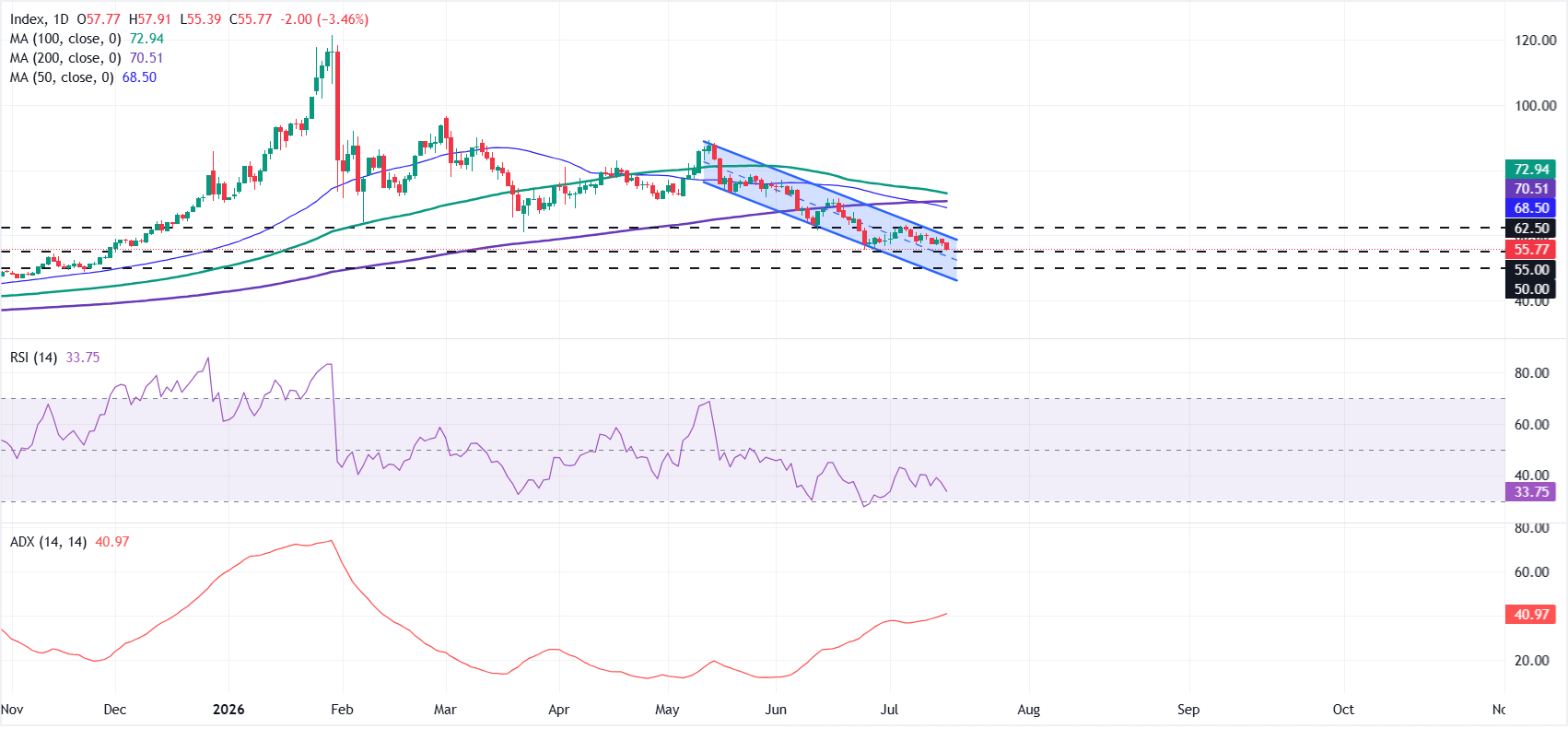
From a technical perspective, XAG/USD extends its decline within a well-defined descending parallel channel and trades below the 50-day, 100-day and 200-day Simple Moving Averages (SMAs), reinforcing the bearish outlook.
The Relative Strength Index (RSI) on the daily chart is near 34 and the Average Directional Index around 41, suggesting a strong but still downside-skewed trend as price consolidates only slightly above the $55 structural floor.
On the upside, initial resistance emerges at the upper boundary of the descending channel near $60, followed by the horizontal barrier at $62.50 before the clustered 50- and 200-day SMAs around $68.50-70.51, and the more distant 100-day SMA at $72.94.
On the downside, immediate support lies at $55.00, followed by the psychological $50 mark and the lower boundary of the channel near $45.50. These levels could slow the decline, but sellers retain control while XAG/USD trades below its major moving averages.
Inflation FAQs
Inflation measures the rise in the price of a representative basket of goods and services. Headline inflation is usually expressed as a percentage change on a month-on-month (MoM) and year-on-year (YoY) basis. Core inflation excludes more volatile elements such as food and fuel which can fluctuate because of geopolitical and seasonal factors. Core inflation is the figure economists focus on and is the level targeted by central banks, which are mandated to keep inflation at a manageable level, usually around 2%.
The Consumer Price Index (CPI) measures the change in prices of a basket of goods and services over a period of time. It is usually expressed as a percentage change on a month-on-month (MoM) and year-on-year (YoY) basis. Core CPI is the figure targeted by central banks as it excludes volatile food and fuel inputs. When Core CPI rises above 2% it usually results in higher interest rates and vice versa when it falls below 2%. Since higher interest rates are positive for a currency, higher inflation usually results in a stronger currency. The opposite is true when inflation falls.
Although it may seem counter-intuitive, high inflation in a country pushes up the value of its currency and vice versa for lower inflation. This is because the central bank will normally raise interest rates to combat the higher inflation, which attract more global capital inflows from investors looking for a lucrative place to park their money.
Formerly, Gold was the asset investors turned to in times of high inflation because it preserved its value, and whilst investors will often still buy Gold for its safe-haven properties in times of extreme market turmoil, this is not the case most of the time. This is because when inflation is high, central banks will put up interest rates to combat it. Higher interest rates are negative for Gold because they increase the opportunity-cost of holding Gold vis-a-vis an interest-bearing asset or placing the money in a cash deposit account. On the flipside, lower inflation tends to be positive for Gold as it brings interest rates down, making the bright metal a more viable investment alternative.
Author
Vishal Chaturvedi
FXStreet
I am a macro-focused research analyst with over four years of experience covering forex and commodities market. I enjoy breaking down complex economic trends and turning them into clear, actionable insights that help traders stay ahead of the curve.
















