Silver Price Forecast: XAG/USD drops from multi-year highs above $39.00
- Silver retreats from $39.12 peak but maintains bullish long-term structure.
- RSI remains elevated, suggesting buyers still have technical control.
- Break below $37.31 may trigger deeper correction toward $36.69 and $36.00.
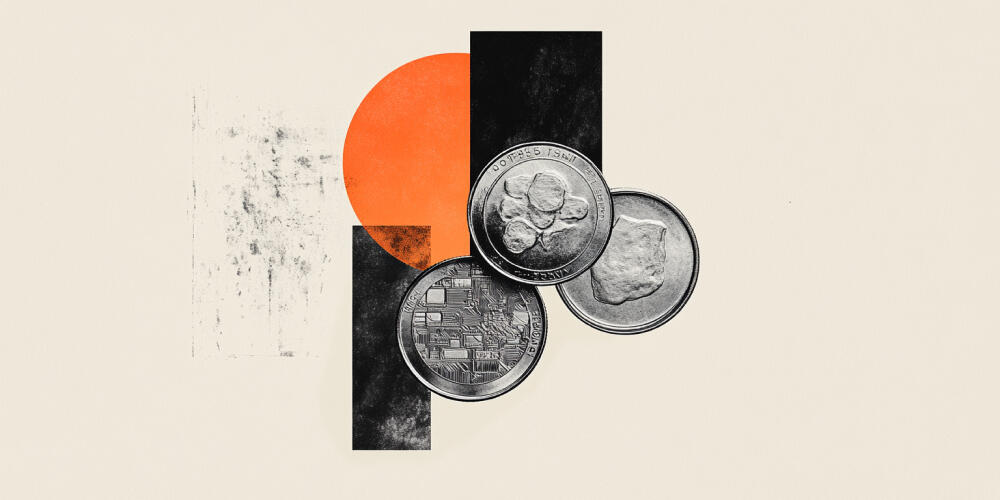
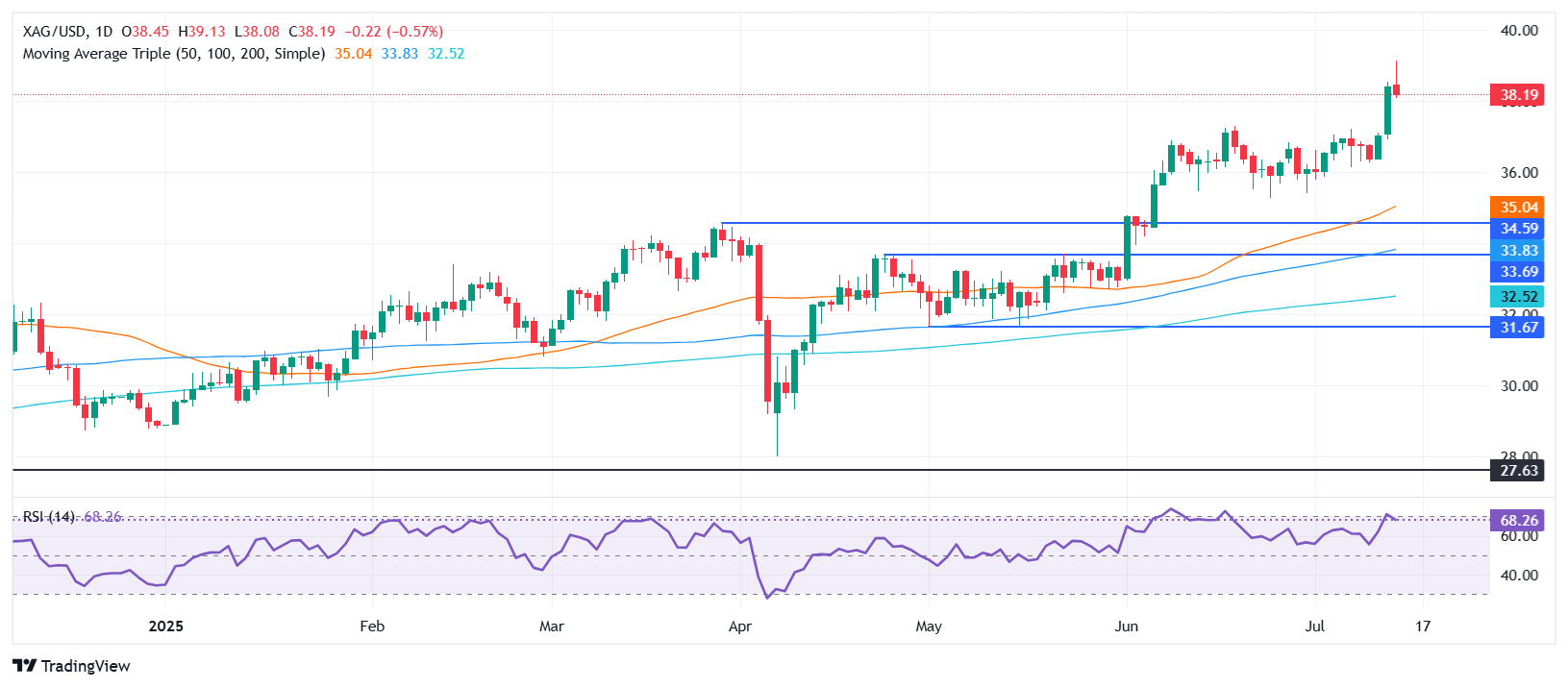
Silver price forms a ‘shooting star’ candle chart pattern amid a day in which precious metals were pressured as traders priced in initial risk-off sentiment. However, they faded the move, amid fears that the White House might backpedal, as they could reach trade agreements with Canada, the EU, and Mexico ahead of the August 1 deadline. The XAG/USD trades at 38.14, down 0.66%.
XAG/USD Price Forecast: Technical outlook
The grey metal is upward biased, despite falling below the $39.00 figure after reaching multi-year highs at $39.12. The Relative Strength Index (RSI) depicts that buyers are still in control, even though XAG/USD dipped toward $38.00.
For a bullish continuation, Silver traders need to push prices back above $38.50 and test the $39.00 figure. A breach of the latter would pave the way to refresh yearly highs.
Conversely, if Silver tumbles below the June 18 high of $37.31, expect further downside and a possible test of the 20-day Simple Moving Average (SMA) at $36.69. On further weakness, the $36.00 figure is up next.
XAG/USD Price Chart – Daily
Silver FAQs
Silver is a precious metal highly traded among investors. It has been historically used as a store of value and a medium of exchange. Although less popular than Gold, traders may turn to Silver to diversify their investment portfolio, for its intrinsic value or as a potential hedge during high-inflation periods. Investors can buy physical Silver, in coins or in bars, or trade it through vehicles such as Exchange Traded Funds, which track its price on international markets.
Silver prices can move due to a wide range of factors. Geopolitical instability or fears of a deep recession can make Silver price escalate due to its safe-haven status, although to a lesser extent than Gold's. As a yieldless asset, Silver tends to rise with lower interest rates. Its moves also depend on how the US Dollar (USD) behaves as the asset is priced in dollars (XAG/USD). A strong Dollar tends to keep the price of Silver at bay, whereas a weaker Dollar is likely to propel prices up. Other factors such as investment demand, mining supply – Silver is much more abundant than Gold – and recycling rates can also affect prices.
Silver is widely used in industry, particularly in sectors such as electronics or solar energy, as it has one of the highest electric conductivity of all metals – more than Copper and Gold. A surge in demand can increase prices, while a decline tends to lower them. Dynamics in the US, Chinese and Indian economies can also contribute to price swings: for the US and particularly China, their big industrial sectors use Silver in various processes; in India, consumers’ demand for the precious metal for jewellery also plays a key role in setting prices.
Silver prices tend to follow Gold's moves. When Gold prices rise, Silver typically follows suit, as their status as safe-haven assets is similar. The Gold/Silver ratio, which shows the number of ounces of Silver needed to equal the value of one ounce of Gold, may help to determine the relative valuation between both metals. Some investors may consider a high ratio as an indicator that Silver is undervalued, or Gold is overvalued. On the contrary, a low ratio might suggest that Gold is undervalued relative to Silver.
Author

Christian Borjon Valencia
FXStreet
Markets analyst, news editor, and trading instructor with over 14 years of experience across FX, commodities, US equity indices, and global macro markets.