Silver Price Forecast: XAG/USD declines to near $58.70 in countdown to US inflation data
- Silver price slumps to near $58.70 amid the recent recovery in oil prices.
- Investors keenly await the US CPI data for September.
- Danske Bank said that the Fed has signaled no urgency for interest rate hikes.

Silver price (XAG/USD) is down 0.65% to near $58.70 during the European trading session on Wednesday. The white metal is under pressure as oil prices have increased recently amid ongoing tensions in the Middle East.
As of writing, the WTI Oil price trades 0.5% lower to near $93.44, but has recovered almost 7.5% from its recent low of $86.32.
Analysts at Commerzbank report that oil prices extended its recent advance, as "fresh Houthi attacks on Saudi infrastructure and continued tanker diversions from the Persian Gulf stoked supply fears." The bank highlights that the renewed disruption to Saudi facilities and shipping routes is reinforcing market concerns over the reliability of Middle East supply at current price levels.
Higher oil prices prompt global inflationary fears, a scenario that boosts the odds of hawkish interest rate decisions from central banks, which diminishes the appeal of non-yielding assets, such as Silver.
Meanwhile, investors keenly await the United States (US) Consumer Price Index (CPI) data for September, which will be published at 12:30 GMT. The data is expected to have a significant impact on Federal Reserve’s (Fed) interest rate expectations.
US inflation seen edging higher but Fed likely to stay patient
Analysts at Danske Bank expect a modest firming in the September data, forecasting “headline inflation at 0.5% m/m SA, 3.6% y/y (prior: 0.6% m/m, 3.4% y/y) and core inflation at 0.2% m/m SA, 2.5% y/y (prior: 0.3% m/m, 2.4% y/y), with energy prices being the main driver of the expected pickup in headline inflation.” For the policy outlook, Danske Bank emphasises that “for the Fed, focus will be on whether underlying inflation pressures are broadening.” With this being the final inflation release before the October FOMC meeting and “recent Fed communication signalling little urgency to hike again,” the bank judges that “it would take a clear upside surprise for the Fed to signal a rate hike already in October.”
Silver Technical Analysis
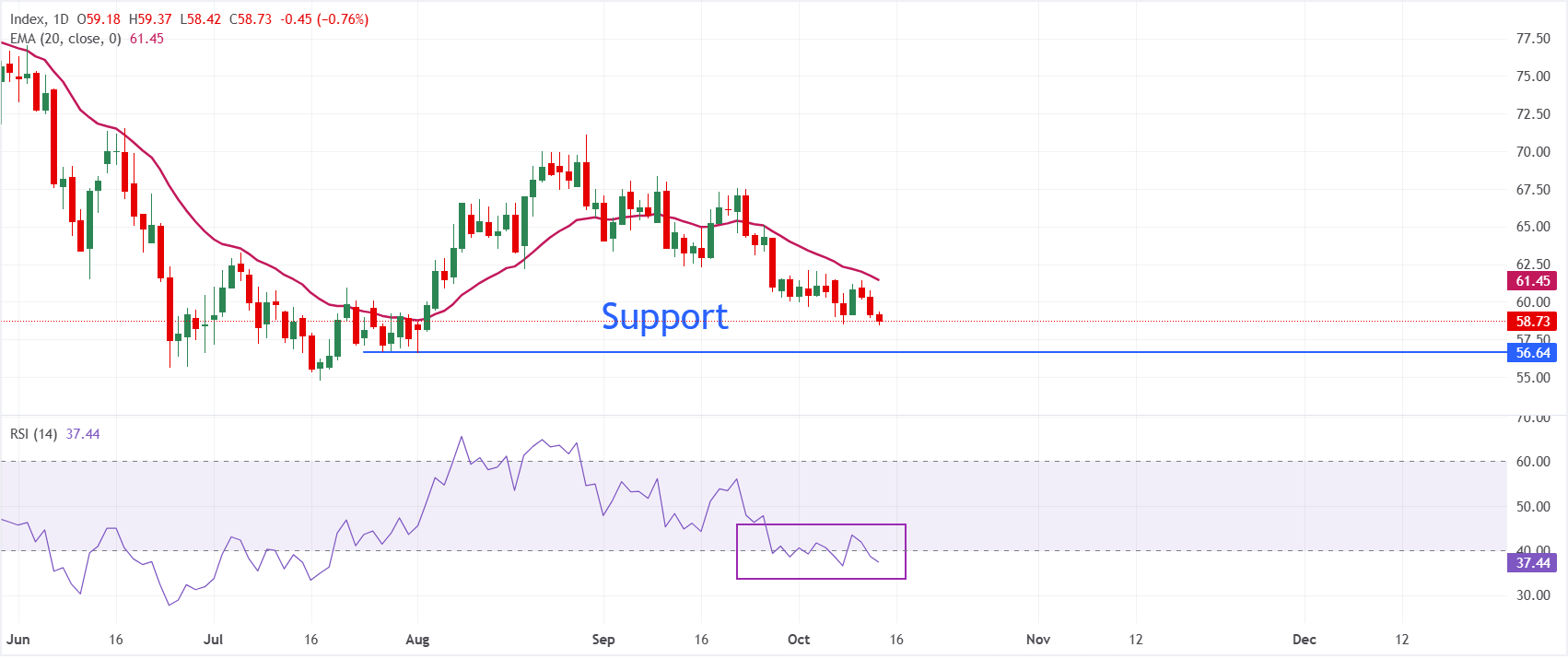
In the daily chart, XAG/USD trades at $58.75, extending its slide below the 20-day exponential moving average (EMA) at $61.45, which now acts as immediate overhead resistance and keeps the near-term tone bearish. The location of price under this key trend gauge suggests rallies are likely to be capped while the Relative Strength Index (14) at 37.49 stays on the weak side of neutral, hinting at lingering downside pressure rather than a decisive oversold rebound.
On the topside, the first level to watch is the 20-day EMA at $61.45, and a sustained break above this barrier would be needed to ease the current bearish bias and open scope for a broader recovery. On the downside, while no nearby structural price supports are evident in the dataset, the RSI reading at 37.49 indicates that sellers still have control but are approaching levels where dip-buying interest could start to emerge if the slide in XAG/USD extends further.
(The technical analysis of this story was written with the help of an AI tool. Know more.)
Silver FAQs
Silver is a precious metal highly traded among investors. It has been historically used as a store of value and a medium of exchange. Although less popular than Gold, traders may turn to Silver to diversify their investment portfolio, for its intrinsic value or as a potential hedge during high-inflation periods. Investors can buy physical Silver, in coins or in bars, or trade it through vehicles such as Exchange Traded Funds, which track its price on international markets.
Silver prices can move due to a wide range of factors. Geopolitical instability or fears of a deep recession can make Silver price escalate due to its safe-haven status, although to a lesser extent than Gold's. As a yieldless asset, Silver tends to rise with lower interest rates. Its moves also depend on how the US Dollar (USD) behaves as the asset is priced in dollars (XAG/USD). A strong Dollar tends to keep the price of Silver at bay, whereas a weaker Dollar is likely to propel prices up. Other factors such as investment demand, mining supply – Silver is much more abundant than Gold – and recycling rates can also affect prices.
Silver is widely used in industry, particularly in sectors such as electronics or solar energy, as it has one of the highest electric conductivity of all metals – more than Copper and Gold. A surge in demand can increase prices, while a decline tends to lower them. Dynamics in the US, Chinese and Indian economies can also contribute to price swings: for the US and particularly China, their big industrial sectors use Silver in various processes; in India, consumers’ demand for the precious metal for jewellery also plays a key role in setting prices.
Silver prices tend to follow Gold's moves. When Gold prices rise, Silver typically follows suit, as their status as safe-haven assets is similar. The Gold/Silver ratio, which shows the number of ounces of Silver needed to equal the value of one ounce of Gold, may help to determine the relative valuation between both metals. Some investors may consider a high ratio as an indicator that Silver is undervalued, or Gold is overvalued. On the contrary, a low ratio might suggest that Gold is undervalued relative to Silver.
Author
Sagar Dua
FXStreet
Sagar Dua is associated with the financial markets from his college days. Along with pursuing post-graduation in Commerce in 2014, he started his markets training with chart analysis.