Silver Price Forecast: Bearish momentum builds as XAG/USD struggles below SMAs
- Silver slides as stalled US-Iran talks keep the US Dollar supported.
- Rising Oil prices fuel inflation risks and push yields higher, weighing on non-yielding metals.
- XAG/USD remains capped below key SMAs on the daily chart, keeping the near-term bias bearish.
Silver (XAG/USD) trades with a downside bias on Tuesday, down over 2.5%, as a higher-for-longer interest rate outlook continues to weigh on price action. Rising inflation risks, driven by elevated Oil prices amid ongoing Middle East supply disruptions, are pushing US Treasury yields higher, reducing the appeal of the non-yielding metal. At the time of writing, XAG/USD is trading around $73.25, its lowest level since April 13.
Meanwhile, a lack of progress in US-Iran talks to end the war keeps the US Dollar (USD) firmly supported, adding further pressure on XAG/USD. While Silver typically benefits from geopolitical tensions, rising expectations of tighter monetary policy by global central banks remain a key headwind for the metal, which is currently down over 20% since the US-Iran war began, despite recovering from its March low.
Attention now turns to the Federal Reserve’s (Fed) monetary policy decision due on Wednesday, where traders widely expect the central bank to keep interest rates unchanged. Inflation in the US remains sticky and above the Fed’s 2% target, with the recent surge in Oil prices adding further pressure. As a result, the focus will be on forward guidance, with markets awaiting clarity on the future path of interest rates. Higher borrowing costs increase the opportunity cost of holding non-yielding assets like Silver.
Technical Analysis:
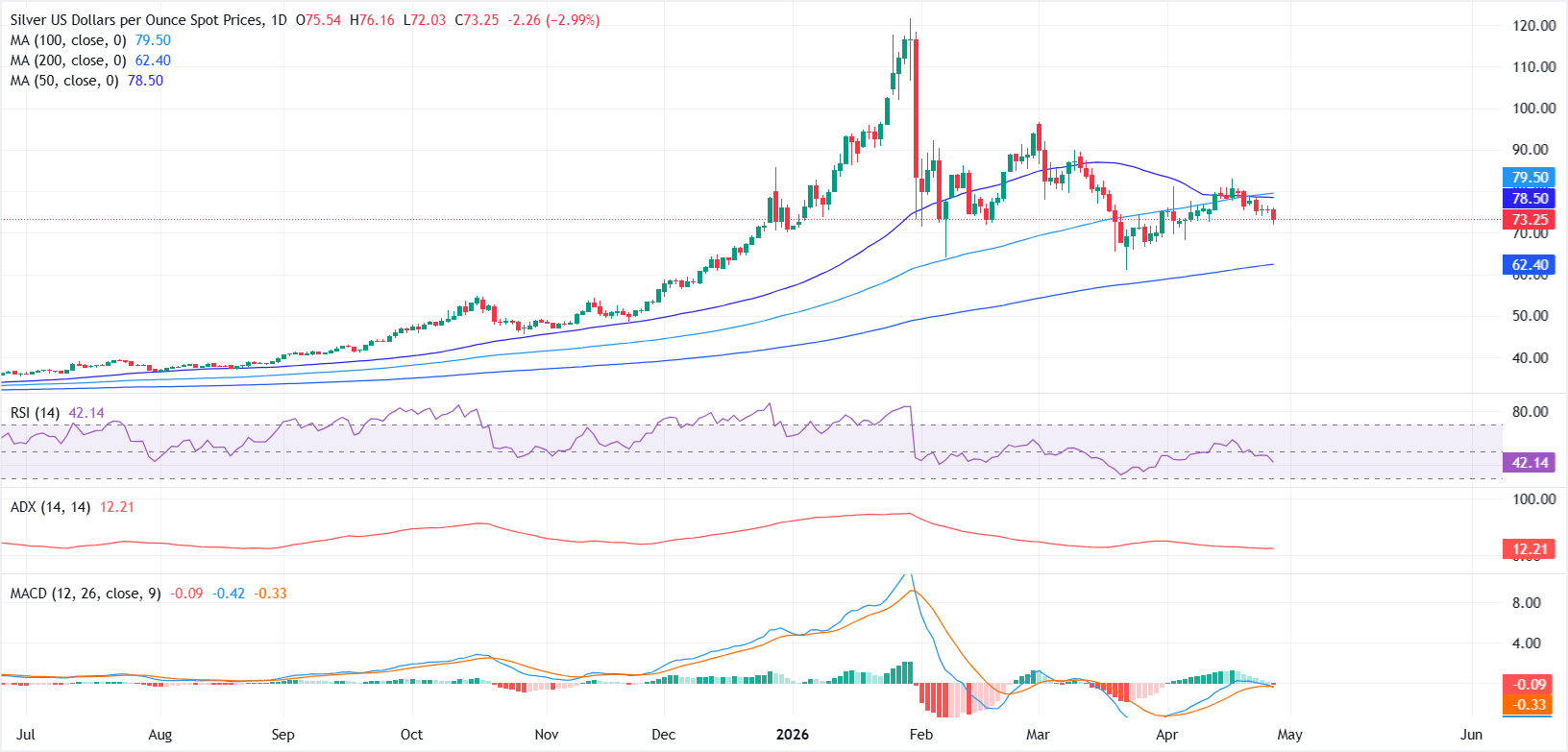
In the daily chart, XAG/USD maintains a bearish near-term bias as it trades below both the 100-day and 50-day Simple Moving Averages (SMAs), which are closely aligned and showing early signs of a bearish crossover, keeping the near-term bias tilted to the downside.
Momentum indicators echo this soft tone, with the Relative Strength Index (RSI) hovering near 42 and the Moving Average Convergence Divergence (MACD) line slipping just below zero, while a subdued Average Directional Index (ADX) around 12 suggests a weak and potentially range-bound trend.
On the upside, the moving average cluster between $78.50-$79.50, where the 50-day and 100-day SMAs converge, marks initial resistance and would need to be reclaimed to ease the current bearish pressure. The next meaningful resistance is seen near the $90 psychological level.
On the downside, the $70 level marks initial support, followed by the 200-day SMA near $62.40, which stands out as the next major structural support.
(The technical analysis of this story was written with the help of an AI tool.)
Silver FAQs
Silver is a precious metal highly traded among investors. It has been historically used as a store of value and a medium of exchange. Although less popular than Gold, traders may turn to Silver to diversify their investment portfolio, for its intrinsic value or as a potential hedge during high-inflation periods. Investors can buy physical Silver, in coins or in bars, or trade it through vehicles such as Exchange Traded Funds, which track its price on international markets.
Silver prices can move due to a wide range of factors. Geopolitical instability or fears of a deep recession can make Silver price escalate due to its safe-haven status, although to a lesser extent than Gold's. As a yieldless asset, Silver tends to rise with lower interest rates. Its moves also depend on how the US Dollar (USD) behaves as the asset is priced in dollars (XAG/USD). A strong Dollar tends to keep the price of Silver at bay, whereas a weaker Dollar is likely to propel prices up. Other factors such as investment demand, mining supply – Silver is much more abundant than Gold – and recycling rates can also affect prices.
Silver is widely used in industry, particularly in sectors such as electronics or solar energy, as it has one of the highest electric conductivity of all metals – more than Copper and Gold. A surge in demand can increase prices, while a decline tends to lower them. Dynamics in the US, Chinese and Indian economies can also contribute to price swings: for the US and particularly China, their big industrial sectors use Silver in various processes; in India, consumers’ demand for the precious metal for jewellery also plays a key role in setting prices.
Silver prices tend to follow Gold's moves. When Gold prices rise, Silver typically follows suit, as their status as safe-haven assets is similar. The Gold/Silver ratio, which shows the number of ounces of Silver needed to equal the value of one ounce of Gold, may help to determine the relative valuation between both metals. Some investors may consider a high ratio as an indicator that Silver is undervalued, or Gold is overvalued. On the contrary, a low ratio might suggest that Gold is undervalued relative to Silver.
Author

Vishal Chaturvedi
FXStreet
I am a macro-focused research analyst with over four years of experience covering forex and commodities market. I enjoy breaking down complex economic trends and turning them into clear, actionable insights that help traders stay ahead of the curve.

















