Semis echo Wall Street’s cycle: Is the AI selloff just starting?


On October 17th, we floated the possibility that the stock markets were in the complacency phase.
This was when the VanEck Semiconductors ETF printed what looked like a double top (with a lower high) on the weekly timeframe, and back when it was still trading at around ~530. Now it is currently trading at 400 dollars.
A far cry from the reading a month ago.
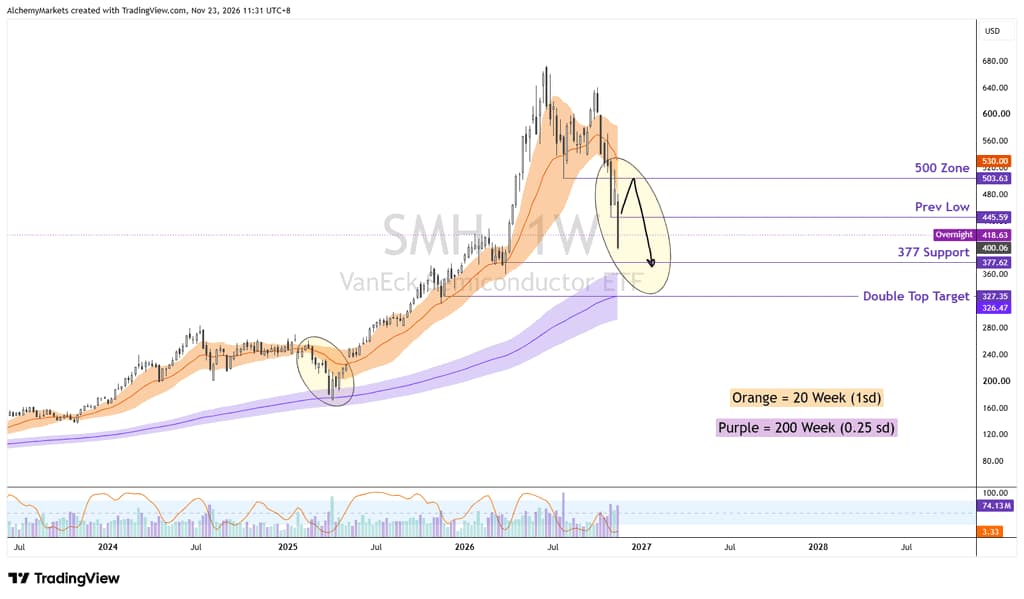
Now take a look at the Wall Street market cycle cheat sheet. The SMH is practically drawing near-identical similarities to the fractal.

Contrary to our last read in October (complacency phase), the current SMH structure now looks like the anxiety phase to me.
By extension, that also means a longer drawn out bear market from here is possible.
“But mate-” you say, “Isn’t the S&P 500 not printing the same pattern?”
“How can you be so sure we’re not going to simply reverse from here?”
Well, that’s not exactly what I’m suggesting… Let me clarify. I’m talking strictly about the Semiconductors market. Not the S&P.
I do believe however, that the S&P still has room to the downside before we reverse:
- Semis have been the cornerstone of this AI rally since 2025.
- Semis are currently bearish. That is going to severely affect the bullish integrity of the S&P.
- We are currently playing a similar rollover pattern on the S&P that’s occurred in early 2026, mid 2025, and late 2023.
Take a look here – whenever the 20 day EMA crosses below the 50 day EMA, the SPX has tended to rollover to the downside. Often, it’ll find support right at the 100-week exponential moving average.
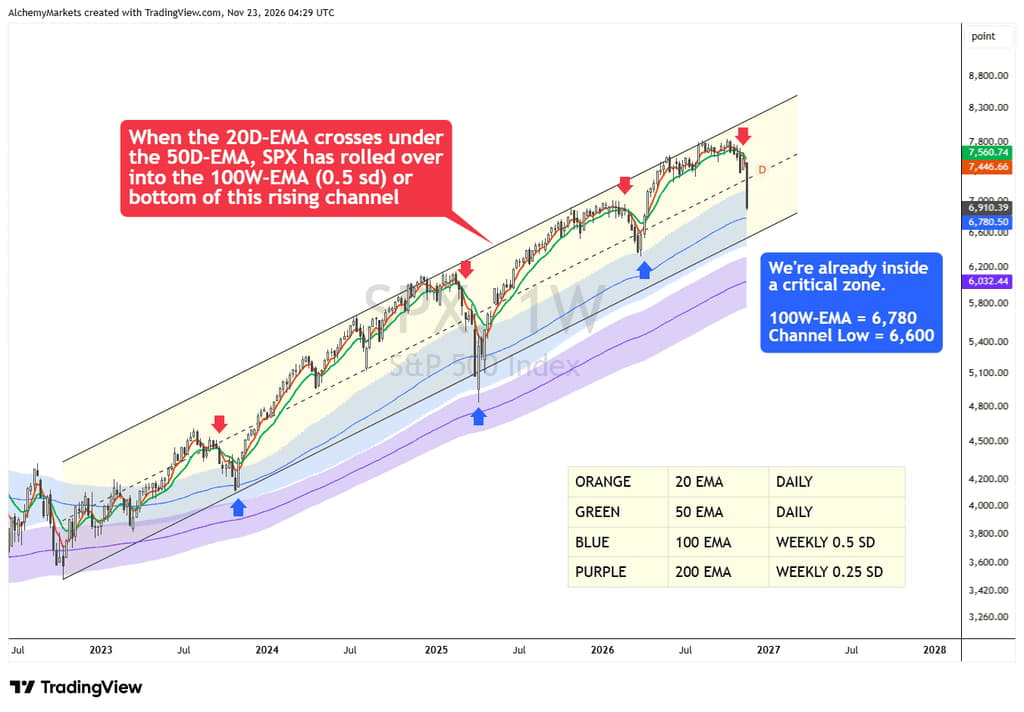
Additionally, you can clearly see that the S&P has been trading within this logarithmic rising channel structure from 2022, maturing only in 2024.
Since then, the S&P has traded lower after touches to the high of the channel. But when paired with the daily crossover signal, this results in a much larger downturn. We’re currently in the middle of playing that out.
Should the S&P continue its decline, watch the 100W-EMA dynamic support at ~6,780 or the channel low at around 6,600.
If those areas break, the market could be going for a great reset, perhaps spurred on by the rising interest rates of the US Federal Reserve. In that case, the next support zone to watch would be the 200W-EMA zone at around 6,000 dollars.
Can we get a small reversal in the meantime?
If we do get a reversal in the meantime, the markets would first need to see semis begin to stabilise.
Fortunately, we may just be seeing the first signs of that.
The SMH index appears to be gapping up in its overnight trading from 400 to ~420 today, which is almost reclaiming the anchored vWAP support of the rally from 2025.
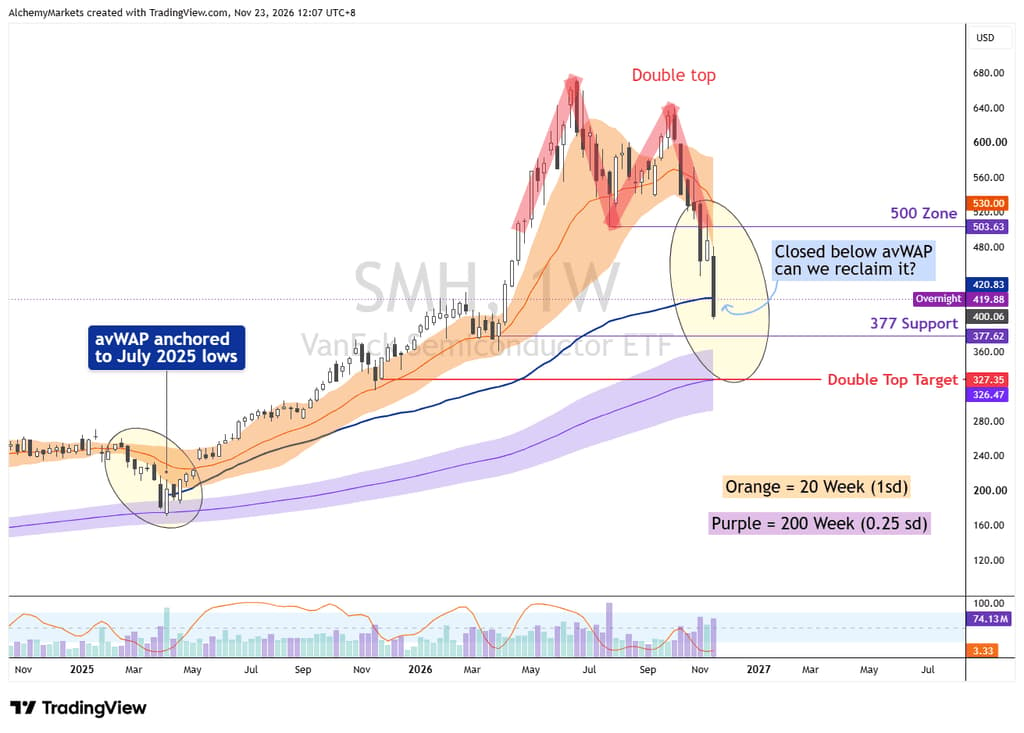
However, we need to see SMH definitively hold above 420.83 (the anchored vWAP) to anticipate some kind of a dead cat bounce or at least sideways stabilisation.
Bottom line: Semiconductors may already be entering a deeper bearish phase, but that doesn’t necessarily mean the broader market is headed for a prolonged bear market.
For now, 420.83 is the line to watch on SMH. A sustained reclaim could give semis some breathing room for a recovery, potentially lifting the S&P alongside it. But if the rebound fails, the 377 and 327 downside targets remain in play.
The bigger question is whether this is simply another correction in the AI rally, or the beginning of a much longer downturn.
Author
Zorrays Junaid
Alchemy Markets
Zorrays Junaid has extensive combined experience in the financial markets as a portfolio manager and trading coach. More recently, he is an Analyst with Alchemy Markets, and has contributed to DailyFX and Elliott Wave Forecast in the past.