QYLD – Want to get a 10% dividend yield, look here
-
The Global X NASDAQ 100 Covered Call ETF yields more than 10%.
-
The ETF tracks the CBOE NASDAQ 100 Buy-Write Index with Full Replication.
-
While attractive, the yield comes with risks that include capital erosion.

If you want to invest in covered calls the Global X Funds NASDAQ 100 ETF (NASDAQ:QYLD) is something you should check out. Better yet, if you want to get a high double-digit yield in a stock with a long track record of successive monthly dividend payments this should be on your list.
It is an ETF that is based on the CBOE NASDAQ 100 Buy-Write Index which seeks to mimic a portfolio of covered call trades based on NASDAQ 100 (NYSEARCA:QQQM) stocks. The key takeaway is that this ETF tends to pay $0.16 to $0.19 per month in yield which is worth upwards of 10% depending on the share price.
What is a covered call and why you should care
A covered call is one of the simplest options strategies an investor can take advantage of. Options are derivative trading instruments that allow an investor to “rent” stocks for cheaper than what they cost to buy.
The salient point is that if the underlying stock moves higher in price a call option will also move higher in price and vice versa. Call options, versus a put option, is a derivative trading contract used by bullish speculators to capture upward price movement and by investors to generate cash. An investor in an “optionable” stock can sell one call option for every 100 shares of stock they own.
Naturally, if the options sell for $0.50 per share or $50 per contract compared to $10 per share to buy or $1000 per covered call it is an attractive trade that can make 5% or more in 30 days or less. If the call option sold is at a higher strike or selling price than the stock was purchased for the potential earnings multiply.
The hurdle for investors is the amount of capital it can take to generate that 5% on a consistent monthly basis which is why the Global X Funds NASDAQ 100 Covered Call ETF exists today. It takes the burden of not only finding the covered call trades but of managing the portfolio. The only requirement for investors is to buy and hold the stock which is where the risk lay.
The risk of covered calls: Capital erosion
Earning the 5% monthly return of a covered call is attractive but it does come with risks. If the stock moves higher and the options is “exercised” which means you have to sell it then good, you have probably sold it at a higher price than it was purchased for and made the maximum profit for the trade.
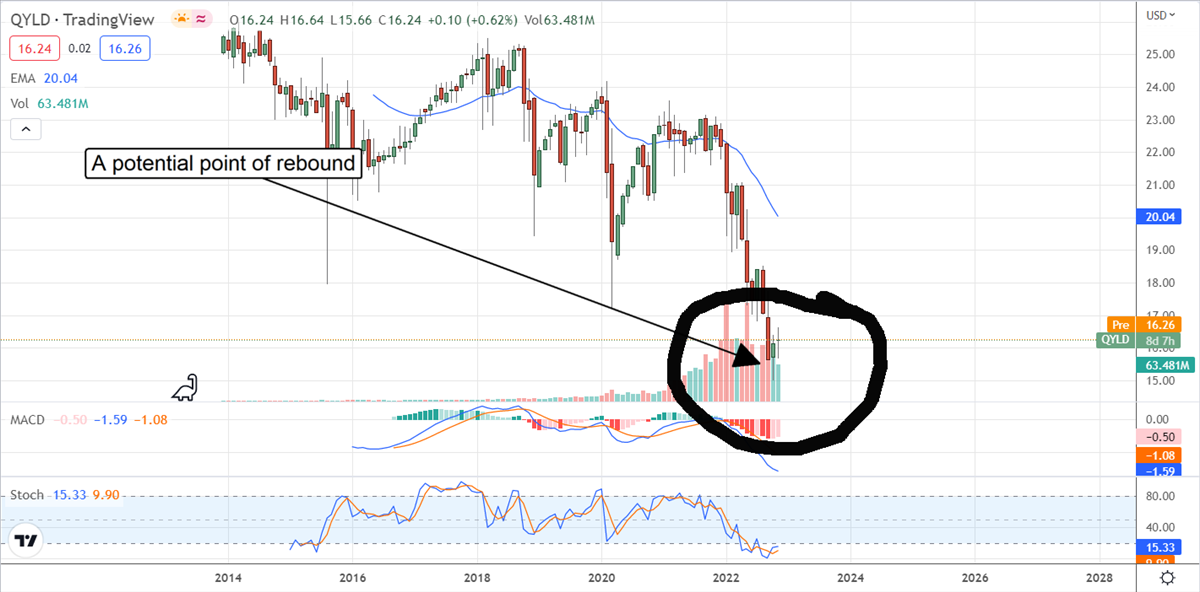
The downside is that the stock price will not move higher and not get exercised. In this case, you’ve earned the 5% for selling the call but what about the underlying stock? In the case of the NASDAQ 100, which is tech-heavy and down 30% YOY, there would be significant capital erosion within the portfolio and that can be seen in the ETF price action.
Net Asset Value is an important metric to watch in an ETF of this nature. The fund has more than $6.4 billion under management as of 9/30/3033 which is up since inception and versus 5 years ago but down slightly in the 3-year comparison and down nearly 20% in the 1-year comparison and that figure could grow before the market begins to rebound.
The technical outlook: QYLD at a bottom
The QYLD has done little but trend lower since its inception and that may continue due to the generally bearish conditions on Wall Street. The upshot is that, for each major dip, there has been a significant rebound in the action and that is where the stock is now. At a bottom with a potential rebound in the works.
Author

Jacob Wolinsky
ValueWalk
Jacob Wolinsky is the founder of ValueWalk, a popular investment site. Prior to founding ValueWalk, Jacob worked as an equity analyst for value research firm and as a freelance writer. He lives in Passaic New Jersey with his wife and four children.

















