|

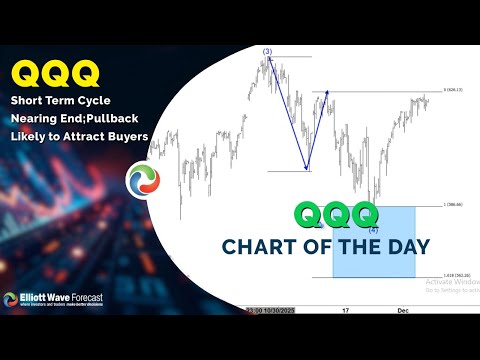
QQQ short term cycle nearing end, pullback likely to attract buyers [Video]

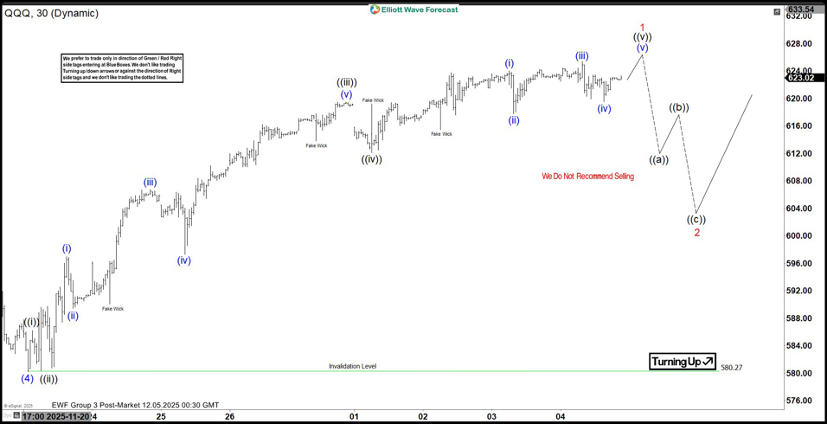
The short-term Elliott Wave outlook for the Nasdaq 100 ETF (QQQ) indicates that the cycle from the April 2025 low remains active. Wave (4) of the ongoing impulse concluded at 580.27, and the ETF has since resumed its upward trajectory. To confirm continuation, price must break above the prior wave (3) peak recorded on 30 October at 638.41. The rally from the 21 November wave (4) low has matured and is expected to complete soon, reflecting the natural rhythm of the Elliott Wave sequence.

The advance from wave (4) has unfolded as a five-wave impulse. Within this structure, wave ((i)) ended at 586.25, followed by a corrective pullback in wave ((ii)) that terminated at 580.36. From there, the ETF nested higher. Wave (i) of the next sequence ended at 596.98, while wave (ii) pulled back to 589.44. Momentum carried wave (iii) to 606.76, before wave (iv) corrected to 597.32. The final leg, wave (v), reached 619.51, completing wave ((iii)) at a higher degree. A subsequent pullback in wave ((iv)) ended at 612.13.

Looking ahead, wave ((v)) of 1 is expected to finish soon. Afterward, a corrective wave 2 should unfold, addressing the cycle from the 21 November low before the ETF resumes higher. In the near term, as long as the pivot at 580.27 remains intact, dips are anticipated to find support in a 3, 7, or 11 swing sequence, reinforcing prospects for further upside.

Nasdaq 100 ETF (QQQ) 30-minute Elliott Wave chart from 12.5.2025
Nasdaq 100 ETF Elliott Wave [Video]
Youtube preview

Author

Elliott Wave Forecast Team

Elliott Wave Forecast Team

ElliottWave-Forecast.com

More from Elliott Wave Forecast Team
Share:

Editor's Picks

AUD/USD remains depressed near 0.6950 after RBA minutes

AUD/USD attracts follow-through selling during Tuesday’s Asian session, looking to extend the overnight rejection slide from 0.7000, or a two-week top, following the release of RBA meeting Minutes. The US Dollar retains a bullish undertone near its highest level since April 2025 as energy-driven inflation risks keep December Fed rate hike bets firmly on the table. Adding to this, geopolitical risks further underpin the safe-haven USD.

USD/JPY extends retreat below 158.50 as intervention risks loom

USD/JPY is dropping below 158.50 in the Asian session on Tuesday, snapping a two-day winning streak and pulling back from an over two-week top touched the previous day, despite Japan's soft PPI inflation print. Bulls turn cautious amid speculation that authorities will step in to prop up the Japanese Yen, which, in turn, weighs on the pair.

Gold struggles above $4.150 amid geopolitical escalation

Gold struggles above $4,150 in the Asian session on Tuesday as elevated US Treasury yields and a hawkish Fed keep the US Dollar near its highest level since April 2025. Adding to this, persistent geopolitical uncertainties stemming from Middle East conflicts continue to underpin the safe-haven buck, which, in turn, is seen as weighing on the bullion. Traders now look to US inflation figures for some impetus ahead of Fed Chair Kevin Warsh's appearance on Friday.

Fed hold remains base case, September inflation surprise could push Dollar

The FOMC minutes read as hawkish last week, but they predate the soft September payrolls print and the modest inflation reads since then. We continue to think the Fed will hold rates this month, since we expect a moderate (i.e. 0.2% or less) monthly core print in this week's inflation report for September.

Earnings preview US and Europe: Can the stock market rally continue?
Stocks have been remarkably resilient this year. They have navigated geopolitical turmoil, an energy price spike and surging global bond yields which is rapidly pushing up the cost of borrowing. US blue chip stocks are now in their 4th year of a bull market, however, they now face their toughest test of Q4 so far, the latest earnings updates.
Has Bitcoin really escaped the macro forces it was built to fight?
Over 17 years ago, Satoshi Nakamoto designed Bitcoin (BTC) on the back of a global financial crisis as an alternative to the global monetary system outside the control of central banks, governments and traditional intermediaries. This raises a key question: has Bitcoin really become independent of the macroeconomic forces it was built to challenge?