Pound Sterling runs out of room at the July high
- GBP/USD trades near 1.3495 after a London high just short of 1.3550.
- American July inflation matched consensus on all four headline measures.
- Washington's July deficit hit a record 432 billion Dollars for the month.

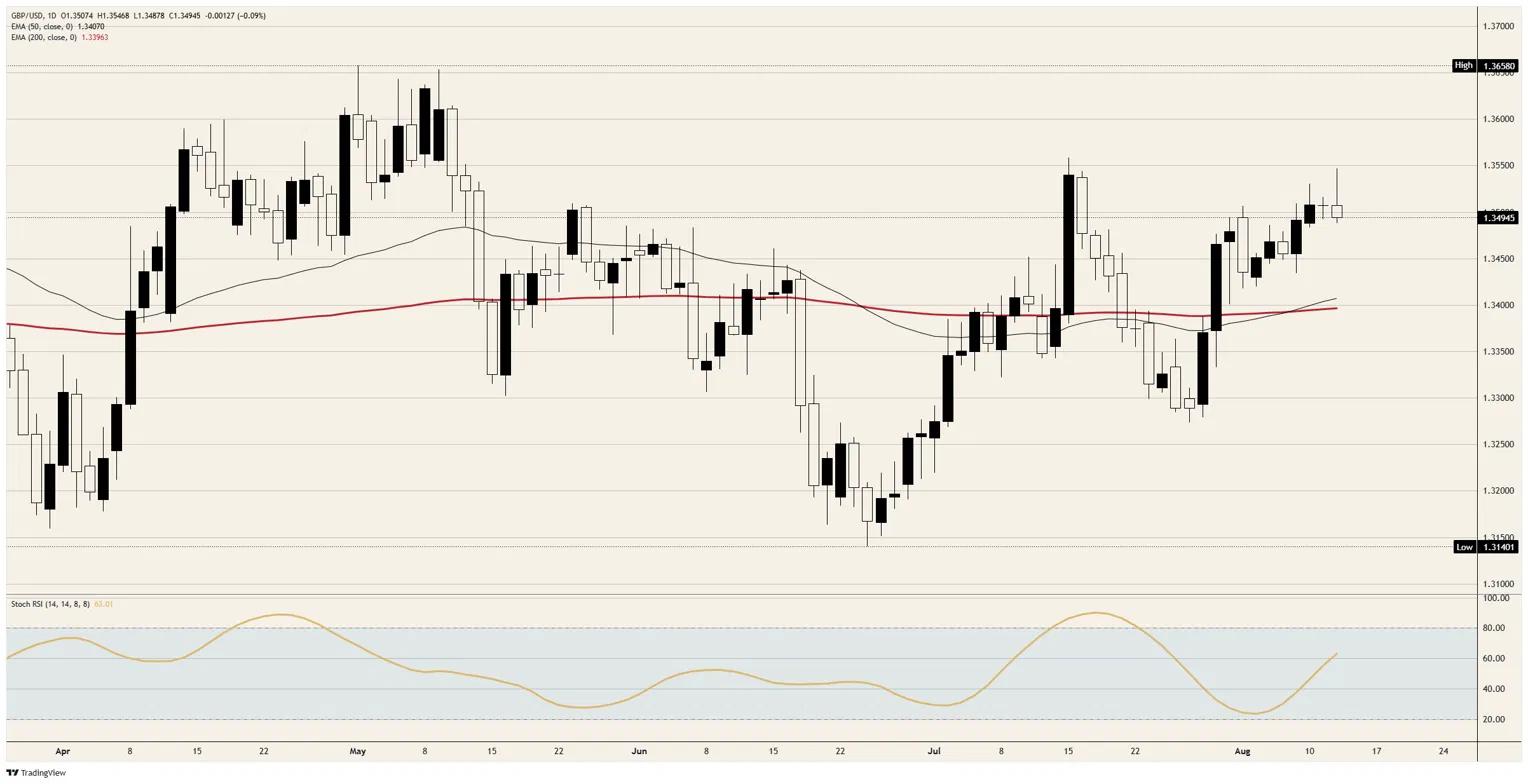
Sterling spent the London morning building a case for a break and the rest of the session dismantling it, trading near 1.3495 after a high just short of 1.3550 and a loss of not quite a tenth of a percent. The mid-July peak sits a handful of pips above where today's advance stopped, which makes this the second time in four weeks that one level has turned the Pound around.
What sits underneath the day is better than the day itself. The 50-day and 200-day Exponential Moving Averages (EMA) are converged just above 1.3400 and have crossed back with the faster line on top, and price has held above both for ten sessions. The daily Stochastic Relative Strength Index (Stoch RSI) reads near 63 and rising, with room left before it argues anything.
The inflation print that changed nothing
The July Consumer Price Index (CPI) arrived at 12:30 GMT and matched the forecast on every line: 0.1% MoM and 3.4% YoY on the headline, 0.2% and 2.5% on the core measure, with both annual rates a tenth beneath June. The most anticipated number of the week produced no reversal in a currency that had been falling for three hours before it landed.
The composition is no cleaner than the headline. Shelter did roughly two thirds of the monthly work and energy still runs close to 15% higher than a year ago, so the deceleration owes more to arithmetic than to any change in what households pay. Futures trimmed the odds on a September increase toward the low forties, from a coin flip a day earlier and three quarters at the end of July, and left the Federal Reserve question open in a way no single print this month will resolve.
Washington out-borrowed Westminster
The larger American number came later in the session. The July federal deficit reached 432 billion Dollars against a 346 billion consensus, a record for the month and the widest gap since March 2021, and the fiscal year to date now stands at 1.799 trillion Dollars with two months still to run. That total has already passed the whole of the previous fiscal year.
Net interest alone cost 104 billion Dollars in the month, and customs receipts ran negative once refunds are counted. Sterling has traded all summer on whether a new government can be trusted with the public finances, a question the gilt market prices through a 10-year yield sitting near 5% since the leadership change. The country on the other side of this exchange rate posted its worst July on record and funded it at a 10-year auction clearing above 4.68%.
Britain finally has to show its numbers
The first British release in three weeks lands Thursday at 06:00 GMT, and it covers the quarter rather than a month. Second-quarter Gross Domestic Product (GDP) carries a 0.4% consensus after 0.6%, with the annual rate seen accelerating to 1.1% from 0.9%. One set of figures will therefore produce a slowdown headline and an acceleration headline at the same time, which is what base effects do to a growth story.
The detail beneath is where any damage comes from. Business investment is forecast at -0.5% on the quarter after 0.9%, June monthly output at zero after 0.1%, and manufacturing production at -0.2% after 0.1%. Swaps still price another 50 basis points of Bank of England tightening across twelve months, which would lift Bank Rate above the range the central bank itself treats as neutral, so a soft quarter is the cleanest route to unwinding it.
The American side then runs two more days. Producer prices at 12:30 GMT Thursday carry a 0.2% MoM consensus after -0.3%, with the core annual rate seen at 4.2% from 4.7%, alongside jobless claims at 202K from 199K and two regional Federal Reserve presidents speaking either side of the release. Friday brings retail sales at 0.1% MoM and preliminary August consumer sentiment at 54.5 from 55.2.
Positioning is the quiet risk running through all of it. Commodity Futures Trading Commission (CFTC) figures published Friday at 19:30 GMT last showed speculators net short 57.8K Sterling contracts, a position built while the currency was making its lows in late July. Close to three cents of rally later, that is a crowd with every reason to keep buying and nothing British yet to justify it.
Levels and bias
Resistance: 1.3550 is the line, the mid-July peak and the level that stopped today's advance within a handful of pips. Above it 1.3600 is clear air, with the early-May high near 1.3650 capping the frame.
Support: The session low sits just beneath 1.3500, with 1.3450 the first real shelf and the converged EMA band just above 1.3400 the floor that decides the trend. Beneath both, 1.3350 and then the late-July base just above 1.3250.
Bias: Bullish while the 1.3400 band holds, with a daily close above 1.3550 the trigger for a run at 1.3600. This rally has been paid for entirely by a weakening Greenback, so the threat is not American: it is a British growth miss on Thursday morning that unwinds the tightening still priced into the front end. Invalidation is a daily close back beneath 1.3400.
GBP/USD daily chart
Pound Sterling FAQs
The Pound Sterling (GBP) is the oldest currency in the world (886 AD) and the official currency of the United Kingdom. It is the fourth most traded unit for foreign exchange (FX) in the world, accounting for 12% of all transactions, averaging $630 billion a day, according to 2022 data. Its key trading pairs are GBP/USD, also known as ‘Cable’, which accounts for 11% of FX, GBP/JPY, or the ‘Dragon’ as it is known by traders (3%), and EUR/GBP (2%). The Pound Sterling is issued by the Bank of England (BoE).
The single most important factor influencing the value of the Pound Sterling is monetary policy decided by the Bank of England. The BoE bases its decisions on whether it has achieved its primary goal of “price stability” – a steady inflation rate of around 2%. Its primary tool for achieving this is the adjustment of interest rates. When inflation is too high, the BoE will try to rein it in by raising interest rates, making it more expensive for people and businesses to access credit. This is generally positive for GBP, as higher interest rates make the UK a more attractive place for global investors to park their money. When inflation falls too low it is a sign economic growth is slowing. In this scenario, the BoE will consider lowering interest rates to cheapen credit so businesses will borrow more to invest in growth-generating projects.
Data releases gauge the health of the economy and can impact the value of the Pound Sterling. Indicators such as GDP, Manufacturing and Services PMIs, and employment can all influence the direction of the GBP. A strong economy is good for Sterling. Not only does it attract more foreign investment but it may encourage the BoE to put up interest rates, which will directly strengthen GBP. Otherwise, if economic data is weak, the Pound Sterling is likely to fall.
Another significant data release for the Pound Sterling is the Trade Balance. This indicator measures the difference between what a country earns from its exports and what it spends on imports over a given period. If a country produces highly sought-after exports, its currency will benefit purely from the extra demand created from foreign buyers seeking to purchase these goods. Therefore, a positive net Trade Balance strengthens a currency and vice versa for a negative balance.
Author

Joshua Gibson
FXStreet
Joshua joins the FXStreet team as an Economics and Finance double major from Vancouver Island University with twelve years' experience as an independent trader focusing on technical analysis.