Pound Sterling Price News and Forecast: GBP/USD turns positive for the second straight day

GBP/USD Price Forecast: Bulls likely to target 1.3600 as USD weakens on US-Iran peace hopes
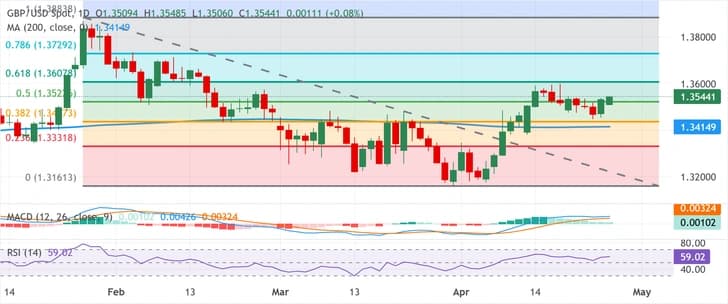
The GBP/USD pair attracts some dip-buyers in the vicinity of the 1.3500 psychological mark and climbs to over a one-week top during the Asian session on Monday. Spot prices currently trade just below mid-1.3500s, up 0.10% for the day, and seem poised to appreciate further.
The US Dollar (USD) turns lower in reaction to the optimism led by reports that Iran gave the US a new proposal on the reopening of the Strait of Hormuz and the ending of the war. Furthermore, sliding Oil prices ease inflationary concerns and temper hawkish US Federal Reserve (Fed) expectations, which exerts additional pressure on the USD and acts as a tailwind for the GBP/USD pair. Apart from this, bets for further policy tightening by the Bank of England (BoE) this year underpin the British Pound (GBP) and validate the positive outlook for the currency pair. Read more...
Pound Sterling loses ground as US–Iran peace talks stall
GBP/USD remains in the negative territory after trimming daily losses, trading around 1.3520 during the Asian hours on Monday. The pair faced pressure as the risk-sensitive Pound Sterling (GBP) weakened amid stalled US–Iran peace talks.
US President Donald Trump called off that delegation to Pakistan to potentially discuss directly with Iran, Bloomberg reported on Sunday. "If they want to talk, they can come to us, or they can call us. You know, there is a telephone. We have nice, secure lines," said Trump. Trump on Saturday also told Jared Kushner and Steve Witkoff to skip the trip to Pakistan, which is mediating talks, saying that Iran “offered a lot, but not enough. Iranian President Masoud Pezeshkian stated that his nation won’t enter “imposed negotiations under threats or blockade.” Read more...
Author

FXStreet Team
FXStreet
Composed of a group of economic journalists and FX experts, the FXStreet content team produces and oversees all content published on FXStreet. It provides a purely journalistic approach to the Forex market.