|

Pound Sterling Price News and Forecast: GBP/USD edges higher to 1.2655

GBP/USD Weekly Forecast: Pound Sterling awaits UK election, key US data

The Pound Sterling (GBP) continued to weaken against the US Dollar (USD) for the fourth week in a row, dragging the GBP/USD pair to a six-week low just above 1.2600. All eyes turn to the much-awaited UK general elections on July 4 and the US Nonfarm Payrolls data on July 5 for a fresh directional impetus to GBP/USD.

The US Dollar extended its previous week’s strength and exacerbated GBP/USD’s pain. Greenback buyers flexed their muscles on fresh pushback by US Federal Reserve (Fed) policymakers against interest rate cuts this year, especially after the S&P Global preliminary US business activity jumped to a 26-month high on Friday. Data indicated fresh signs of US economic resilience, suggesting that the Fed could hold rates higher for longer. Read more...
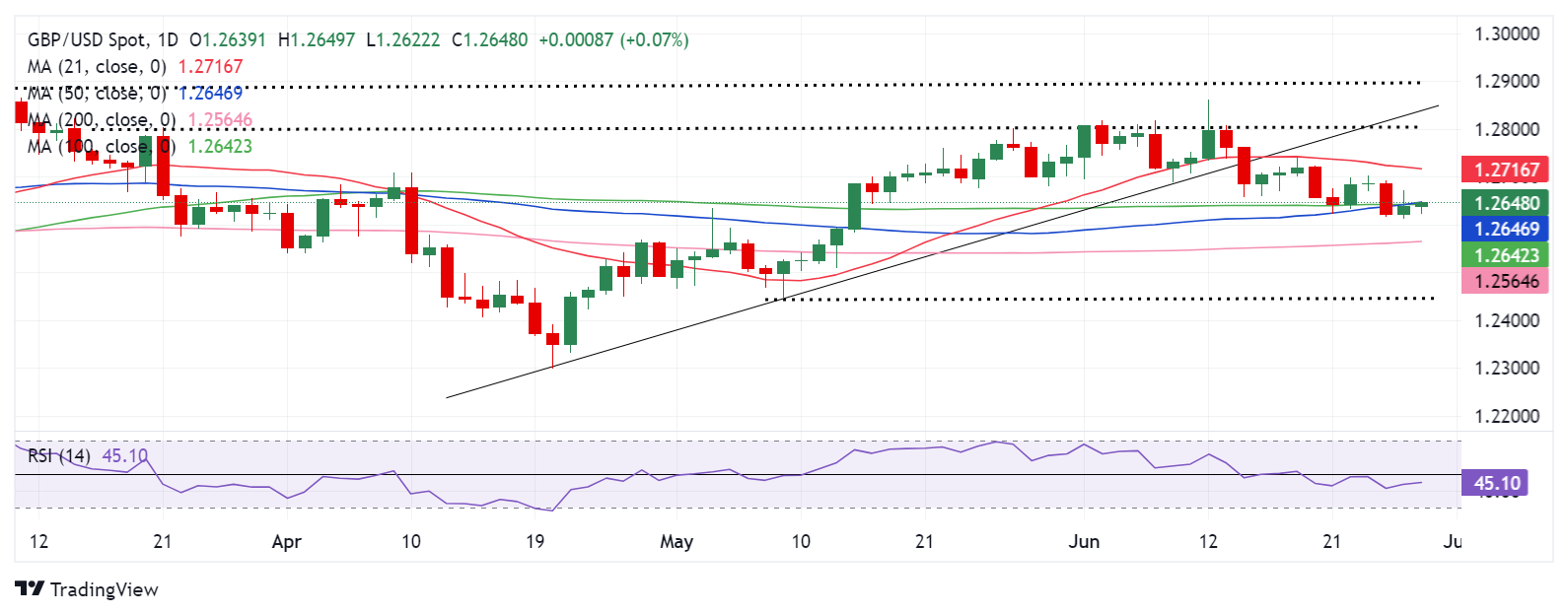
GBP/USD gains traction above 1.2650, eyes on US PMI data

The GBP/USD pair trades on a stronger note around 1.2655 during the early Asian session on Monday. The US Dollar (USD) edges lower as the US Personal Consumption Expenditures (PCE) Price Index for May eased to its lowest annual rate in more than three years, which provides some support to the major pair. Traders await the US June ISM Purchasing Managers Index (PMI) for fresh impetus, which is due on Monday. 

The US core PCE, the Federal Reserve’s (Fed) preferred inflation measure, continued to cool in May, prompting speculation that the Fed will cut the interest rate this year. The core PCE figure climbed 2.6% from 2.8% in April, matching the forecast. The headline PCE increased 2.6% YoY in May from 2.7% prior, in line with the estimation. Read more...

Author

FXStreet Team

Composed of a group of economic journalists and FX experts, the FXStreet content team produces and oversees all content published on FXStreet. It provides a purely journalistic approach to the Forex market.


More from FXStreet Team
Share:

Editor's Picks

AUD/USD eyes 0.7150 barrier nine-day EMA

AUD/USD inches higher after registering modest losses in the previous day, trading around 0.7130 during the Asian hours. The technical analysis of the daily chart indicates that the pair is moving sideways within the rectangle pattern, suggesting a consolidation as neither the bulls nor the bears have enough momentum to take control of the market.

USD/JPY trades below 160.00 intervention threshold; bullish bias intact

The USD/JPY pair attracts some sellers during the Asian session amid fears that authorities will step in again to prop up the Japanese Yen. Furthermore, the Israel-Lebanon truce prompts some profit-taking around the US Dollar and exerts downward pressure on the currency pair.

Gold extends rebound to $4,500 as US yields edge lower

Gold (XAU/USD) preserves its recovery momentum following Wednesday's slide and tests the $4,500 mark in the second half of the day on Thursday. While US-Iran uncertainty remains, easing tensions between Lebanon on Israel seems to be helping the market mood improve, causing the USD to lose strength alongside falling US T-bond yields and opening the door for a decisive rebound in XAU/USD.

Bitcoin’s massive storm is back: Why the sell-off is far from over

Bitcoin price action over the last few weeks has felt less like a normal, healthy correction and more like a slow grinding crash that continues to wreak havoc on holdings and trading accounts. And everything suggests that the dramatic crash isn’t over.

Nonfarm payrolls: Testing the limits of Fed policy patience

The upcoming nonfarm payrolls report for May will provide the final update on the US labor market before Kevin Warsh attends his first policy meeting as the new Fed Chair later this month.

Recession on paper: What really moves the Canadian Loonie now?

Statistics Canada handed the headline writers a gift and the analysts a headache. Real GDP shrank 0.1% on an annualized basis in the first quarter, and with the fourth quarter of 2025 revised down to a 1.0% contraction, that is two negative quarters in a row, the textbook definition of a technical recession and Canada's first since the pandemic.