Pound Sterling buckles in a leadership vacuum
- GBP/USD slid to fresh multi-month lows, trading well below its 50-day and 200-day moving averages as a UK political vacuum overwhelmed an otherwise hawkish central bank.
- Starmer's resignation and an open Labour leadership contest have put a political risk premium back into the Pound just as firm US data lifts the Dollar.
- UK growth figures and a run of Bank of England speakers next week sit alongside US payrolls as the catalysts that matter.

Sterling spent the back half of June proving that a hawkish central bank counts for little when the government is falling apart. The Bank of England (BoE) held Bank Rate at 3.75% on June 18 in a 7-2 vote, with two members pushing for a hike and services inflation still near 3.7%, which on any normal week would have handed the Pound a yield story to lean on. Instead Cable has shed roughly three big figures since, sliding from the 1.3450 area to a multi-month low near 1.3150 before steadying close to 1.3200. The catalyst was not the Bank; it was the resignation of Prime Minister Keir Starmer on June 22 and the open Labour leadership contest that followed.
Politics took the wheel
A leadership vacuum is exactly the kind of risk currency markets struggle to price, and the Pound has taken the hit. Starmer's exit makes him the latest in a run of short-lived premierships, with Andy Burnham the clear frontrunner to replace him and a contest now playing out against weak local-election results and a resurgent Reform UK. For Sterling the problem is less about who wins than the gap itself: an open question over fiscal direction, spending plans, and election timing is a discount the market applies first and asks about later. None of that shows up in a rate decision, which is why the hawkish BoE hold has been comprehensively ignored.
A firm Dollar made it worse
The timing could hardly have been less kind to the Pound. US data on Thursday was firm where it counted: first-quarter Gross Domestic Product (GDP) was revised up to 2.1% from 1.6%, initial jobless claims dropped to 215K against a 225K consensus, and personal income and spending both rose 0.7%. Core Personal Consumption Expenditures (PCE), the inflation gauge the Federal Reserve (Fed) watches most closely, held at 3.4% YoY. That keeps the Fed's hawkish hold intact, with the dot plot still pointing to a possible October hike and no cuts left in the 2026 curve, and it leaves the Dollar bid into a Pound that already has its own reasons to fall.
Below every average that matters
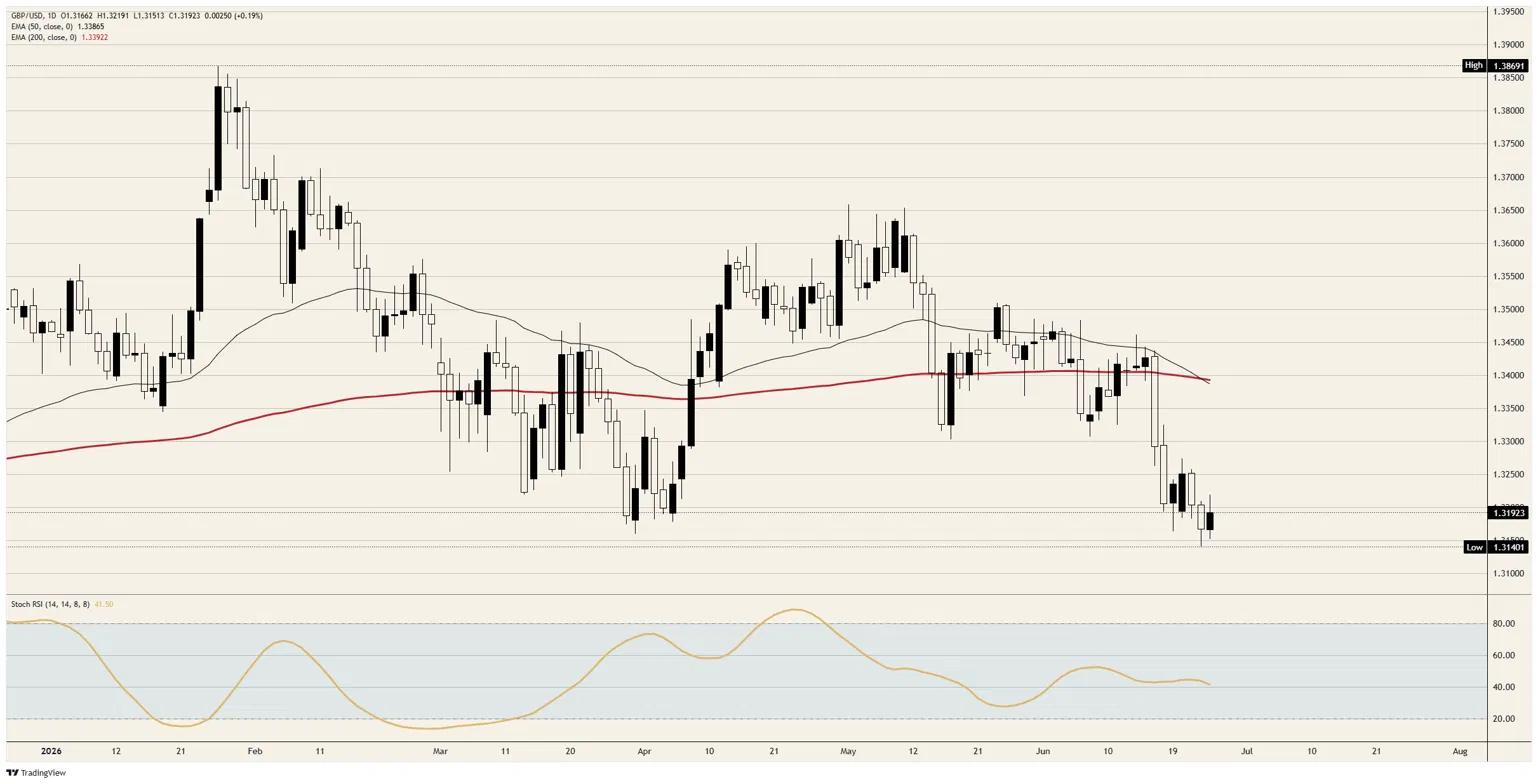
The chart leaves little room for ambiguity. Cable is trading well beneath both its 50-day and 200-day Exponential Moving Averages (EMA), which have converged near 1.3400 and now sit as a thick band of overhead resistance roughly two big figures above spot. The daily Stochastic Relative Strength Index (Stoch RSI) near 41 is recovering off oversold but says nothing about a trend change, and Thursday's bounce off 1.3150 looks like a corrective pause inside a clean downtrend rather than a base. While price holds below 1.3300, every rally is a sell-the-rip candidate.
A loaded week into month-end
The week ahead gives the Pound no shortage of catalysts, and most are domestic. Final first-quarter UK growth figures land Tuesday, with the quarterly reading expected near 0.6%, and the Bank of England puts up a string of speakers through the week, including the Governor on Wednesday and Friday. With the leadership contest live, any speaker straying near fiscal or political territory will be parsed harder than usual. From the US, Nonfarm Payrolls (NFP) on Thursday, pulled forward around the Independence Day holiday, is the marquee release, with the Institute for Supply Management (ISM) manufacturing survey on Wednesday ahead of it. A soft US print is the most realistic path to a Cable bounce; absent that, the political overhang and the trend point the same way.
Levels to watch
Resistance: First resistance sits near 1.3200 just overhead, then 1.3250 and the round 1.3300 level. The heavier barrier is the converged 50-day and 200-day EMA band near 1.3400, which the Pound would need to reclaim to threaten the downtrend.
Support: The line in the sand is the multi-month low near 1.3150. A daily close below it opens 1.3100 and then the psychological 1.3000 handle.
Bias: Bearish. A hawkish BoE has been overridden by a domestic political vacuum and a firm US Dollar, and until the leadership picture clears the Pound lacks a reason to hold gains. Selling rallies toward 1.3300 is favoured while price trades below that level; only a daily close back above 1.3400 neutralizes the bearish structure.
GBP/USD daily chart
Pound Sterling FAQs
The Pound Sterling (GBP) is the oldest currency in the world (886 AD) and the official currency of the United Kingdom. It is the fourth most traded unit for foreign exchange (FX) in the world, accounting for 12% of all transactions, averaging $630 billion a day, according to 2022 data. Its key trading pairs are GBP/USD, also known as ‘Cable’, which accounts for 11% of FX, GBP/JPY, or the ‘Dragon’ as it is known by traders (3%), and EUR/GBP (2%). The Pound Sterling is issued by the Bank of England (BoE).
The single most important factor influencing the value of the Pound Sterling is monetary policy decided by the Bank of England. The BoE bases its decisions on whether it has achieved its primary goal of “price stability” – a steady inflation rate of around 2%. Its primary tool for achieving this is the adjustment of interest rates. When inflation is too high, the BoE will try to rein it in by raising interest rates, making it more expensive for people and businesses to access credit. This is generally positive for GBP, as higher interest rates make the UK a more attractive place for global investors to park their money. When inflation falls too low it is a sign economic growth is slowing. In this scenario, the BoE will consider lowering interest rates to cheapen credit so businesses will borrow more to invest in growth-generating projects.
Data releases gauge the health of the economy and can impact the value of the Pound Sterling. Indicators such as GDP, Manufacturing and Services PMIs, and employment can all influence the direction of the GBP. A strong economy is good for Sterling. Not only does it attract more foreign investment but it may encourage the BoE to put up interest rates, which will directly strengthen GBP. Otherwise, if economic data is weak, the Pound Sterling is likely to fall.
Another significant data release for the Pound Sterling is the Trade Balance. This indicator measures the difference between what a country earns from its exports and what it spends on imports over a given period. If a country produces highly sought-after exports, its currency will benefit purely from the extra demand created from foreign buyers seeking to purchase these goods. Therefore, a positive net Trade Balance strengthens a currency and vice versa for a negative balance.
Author

Joshua Gibson
FXStreet
Joshua joins the FXStreet team as an Economics and Finance double major from Vancouver Island University with twelve years' experience as an independent trader focusing on technical analysis.