Pound Sterling braces for a heavy week as Westminster empties out
- GBP/USD held on the defensive after brushing fresh seven-month lows, mustering only a shallow bounce.
- Starmer's resignation handed the Pound another stretch of political limbo.
- Renewed Iran rhetoric kept the safe-haven Dollar firmly bid and risk appetite subdued.
- A dense data week, led by Tuesday's PMIs and Thursday's US core PCE, looms as the main volatility risk.

The British Pound enters the new week on the back foot, having come within a whisker of fresh seven-month lows before steadying into a tentative bounce that has done little to change the bigger picture. Cable now carries a double burden, with a domestic political vacuum opening up after Keir Starmer's resignation and a global risk backdrop turning hostile as the US and Iran reheat their dispute. Layered on top is a US data calendar dense enough to set the tone for the Dollar through Thursday, which leaves the Pound short of friends just as it most needs them.
A vacuum where the leadership used to be
Sterling has weathered Westminster leadership vacuums before, with little joy each time, because every transition reopens a window of fiscal and policy uncertainty that markets quickly price as a risk premium on the currency. Starmer's exit reopens exactly that question at an awkward moment, with the gilt market already wary of a fiscal position under scrutiny. Until a successor and a credible spending line emerge, the Pound looks set to trade with a political discount baked in, vulnerable to any headline pointing to a messy contest or slipping budget plans.
The Dollar finds two excuses
On the external side, the Pound is fighting a US Dollar handed two fresh reasons to firm. The first is geopolitical, with rhetoric from Washington and Tehran hardening into Tuesday and undercutting the ceasefire optimism that had pulled safe-haven flows out of the greenback only days ago. The second is monetary, as last week's Federal Reserve (Fed) hold at 3.75% arrived alongside a hawkish dot plot and an upgraded inflation track, a higher-for-longer message that sits awkwardly against a Bank of England (BoE) the market still expects to cut first.
A bounce on a short leash
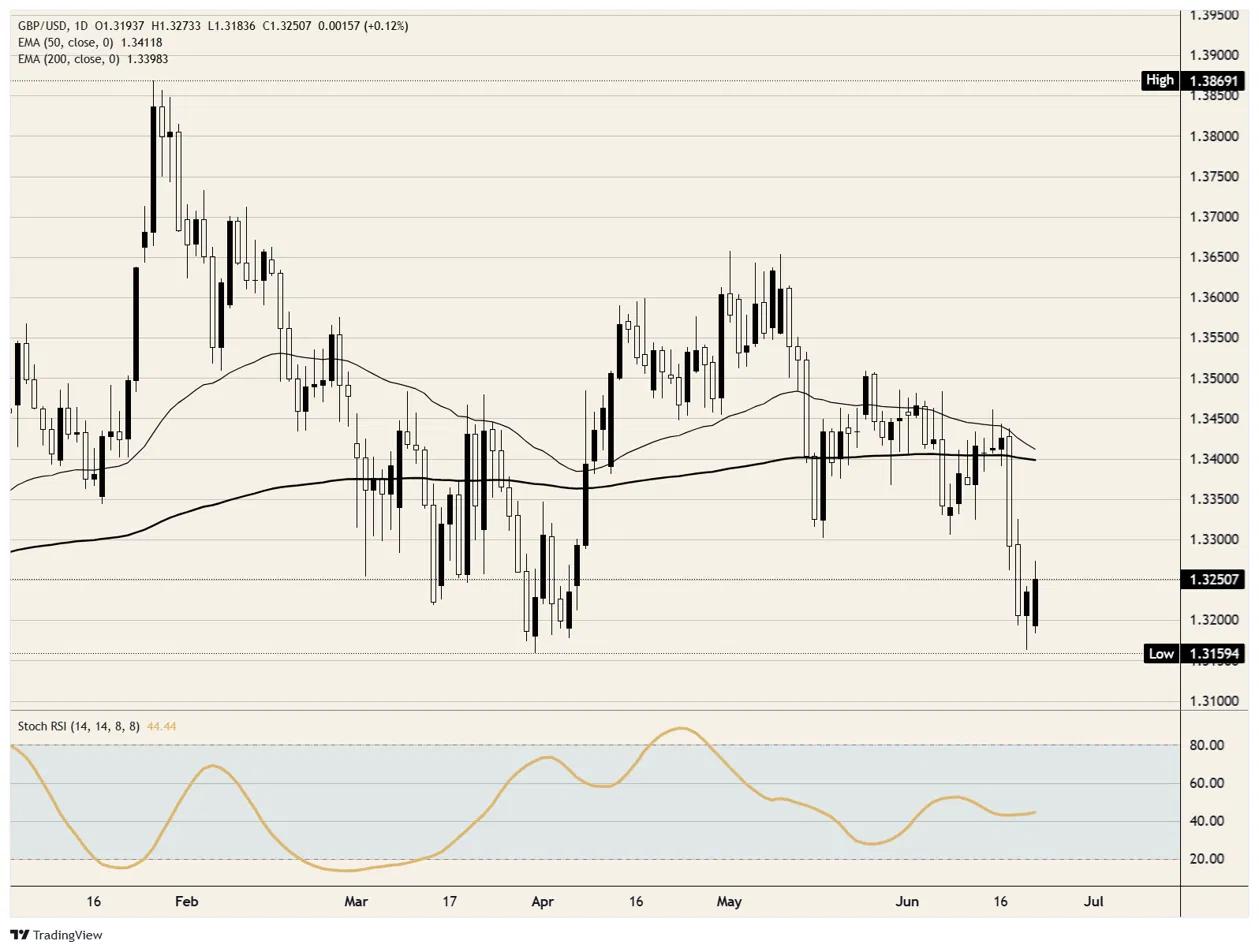
The price structure underlines the defensive tone. Cable spent last week probing the 1.3150 area, a level not seen in seven months, before this week's modest recovery lifted it back toward 1.3250, still shy of the 1.3300 handle. Overhead, the daily 50-period and 200-period Exponential Moving Average (EMA) have converged near 1.3400, forming a ceiling that any sustained rebound must clear to mean anything, while the daily Stochastic Relative Strength Index (Stoch RSI) has only just turned higher from depressed levels. Speculative positioning tells the same story, with the latest Commodity Futures Trading Commission (CFTC) data showing net shorts on the Pound deepening rather than covering.
The week's real catalysts
The calendar does the rest of the talking. Tuesday delivers a Purchasing Managers Index (PMI) doubleheader, with June flash readings for the UK at 08:30 GMT and the US at 13:45 GMT. The UK services print, sitting right on the 50 line between expansion and contraction, is the key domestic input, while a run of BoE speakers across Tuesday and Wednesday adds headline risk from the committee's dovish wing.
The marquee event lands Thursday at 12:30 GMT, when US core Personal Consumption Expenditures Price Index (PCE) inflation prints alongside the third estimate of first-quarter Gross Domestic Product (GDP) and durable goods orders, a bundle capable of resetting Fed expectations and the Dollar with them. Friday's University of Michigan (UoM) sentiment survey and a fresh speculative positioning update round out the slate.
Resistance: The immediate barrier is the 1.3300 handle, with the heavier obstacle the 1.3400 region where the daily moving averages converge; only a clean break above the latter would signal the downtrend is genuinely turning.
Support: The 1.3150 zone marks last week's near-miss with new seven-month lows and the first line of defence; a daily close beneath it opens 1.3100 and, on a deeper risk-off extension, the 1.3000 figure.
Bias: Bearish while Cable trades below 1.3400. The current bounce reads as corrective rather than a base. With politics, positioning and a hawkish Fed all leaning the same way, selling into strength toward the 1.3300 to 1.3400 band is the higher-probability play. A hot US core PCE reading on Thursday would be the most likely trigger for a retest of the lows.
GBP/USD daily chart
Pound Sterling FAQs
The Pound Sterling (GBP) is the oldest currency in the world (886 AD) and the official currency of the United Kingdom. It is the fourth most traded unit for foreign exchange (FX) in the world, accounting for 12% of all transactions, averaging $630 billion a day, according to 2022 data. Its key trading pairs are GBP/USD, also known as ‘Cable’, which accounts for 11% of FX, GBP/JPY, or the ‘Dragon’ as it is known by traders (3%), and EUR/GBP (2%). The Pound Sterling is issued by the Bank of England (BoE).
The single most important factor influencing the value of the Pound Sterling is monetary policy decided by the Bank of England. The BoE bases its decisions on whether it has achieved its primary goal of “price stability” – a steady inflation rate of around 2%. Its primary tool for achieving this is the adjustment of interest rates. When inflation is too high, the BoE will try to rein it in by raising interest rates, making it more expensive for people and businesses to access credit. This is generally positive for GBP, as higher interest rates make the UK a more attractive place for global investors to park their money. When inflation falls too low it is a sign economic growth is slowing. In this scenario, the BoE will consider lowering interest rates to cheapen credit so businesses will borrow more to invest in growth-generating projects.
Data releases gauge the health of the economy and can impact the value of the Pound Sterling. Indicators such as GDP, Manufacturing and Services PMIs, and employment can all influence the direction of the GBP. A strong economy is good for Sterling. Not only does it attract more foreign investment but it may encourage the BoE to put up interest rates, which will directly strengthen GBP. Otherwise, if economic data is weak, the Pound Sterling is likely to fall.
Another significant data release for the Pound Sterling is the Trade Balance. This indicator measures the difference between what a country earns from its exports and what it spends on imports over a given period. If a country produces highly sought-after exports, its currency will benefit purely from the extra demand created from foreign buyers seeking to purchase these goods. Therefore, a positive net Trade Balance strengthens a currency and vice versa for a negative balance.
Author

Joshua Gibson
FXStreet
Joshua joins the FXStreet team as an Economics and Finance double major from Vancouver Island University with twelve years' experience as an independent trader focusing on technical analysis.