Oil jumps 4%, Vance stuck in DC as Iran deadline looms: Deal or bombs?
- Trump tells CNBC the US military is "raring to go" with the ceasefire expiration hours away.
- Iran's parliament speaker warns Tehran rejects negotiations under the shadow of threats.
- Vance's Islamabad trip is put on hold as Iran stalls on confirming a delegation.
- West Texas Intermediate rips 4% above $93 a barrel as Strait of Hormuz traffic thins out.

The countdown is on, and the American delegation isn't even airborne. With the US-Iran ceasefire set to expire late Wednesday, Tuesday's messaging from both sides looked more like pre-conflict posturing than pre-deal diplomacy, capped by news that Vice President JD Vance's trip to Islamabad has been put on hold.
A Trump ultimatum, not an olive branch
President Donald Trump used Tuesday's CNBC interview to tell Wall Street he has no appetite for an extension. The president said time is running short, pointed to a favorable agreement as the likely outcome, and made clear the military is ready to resume operations, describing the US posture as "raring to go." Earlier on Truth Social, Trump accused Iran of repeatedly violating the ceasefire. But the American side looked less coordinated than the rhetoric suggested. Vance, special envoy Steve Witkoff, and Jared Kushner had been set to depart for Islamabad Tuesday morning for a second round of Pakistani-brokered talks, following a 21-hour session earlier this month that produced no deal. That flight was postponed as Iran's leadership stayed split on whether to attend, with the holdup reportedly tied to the ongoing US naval blockade of Iranian ports. Defense Secretary Pete Hegseth and Secretary of State Marco Rubio were spotted at the White House for policy meetings as the delegation sat idle.
Tehran digs in its heels
Iran's messaging on Tuesday did little to soften the tone. Foreign Minister Abbas Araghchi told his Pakistani counterpart Ishaq Dar that Tehran is still weighing options, while the Iranian Foreign Ministry pinned the impasse on what it called provocative actions by Washington, including Sunday's seizure of the Iranian commercial ship Touska. Parliament Speaker Mohammad Bagher Ghalibaf went harder, warning on X that Trump is attempting to turn negotiations into a "table of surrender." Foreign ministry spokesperson Esmaeil Baghaei added that Tehran's reluctance reflects contradictory US behavior, not indecision.
Markets stop pricing the deal
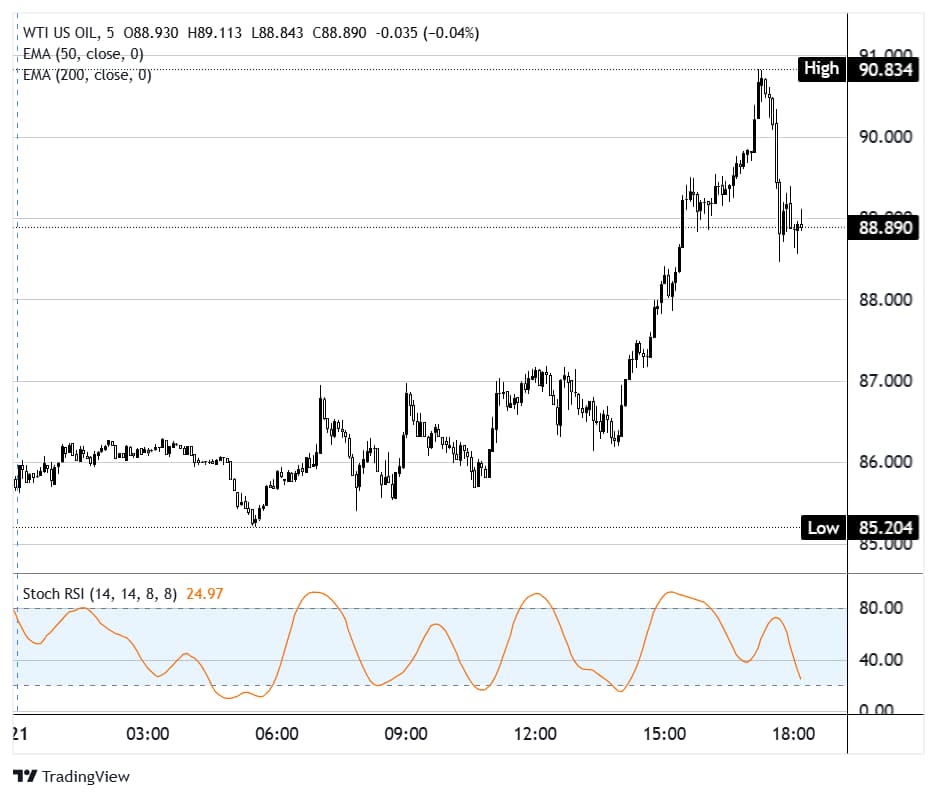
West Texas Intermediate (WTI) futures jumped 4% to trade above $93 per barrel, while Brent futures added 2% above $98, retracing the bulk of last week's slide on initial ceasefire optimism. Dow Jones Industrial Average (DJIA) futures, which printed an overnight high near 49,800, reversed to trade back near 49,400 as the Oil complex rallied and Treasury yields firmed. Only 16 vessels transited the Strait of Hormuz on Monday, per MarineTraffic data, a reminder that a waterway normally carrying around 20% of global Oil flow remains shut.
What happens if the clock runs out?
With Vance still in Washington and Iran yet to confirm a delegation, the diplomatic runway is shrinking fast. Trump sees little reason to extend, and Tehran will not negotiate under active military threat. Pakistan is still pushing both sides back to the table. If that push fails in the next 24 hours, the Strait of Hormuz and the Oil complex are the first places markets will register the fallout.
WTI 5-minute chart
WTI Oil FAQs
WTI Oil is a type of Crude Oil sold on international markets. The WTI stands for West Texas Intermediate, one of three major types including Brent and Dubai Crude. WTI is also referred to as “light” and “sweet” because of its relatively low gravity and sulfur content respectively. It is considered a high quality Oil that is easily refined. It is sourced in the United States and distributed via the Cushing hub, which is considered “The Pipeline Crossroads of the World”. It is a benchmark for the Oil market and WTI price is frequently quoted in the media.
Like all assets, supply and demand are the key drivers of WTI Oil price. As such, global growth can be a driver of increased demand and vice versa for weak global growth. Political instability, wars, and sanctions can disrupt supply and impact prices. The decisions of OPEC, a group of major Oil-producing countries, is another key driver of price. The value of the US Dollar influences the price of WTI Crude Oil, since Oil is predominantly traded in US Dollars, thus a weaker US Dollar can make Oil more affordable and vice versa.
The weekly Oil inventory reports published by the American Petroleum Institute (API) and the Energy Information Agency (EIA) impact the price of WTI Oil. Changes in inventories reflect fluctuating supply and demand. If the data shows a drop in inventories it can indicate increased demand, pushing up Oil price. Higher inventories can reflect increased supply, pushing down prices. API’s report is published every Tuesday and EIA’s the day after. Their results are usually similar, falling within 1% of each other 75% of the time. The EIA data is considered more reliable, since it is a government agency.
OPEC (Organization of the Petroleum Exporting Countries) is a group of 12 Oil-producing nations who collectively decide production quotas for member countries at twice-yearly meetings. Their decisions often impact WTI Oil prices. When OPEC decides to lower quotas, it can tighten supply, pushing up Oil prices. When OPEC increases production, it has the opposite effect. OPEC+ refers to an expanded group that includes ten extra non-OPEC members, the most notable of which is Russia.
Author

Joshua Gibson
FXStreet
Joshua joins the FXStreet team as an Economics and Finance double major from Vancouver Island University with twelve years' experience as an independent trader focusing on technical analysis.