NZD/USD Price Forecast: Pair slumps further below 200-day SMA, eyes on 0.5700
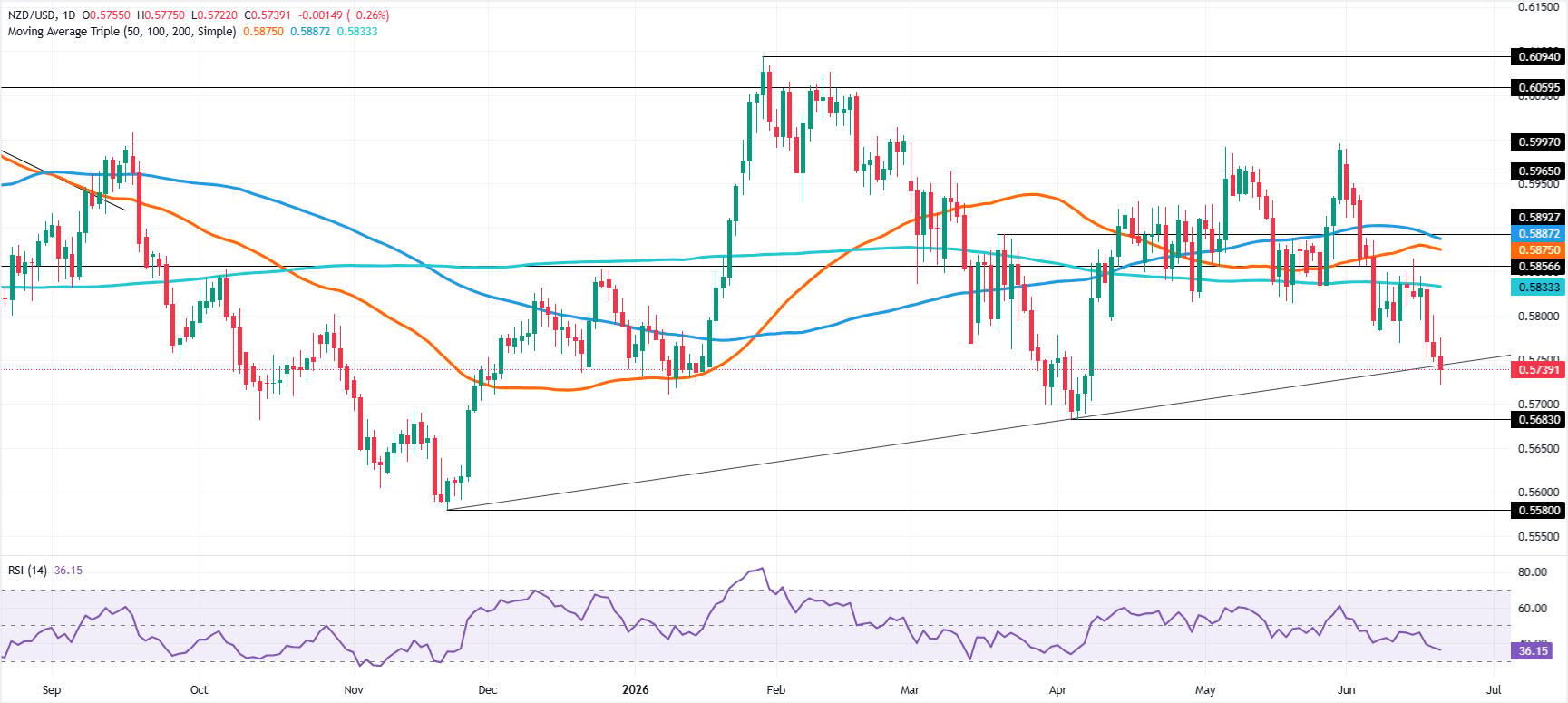
- NZD/USD breaks 200-day SMA, confirming bearish technical shift lower.
- Three-day slide exposes January low and 0.5700 support zone.
- Reclaiming 0.5800 is needed to challenge the 200-day SMA resistance.

The New Zealand Dollar (NZD) dives for the third consecutive day on Friday, down in the week by over 1.48%, after hitting two-month lows of 0.5722 against the Greenback. The NZD/USD pair trades at 0.5738, down 0.25% on the day.
NZD/USD Price Forecast: Technical outlook
After the Reserve Bank of New Zealand's (RBNZ) hawkish tilt, NZD/USD rose from around 0.5800ish to near 0.6000 before recoiling beneath the 0.5750 figure. Broad US Dollar (USD) strength stemming from the US-Iran conflict, along with the pair diving below the 200-day Simple Moving Average (SMA) at 0.5833, has weighed on the exchange rate. The 200-day SMA is a key technical level often used to assess trend direction, with prices above it generally considered bullish and prices below it viewed as bearish.
Therefore, the NZD/USD path of least resistance is downwards. The next support is the January 9 low of 0.5711, ahead of 0.5700. On further weakness, the next area of interest would be the April 3 swing low of 0.5683, before testing the psychological 0.5650 mark.
For a bullish reversal, buyers must challenge the 0.5800 level to push NZD/USD towards the 200-day SMA. A breach of the latter will expose the 50-day SMA at 0.5875.
NZD/USD Price Chart – Daily
New Zealand Dollar Price This week
The table below shows the percentage change of New Zealand Dollar (NZD) against listed major currencies this week. New Zealand Dollar was the strongest against the Swiss Franc.
| USD | EUR | GBP | JPY | CAD | AUD | NZD | CHF | |
|---|---|---|---|---|---|---|---|---|
| USD | 0.90% | 1.32% | 0.73% | 1.29% | 0.47% | 1.55% | 1.35% | |
| EUR | -0.90% | 0.40% | -0.17% | 0.39% | -0.42% | 0.64% | 0.44% | |
| GBP | -1.32% | -0.40% | -0.73% | -0.01% | -0.82% | 0.27% | 0.05% | |
| JPY | -0.73% | 0.17% | 0.73% | 0.55% | -0.26% | 0.86% | 0.62% | |
| CAD | -1.29% | -0.39% | 0.00% | -0.55% | -0.85% | 0.30% | 0.07% | |
| AUD | -0.47% | 0.42% | 0.82% | 0.26% | 0.85% | 1.10% | 0.87% | |
| NZD | -1.55% | -0.64% | -0.27% | -0.86% | -0.30% | -1.10% | -0.19% | |
| CHF | -1.35% | -0.44% | -0.05% | -0.62% | -0.07% | -0.87% | 0.19% |
The heat map shows percentage changes of major currencies against each other. The base currency is picked from the left column, while the quote currency is picked from the top row. For example, if you pick the New Zealand Dollar from the left column and move along the horizontal line to the US Dollar, the percentage change displayed in the box will represent NZD (base)/USD (quote).
Author

Christian Borjon Valencia
FXStreet
Markets analyst, news editor, and trading instructor with over 14 years of experience across FX, commodities, US equity indices, and global macro markets.














