|

NZD/JPY Price Analysis: Pair fell towards 88.00 as bears secure control

  • NZD/JPY fell 0.79% on Monday, trading near 88.05.
  • After breaking out of a range last week, bears pushed NZD/JPY lower, towards 88.00.
  • Indicators continue losing ground but approach oversold conditions which might trigger a period of consolidation.

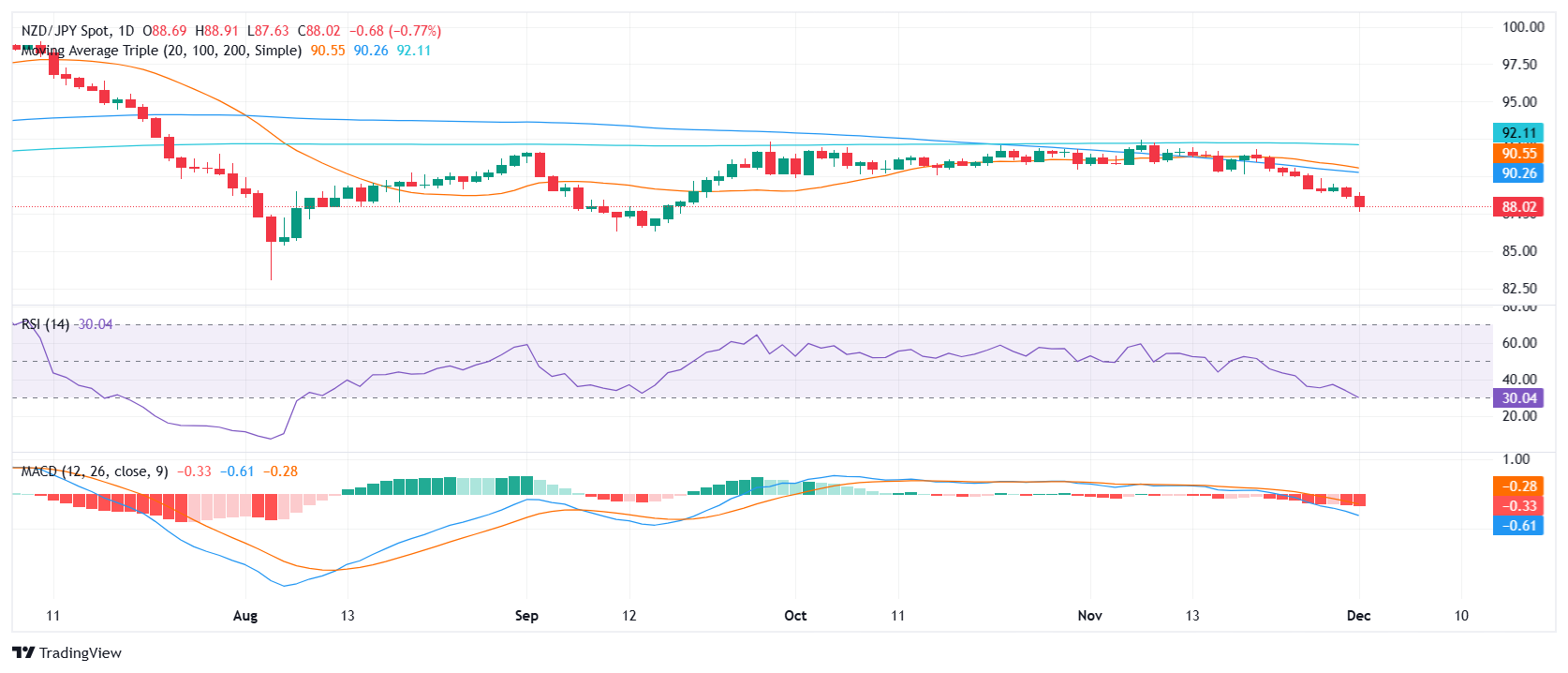
The NZD/JPY declined by 0.79% to 88.05 on Monday, after breaking out of a clear side-ways range last week. The Relative Strength Index (RSI) and the Moving Average Convergence Divergence (MACD) indicators are losing ground and confirm the selling pressure, and the outlook is now bearish, at least for the short-term.

In that sense, the RSI is in the oversold area, signaling rising selling pressure, while the MACD is also indicating that bearish momentum is increasing. The RSI suggests oversold conditions, may trigger consolidation, but the indicators' continued decline indicates that the downtrend is likely to persist. In case the cross corrects upwards, the bulls might attempt to recover the 89.00 area, and if lucky, they might extend a recovery to 90.00. On the downside, the selling traction is strong enough to continue pushing the pair towards the 85.00-86.00 range if the buyers don’t step in.

NZD/JPY daily chart
Author

Patricio Martín

Patricio is an economist from Argentina passionate about global finance and understanding the daily movements of the markets.


More from Patricio Martín
Share:

Editor's Picks

AUD/USD stays bid above 0.7100 on Australian trade data, Mideast optimism

AUD/USD clings to minor recovery gains above 0.7100 in the Asian session on Thursday as a new Israel-Lebanon ceasefire keeps a lid on the safe-haven US Dollar. Meanwhile, strong AustralianTrade Balane data also help the Aussie pair sustain the bounce from weekly lows.

USD/JPY hovers near the 160.00 intervention threshold on Mideast tensions

USD/JPY struggles to find acceptance above 160.00 and retreats from a one-month high in the Asian session on Thursday amid fears that authorities will step in again to prop up the Japanese Yen. Furthermore, a new Israel-Lebanon ceasefire caps the US Dollar and supports the currency pair. However, renewed US-Iran tensions keep the downside limited in the Greenback and the pair.

Gold rebounds from one-week low as Israel-Lebanon truce pressures safe-haven USD

Gold gains some positive traction on Thursday and climbs to the $4,475 area during the Asian session, reversing a major part of the previous day's slide to a one-week low. The Israel-Lebanon truce prompts some profit-taking around the US Dollar and supports the commodity. 


Ethereum: Long-term holders' capitulation drives ETH below $1,800

Ethereum has fallen below $1,800 on Wednesday, the first time since May 2025 following accelerated spot selling pressure and distributions from long-term holders. The Age Consumed metric, which tracks the movement of previously idle tokens or long-term holders' coins, spiked over the past two days as prices declined, indicating increased selling activity among this cohort.

Kevin Warsh takes the Fed helm: What it means for the US Dollar
The Federal Reserve moves away from the highly predictable "forward guidance" model of the Jerome Powell era to a new “Kevin Warsh environment”, characterized by less communication, more policy surprises, and an increased focus on the Fed's complex balance sheet.
Recession on paper: What really moves the Canadian Loonie now?

Statistics Canada handed the headline writers a gift and the analysts a headache. Real GDP shrank 0.1% on an annualized basis in the first quarter, and with the fourth quarter of 2025 revised down to a 1.0% contraction, that is two negative quarters in a row, the textbook definition of a technical recession and Canada's first since the pandemic.