Nvidia earnings and Anthropic IPO: the AI trade is facing another volatility test


The artificial intelligence trade is heading into one of its most important weeks of the year, with Nvidia’s quarterly earnings and Anthropic’s highly anticipated stock market debut expected to put the sector back under the spotlight. Both events could provide fresh evidence of whether demand for AI infrastructure remains strong enough to justify elevated valuations, or whether investors are becoming increasingly selective after months of aggressive positioning.
However, the timing is particularly sensitive. The AI sector has already experienced significant turbulence, with Nvidia losing hundreds of billions of dollars in market capitalisation over the past week. Meanwhile, concerns about excessive investment, financing requirements and crowded institutional positions have started to challenge the assumption that almost every company associated with AI will continue to benefit from the boom.
With two major catalysts approaching, volatility could remain elevated across technology stocks, semiconductors and companies supplying the AI infrastructure ecosystem.
Nvidia earnings and Anthropic IPO put AI sentiment to the test
Nvidia will be the first major event on investors’ calendars. The semiconductor giant is scheduled to publish its third-quarter fiscal 2027 results on Tuesday, November 17, with analysts expecting approximately $109 billion in revenue and 90% earnings growth, according to Reuters.
These figures illustrate the extraordinary scale of demand for Nvidia’s accelerated computing technology. Nevertheless, beating consensus estimates might not be sufficient to reassure investors. The market will also be looking for indications that hyperscalers are maintaining their investment plans, that demand for advanced chips remains robust and that supply constraints are not becoming a more significant obstacle to growth.
The company’s outlook will be particularly important following the departure of its long-standing CEO, Jensen Huang, last week. His exit has introduced an additional layer of uncertainty around the world’s most valuable AI chipmaker, with investors assessing whether the management transition could affect its strategic direction and competitive position.
The reaction in the options market also suggests that traders are preparing for an important move. According to Reuters, Nvidia options implied a potential earnings-related share-price movement of approximately 7% in either direction.
The second major catalyst is Anthropic’s anticipated IPO, with trading expected to begin on Thursday, November 19. The company behind the Claude family of AI models has attracted considerable institutional interest, making its debut an important test of investor appetite for private AI businesses entering public markets.
The proposed offering is particularly significant given the scale of the AI investment cycle. Anthropic’s preliminary prospectus indicates an intended Nasdaq listing under the ticker ANT, with an indicative offering price range of $70 to $78 per share. The company has also disclosed a concurrent $26 billion private placement involving several major technology and semiconductor businesses.
For traders, the IPO could provide a new reference point for valuing companies operating at the application and model-development layers of the AI industry, rather than focusing exclusively on infrastructure providers.
ActivTrades is also preparing to offer clients CFDs on Anthropic ahead of its anticipated stock market debut. The pre-IPO synthetic CFD already available is based on estimates of the underlying company’s share value, rather than an established exchange-traded share price. Once a conventional Anthropic CFD becomes available following the listing, the synthetic product is expected to expire.
The problem with Wall Street’s concentrated AI positions
Beyond the immediate corporate announcements, another issue deserves attention: the growing concentration of institutional portfolios around a relatively small number of AI-related companies.
During the past few years, investors have increasingly gravitated towards the same beneficiaries of the AI investment cycle. Nvidia, semiconductor manufacturers, hyperscalers and specialist cloud infrastructure providers have attracted substantial capital, with their performance becoming closely linked to expectations surrounding future AI spending.
Goldman Sachs has described this phenomenon as a crowded trade, highlighting how investors have accumulated exposure to many of the same technology, semiconductor and hyperscaler stocks.
The concentration has also had a measurable impact on hedge fund performance. According to Goldman Sachs’ prime-brokerage figures reported by The Wall Street Journal, AI-related positions accounted for almost 85% of the excess returns generated by stock-picking hedge funds during the first half of 2026.
Such performance creates an obvious incentive to maintain exposure. However, it also increases the risk that investors will attempt to reduce positions simultaneously when market conditions deteriorate.
This is particularly relevant because different parts of the AI ecosystem do not necessarily carry the same financial risks.
Large technology companies generally benefit from diversified revenue streams and substantial existing cash flows. By contrast, specialised infrastructure providers and newer cloud-computing businesses can be more sensitive to financing conditions, borrowing costs and the availability of capital.
If investors begin questioning the profitability of future AI infrastructure spending, companies dependent on continued investment could experience disproportionate selling pressure.
Goldman Sachs has also highlighted concerns about rising capital costs, the availability of financing and the ability to secure sufficient electricity to operate new data centres. These constraints could delay projects and potentially weaken demand for equipment already ordered by infrastructure operators.
Consequently, a deterioration in sentiment towards one part of the AI ecosystem could quickly spread to other segments, even when their underlying business models differ.
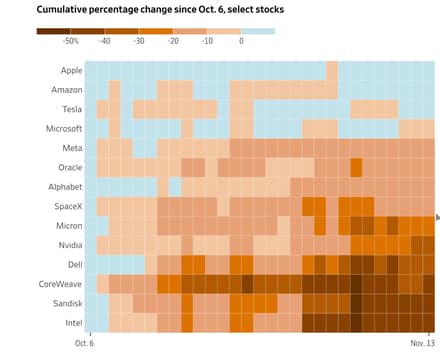
Cumulative percentage change of some stocks since the previous record high - Source: The Wall Street journal.
Last week’s Nvidia sell-off exposes the risks of a crowded trade
Recent market movements offer a clear illustration of how quickly these risks can materialise.
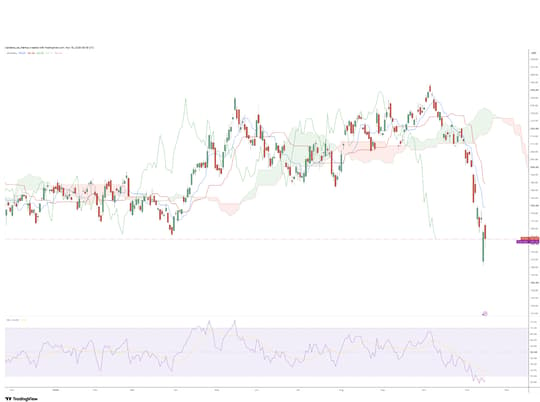
Nvidia Daily Chart - Source: Tradu
Nvidia’s shares came under intense pressure last week, with Reuters reporting that the company’s market capitalisation declined by approximately $550 billion by Thursday. The stock briefly fell as much as 14% during Thursday’s session before recovering some of its losses.
The decline was not limited to Nvidia. Semiconductor companies and specialist AI infrastructure providers also experienced substantial selling pressure, as investors reassessed their exposure to the sector.
The broader market had already been showing signs of fragility. Concerns about data-centre financing, potentially slower infrastructure spending and regulatory obstacles following the US midterm elections had contributed to a more uncertain environment.
The latest developments at Nvidia provided an additional catalyst, demonstrating how a company-specific event can have consequences across an entire investment theme.
There is also an important distinction between short-term buying interest and underlying market confidence. Reuters reported that retail investors purchased approximately $111 million of Nvidia shares during the first half-hour of trading on Thursday, representing an exceptionally strong inflow.
However, aggressive dip-buying does not necessarily indicate that institutional investors have become more confident about the longer-term outlook.
Indeed, the Wall Street Journal reported that technology-focused hedge funds collectively lost 12.6% in October, highlighting the potential consequences of concentrated exposure when market conditions turn against popular positions.
For traders, this creates an environment in which sharp intraday reversals, volatility spikes and changing correlations between AI stocks could become increasingly common.
What traders should watch beyond this week
Nvidia’s results and Anthropic’s IPO will undoubtedly dominate attention, but the broader direction of the AI trade will depend on several factors.
First, investors will need evidence that the enormous capital expenditure commitments made by hyperscalers are translating into sustainable revenue growth and improved returns. Continued spending alone may no longer be sufficient to support valuations if questions about profitability remain unanswered.
Second, financing conditions deserve close attention. Higher borrowing costs could disproportionately affect infrastructure companies relying on external capital to fund ambitious expansion plans. This is particularly relevant as US Treasury yields have moved above 5% for the 10-year maturity, increasing the cost of financing across the economy.
Third, competition at the AI model level could gradually redistribute the benefits of the investment cycle. Companies developing advanced models are competing for customers, computing capacity and market share, making it increasingly difficult to assume that today’s leading players will retain their competitive advantages indefinitely.
Finally, traders should monitor whether Nvidia’s earnings and Anthropic’s market debut generate broad participation across technology stocks or simply trigger isolated rallies.
A strong Nvidia report combined with an encouraging Anthropic debut could restore confidence in the sector. Conversely, disappointing guidance, a volatile IPO or renewed concerns about investment returns could reinforce the recent rotation away from crowded AI positions.
The AI investment cycle is unlikely to disappear overnight. However, the market may be entering a more demanding phase in which company fundamentals, financing requirements and valuations matter considerably more than simply having exposure to artificial intelligence.
For traders, this week’s events could therefore offer more than an opportunity to trade two major corporate announcements. They could provide an indication of whether the AI trade is preparing for another leg higher or entering a period of more selective investment, sharper price adjustments and heightened volatility.
Stay up to date with what's moving and shaking on the world's markets and never miss another important headline again! Check ActivTrades daily news and analyses here.
Author
Carolane de Palmas
ActivTrades
Carolane graduated with a Masters in Corporate Finance & Financial Markets and got the AMF Certification (Financial Markets Regulator in France). Afterward, she became an independent trader, investing mostly in European and American stocks/indices.