Nasdaq 100 futures halt after 7% surge on Jensen Huang’s return


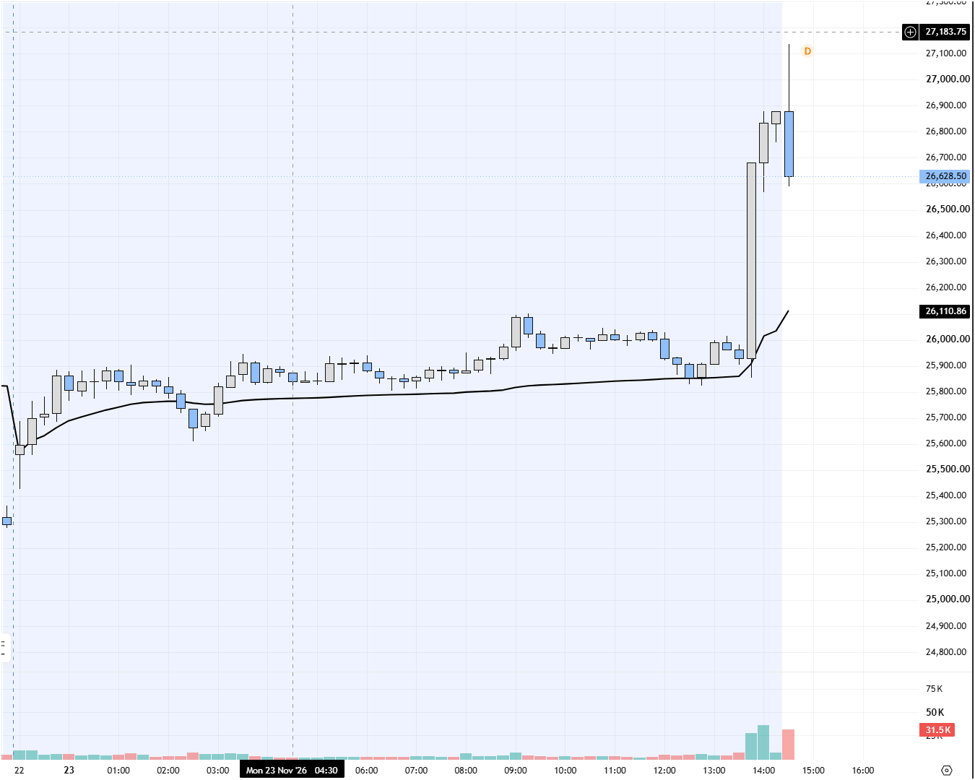
The Nasdaq 100 futures halted trading around 14:20 GMT on Monday on circuit breakers as the index soared over 7% following news linked to NVIDIA (NVDA), with the company reinstating Jensen Huang as President, CEO, and Board Director, effective immediately.
Of note, US President Donald Trump cheered the board’s decision, saying that “The country needs Jensen’s leadership at NVIDIA to ensure the success and prosperity of not only the company, but the American economy.”
Market reaction to the news
The financial markets swung to a risk-on mood, with traders seeking risk, while the Dow Jones Industrial Average (DJIA) gains over 1.60%, and the S&P 500 is up nearly 3.50%. The US Dollar Index (DXY), which tracks the performance of the buck against a basket of six currencies, witnessed a knee-jerk reaction to 103.47, turning negative, but regained composure and sits at 104.12, up 0.27%.
Nasdaq 100 Futures Chart
Nasdaq FAQs
The Nasdaq is a stock exchange based in the US that started out life as an electronic stock quotation machine. At first, the Nasdaq only provided quotations for over-the-counter (OTC) stocks but later it became an exchange too. By 1991, the Nasdaq had grown to account for 46% of the entire US securities’ market. In 1998, it became the first stock exchange in the US to provide online trading. The Nasdaq also produces several indices, the most comprehensive of which is the Nasdaq Composite representing all 2,500-plus stocks on the Nasdaq, and the Nasdaq 100.
The Nasdaq 100 is a large-cap index made up of 100 non-financial companies from the Nasdaq stock exchange. Although it only includes a fraction of the thousands of stocks in the Nasdaq, it accounts for over 90% of the movement. The influence of each company on the index is market-cap weighted. The Nasdaq 100 includes companies with a significant focus on technology although it also encompasses companies from other industries and from outside the US. The average annual return of the Nasdaq 100 has been 17.23% since 1986.
There are a number of ways to trade the Nasdaq 100. Most retail brokers and spread betting platforms offer bets using Contracts for Difference (CFD). For longer-term investors, Exchange-Traded Funds (ETFs) trade like shares that mimic the movement of the index without the investor needing to buy all 100 constituent companies. An example ETF is the Invesco QQQ Trust (QQQ). Nasdaq 100 futures contracts allow traders to speculate on the future direction of the index. Options provide the right, but not the obligation, to buy or sell the Nasdaq 100 at a specific price (strike price) in the future.
Many different factors drive the Nasdaq 100 but mainly it is the aggregate performance of the component companies revealed in their quarterly and annual company earnings reports. US and global macroeconomic data also contributes as it impacts on investor sentiment, which if positive drives gains. The level of interest rates, set by the Federal Reserve (Fed), also influences the Nasdaq 100 as it affects the cost of credit, on which many corporations are heavily reliant. As such the level of inflation can be a major driver too as well as other metrics which impact on the decisions of the Fed.
Author
Christian Borjon Valencia
FXStreet
Markets analyst, news editor, and trading instructor with over 14 years of experience across FX, commodities, US equity indices, and global macro markets.