Magnificent Seven earnings preview

The Magnificent 7 are in focus on Wednesday as we wait for results from Meta, Microsoft, Amazon and Alphabet, who all report earnings after the US market closes. There has been strong momentum in the US tech sector leading up to this earnings season, the Nasdaq and the S&P 500 have both reached record highs in recent days. The rally is taking a pause as we wait for these earnings reports, but together, the Magnificent 7 has rallied 18% in the past month.
Tonight’s results will be a pivotal moment for the AI trade, and it could make or break the recent record rally. The key details to note ahead of the earnings reports include:
Microsoft: The company is expected to report revenues of $81.4bn for last quarter, and capex is expected to be $110-120 for 2026. The company also announced that it was leaving its exclusive deal with OpenAI, although it will remain a major shareholder. Microsoft has the lowest P/E ratio of the big hyperscalers at 26.58x earnings.
Meta: It is expected to report revenues of $55.8bn, and analysts expect capex spending this year of $60-$65bn. The P/E ratio is 28.8, at the low end for the Magnificent 7. On Tuesday, Meta’s tie up with Manus, a Chinese AI provider, was scrapped by the Chinese government, as Meta gets caught up in the crosshairs of geopolitical tensions between China and the US. We expect to hear more about this and what it means for the company in this evening’s earnings call.
Amazon: The company is expected to report sales of $177.28bn, with earnings per share expected at $1.63. Amazon is expected to commit to $200bn in capex spending this year, which is the largest commitment of all the hyperscalers. Amazon has a relatively high P/E ratio compared to its peers, at 36.4 x earnings.
Google: sales are expected to come in at $106.9bn, driven by advertising spending and cloud sales. Capex is expected at $175 - $185bn for this year. Alphabet has been one of the top performers in the Magnificent 7 so far this year, and its share price is higher by 10%.
Capital spending focus
Capital spending plans are the main focus this evening and they could be more important for investors than revenue numbers. These companies announced capex spending plans earlier this year, and we do not expect them to undergo revisions. The market has digested the pre-reported capex plans, and it might not go down well if they increase spending at this stage. While the hyperscalers remain committed to their AI investments, they need to start showing that they are paying off. This will be a major focal point for investors this evening, and growth in cloud computing and AI product sales will be scrutinised.
Will events in the Middle East hit advertising spend?
While most of the analysis going into these results is focused on AI, it is also worth watching other aspects of these results, including the digital advertising market. Advertising sales are vital for sales revenues at Meta, Alphabet and Amazon. There could be pockets of weakness in advertising revenue, which has been disrupted by events in the Middle East, for example airlines and holiday companies may pull back ad spend. If there are signs that advertising sales are creaking, then we could expect share prices to react.
The impact on the broader market
These results are also important for the broader market. These four companies, along with the rest of the Magnificent 7, have been crucial to the doubling of the S&P 500 in the last 4 years. Together, they are expected to commit to spending $600bn in AI investments this year, and the hyperscaler spending has also been crucial for other companies on the US index. For example, the chip makers like Arm Holdings, Nvidia and AMD, and memory chip makers like Sandisk, which is higher by 300% YTD, and CPU producer Intel, which is up 123% so far this year, all rely on hyperscaler spending to sustain their sales. If any of these companies suggest a slowdown in spending on AI investment is coming, then we could see a broad sell-off across the US tech space and US indices in the aftermath of these results.
The options market is expecting big moves later Wednesday. Current options pricing suggest that Amazon could move 4% in either direction, for Meta it is 7%. There is a lot resting on these results: can the hyperscalers convince the market that their AI spending will pay off? How are their other revenue generating businesses performing outside of AI? What is their forward guidance?
The market is priced for perfection, and there is little room for error later tonight.
Microsoft, Amazon, Meta and Alphabet
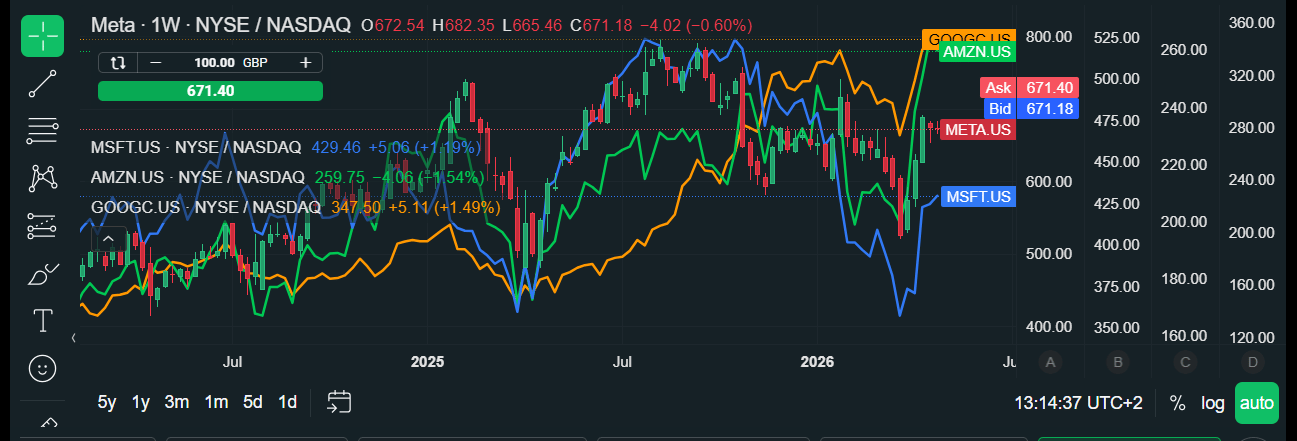
Source: XTB
Author

Kathleen Brooks
XTB UK
Kathleen has nearly 15 years’ experience working with some of the leading retail trading and investment companies in the City of London.














