Indonesian Rupiah inches lower ahead of Bank Indonesia interest rate decision
- Bank Indonesia is widely expected to hold its benchmark interest rate at 5.75% for a fifth straight month.
- The Indonesian Rupiah may gain due to resilient third-quarter growth, retained emerging-market index status, and stepped-up BI market intervention.
- Fed officials Musalem and Williams support further rate hikes to rein in persistent inflation pressures.


USD/IDR rises after opening at a bearish gap, trading around 18,290 during Asian hours on Wednesday. Market participants are closely awaiting Bank Indonesia’s (BI) interest rate decision due later in the day. Policymakers are widely expected to leave the benchmark policy rate unchanged at 5.75% for a fifth consecutive month, holding steady after delivering 100 basis points of cumulative rate hikes in May and June.
Meanwhile, the Indonesian Rupiah (IDR) could find support from resilient third-quarter economic activity, alongside decisions by MSCI and FTSE Russell to preserve Indonesia’s emerging-market classification in their November reviews. To further stabilize the currency, Bank Indonesia has also intensified its market intervention across the spot, forward, and bond markets.
However, the USD/IDR pair may further appreciate as the US Dollar (USD) finds support from hawkish remarks by Federal Reserve officials, with traders now looking ahead to the release of the FOMC October Meeting Minutes later in the day.
St. Louis Fed President Alberto Musalem signaled on Tuesday that the central bank may need to implement several rate hikes to rein in high inflation and urged prompt action to prevent the issue from worsening. This hawkish sentiment was reinforced by strong US economic data.
US Census Bureau reported that Retail Sales rose 0.2% month-over-month in October, meeting market expectations. Underlying figures were even stronger: sales excluding autos climbed 0.6%, outpacing the 0.4% forecast, while the retail sales control group, a key input for GDP consumer spending calculations, advanced 0.6% following a 0.1% gain the prior month.
Consequently, the CME FedWatch tool indicates traders are pricing in roughly a 95.7% probability of a quarter-point rate hike in December, alongside a 4.3% chance of a larger 50-basis-point increase.
Technical Analysis:
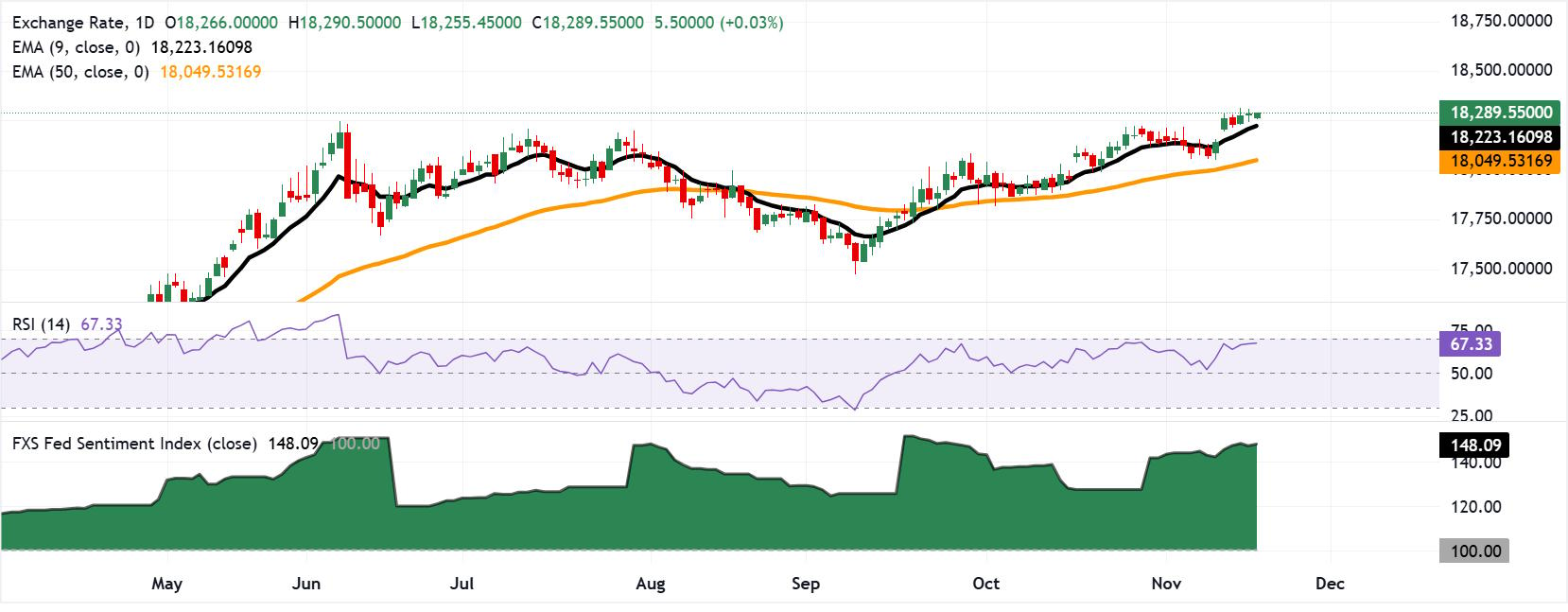
In the daily chart, USD/IDR trades at 18,290. The pair retains a bullish near-term bias as spot holds above both the nine- and 50-period Exponential Moving Averages (EMAs), keeping the short- and medium-term trends positively aligned. The 14-day Relative Strength Index (RSI) at 67.33 stays in bullish territory but below overbought levels, suggesting upside pressure persists but may be losing some acceleration rather than entering a blow-off phase.
On the downside, initial support is seen at the nine-period EMA around 18,223.16, where a pullback could find early demand. A deeper correction would likely look toward the 50-period EMA near 18,049.53 as the next significant support zone, with a daily close below that area needed to materially weaken the current constructive technical setup.
(The technical analysis of this story was written with the help of an AI tool. Know more.)
Indonesian Rupiah FAQs
The Indonesian Rupiah (IDR) is sensitive to a dynamic mix of global market conditions, domestic economic fundamentals, commodity price shifts, and proactive central bank interventions. As an emerging market currency, the Rupiah’s trajectory depends heavily on both domestic resilience and international economic momentum.
Bank Indonesia (BI) plays a central role in stabilizing the Rupiah through strategic monetary policy and direct market operations. By adjusting benchmark interest rates, the central bank manages yield differentials against major global central banks like the US Federal Reserve to attract and retain foreign portfolio investments. BI also utilizes a "triple-intervention" framework—operating across spot, derivative (DNDF), and government bond markets- to smooth out currency volatility, complemented by monetary instruments like Sekuritas Rupiah Bank Indonesia (SRBI) to bolster capital inflows.
From a broader macroeconomic perspective, domestic inflation rates, trade performance, and overall fiscal health dictate the IDR's underlying strength. Indonesia's trade and current account balances are closely tied to these fundamentals, while broader global factors, such as risk-on or risk-off sentiment among international investors and global liquidity trends, directly affect exchange rate movements.
As a major exporter of commodities such as palm oil, coal, nickel, and natural gas, Indonesia benefits from higher global commodity prices, which generate trade surpluses, increase foreign currency inflows, and strengthen the Rupiah. However, because Indonesia is also a net importer of crude oil, elevated global oil prices increase the foreign exchange burden, widening the current account deficit and weighing on the currency's value.
Author
Akhtar Faruqui
FXStreet
Akhtar Faruqui is a Forex Analyst based in New Delhi, India. With a keen eye for market trends and a passion for dissecting complex financial dynamics, he is dedicated to delivering accurate and insightful Forex news and analysis.