Gold surges as Iran talks hopes dent US Dollar again
- Gold jumps as renewed US-Iran talks hopes weaken the Dollar sharply.
- Falling Oil prices and improved sentiment underpin the metal’s rally.
- Traders now eye Fed speeches, Beige Book and jobless claims.

Gold (XAU/USD) price surges nearly 2% on Tuesday amid growing optimism linked to the resumption of US-Iran talks, even though the US military seized Iran-linked ships as the blockade of the Strait of Hormuz persists. The XAU/USD trades at $4,835 after bouncing off daily lows of $4,742.
Bullion rallies as softer Oil and Dollar lift haven demand
Geopolitical news continued to drive the markets, with US President Donald Trump grabbing the headlines and hinting at a possible meeting between Washington and Tehran this week. He told the New York Post, “You should stay there, really, because something could be happening over the next two days, and we’re more inclined to go there.”
The Greenback remains on the back foot due to its safe-haven appeal. The markets are pricing in a possible de-escalation of the conflict, as the buck has fallen to a six-week low at 97.96, according to the US Dollar Index (DXY). In the session, the DXY is down 0.26%, also dragged down by Oil prices.
Western Texas Intermediate (WTI), the US crude oil benchmark and a dollar-denominated asset, tanks nearly 6.40% to $91.72 per barrel. The positive correlation between WTI and the DXY, along with the improvement in risk appetite, is the catalyst behind the rise in bullion prices.
The US economic docket featured Federal Reserve (Fed) speakers, jobs, and inflation data. Regarding the US central bank, Chicago Fed President Austan Goolsbee said they might hold rates steady this year and look for rate cuts in 2027 if energy prices remain high due to the Iran war.
The Federal Reserve may need to wait until 2027 to cut interest rates if an extended bout of high Oil prices from the Iran war delays inflation’s progress towards the US central bank’s 2% goal, Goolsbee said.
Governor Stephen Miran said on Monday that he expects inflation to be closer to target in a year, adding that he sees no reason for oil prices to remain elevated.
Inflationary fears have pushed investors to trim their bets on the Fed’s dovish stance, and now money markets are speculating that the Federal Reserve will keep interest rates steady throughout the year, according to Prime Market Terminal (PMT).
Fed interest rate probabilities
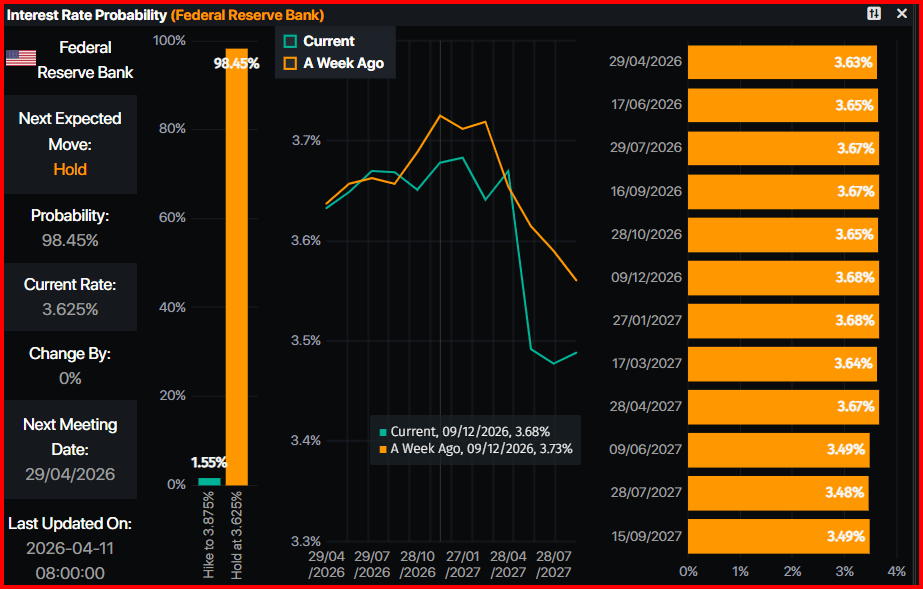
On the data front, the US PPI figures undershot forecasts in March, with headline inflation rising 4% YoY, below the expected 4.6%, while core PPI remained unchanged from February’s at 3.8% YoY.
Meanwhile, the ADP four-week average climbed to 39.25K from 26K, reinforcing the narrative of a still-resilient labor market.
Traders’ eyes will be on developments in the Middle East conflict. Data-wise, the US economic docket will feature speeches by Fed officials, the release of the Fed Beige Book, and Initial Jobless Claims data on Thursday.
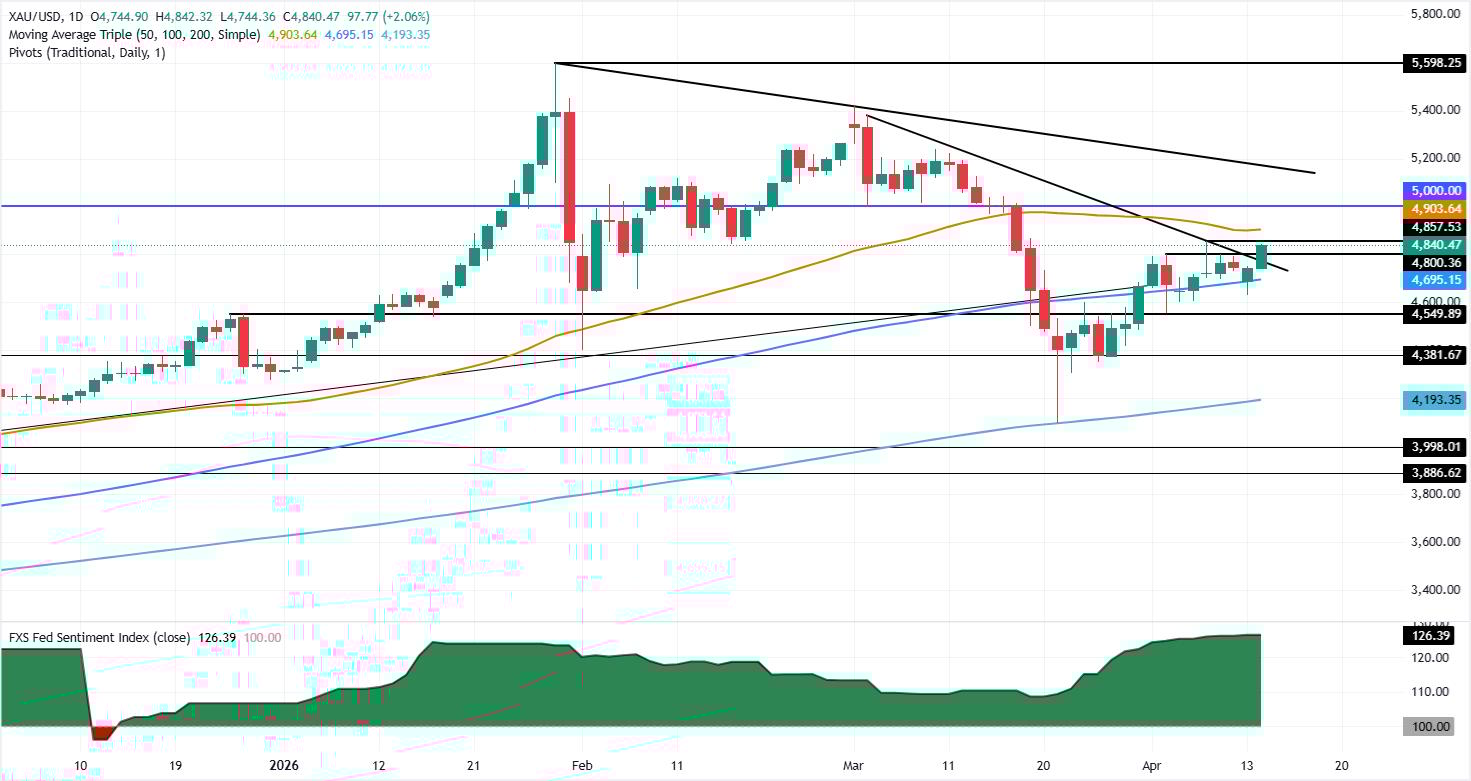
XAU/USD technical outlook: Gold rally, on its way towards $4,900
Gold’s uptrend accelerated past the $4,800 mark with traders facing strong resistance at $4,857, the April 8 daily high, followed by the 50-day Simple Moving Average (SMA) at $4,896.
Price action suggests that Gold is trading at four-day highs, an indication that buyers are gaining traction, as confirmed by the Relative Strength Index (RSI), which turned bullish two days ago.
If XAU/USD extends its gains past $4,900, the $5,000 milestone is up for grabs. Otherwise, if bullion tumbles below the $4,800 mark, a potential move to the confluence of the 100- and 20-day SMAs, each at $ 4,677 and $ 4,650, is possible.
Gold FAQs
Gold has played a key role in human’s history as it has been widely used as a store of value and medium of exchange. Currently, apart from its shine and usage for jewelry, the precious metal is widely seen as a safe-haven asset, meaning that it is considered a good investment during turbulent times. Gold is also widely seen as a hedge against inflation and against depreciating currencies as it doesn’t rely on any specific issuer or government.
Central banks are the biggest Gold holders. In their aim to support their currencies in turbulent times, central banks tend to diversify their reserves and buy Gold to improve the perceived strength of the economy and the currency. High Gold reserves can be a source of trust for a country’s solvency. Central banks added 1,136 tonnes of Gold worth around $70 billion to their reserves in 2022, according to data from the World Gold Council. This is the highest yearly purchase since records began. Central banks from emerging economies such as China, India and Turkey are quickly increasing their Gold reserves.
Gold has an inverse correlation with the US Dollar and US Treasuries, which are both major reserve and safe-haven assets. When the Dollar depreciates, Gold tends to rise, enabling investors and central banks to diversify their assets in turbulent times. Gold is also inversely correlated with risk assets. A rally in the stock market tends to weaken Gold price, while sell-offs in riskier markets tend to favor the precious metal.
The price can move due to a wide range of factors. Geopolitical instability or fears of a deep recession can quickly make Gold price escalate due to its safe-haven status. As a yield-less asset, Gold tends to rise with lower interest rates, while higher cost of money usually weighs down on the yellow metal. Still, most moves depend on how the US Dollar (USD) behaves as the asset is priced in dollars (XAU/USD). A strong Dollar tends to keep the price of Gold controlled, whereas a weaker Dollar is likely to push Gold prices up.
Author

Christian Borjon Valencia
FXStreet
Markets analyst, news editor, and trading instructor with over 14 years of experience across FX, commodities, US equity indices, and global macro markets.

















