Gold struggles near $5,000 as Oil surge caps upside
- XAU/USD hovers near $5,000 as rising Oil offsets a softer Dollar and yields.
- WTI climbs toward $96 amid Strait of Hormuz disruptions and geopolitical tensions.
- Markets expect the Fed to hold rates, pricing just 25 bps of easing this year.
Gold price consolidates on Tuesday during the North American session around the $5,000 level, down 0.11% amid broad US Dollar weakness and falling US Treasury yields. Higher Crude Oil prices, due to the Middle East conflict entering its third week, pushed bullion prices lower, as sellers eye a test of key support levels. At the time of writing, XAU/USD trades at $4,996.
Bullion stalls despite weaker Dollar and yields, with traders eyeing Fed decision
Bullion prices began the week on a lower note, even though the Iran war entered its third week, with no signs of a de-escalation in the short term. Nevertheless, the rise in Oil prices increased the US Dollar’s safe-haven appeal relative to Gold.
The US Dollar Index (DXY), which measures the Greenback’s value against six peers, is down 0.28% at 99.54. Even though the US Dollar is depreciating, traders have continued to book profits on Gold after the yellow metal spent the first half of March above the $5,000 threshold.
US Treasury bond yields are also falling, with the 10-year T-note yield down nearly two basis points to 4.2%.
Disruptions in the Strait of Hormuz are driving Oil prices higher. So far, Western Texas Intermediate (WTI), the US Crude Oil benchmark, has surged nearly 3% to $96.13 per barrel.
Data-wise, the US economic docket features jobs data, with the ADP Employment Change 4-week average edging lower from 14.75K to 9K. At the same time, Pending Home Sales for February improved sharply following January’s 1% contraction, and rose by 1.8% MoM.
Ahead, traders will eye the Federal Reserve’s monetary policy meeting, which began on Tuesday and is expected to end on Wednesday, with the monetary policy statement and the Summary of Economic Projections (SEP).
Money markets expect the Fed to keep rates unchanged at the March meeting, eyeing just 25 basis points of easing towards the end of the year. Following the Fed’s decision, investors eye the press conference by Federal Reserve Chair Jerome Powell.
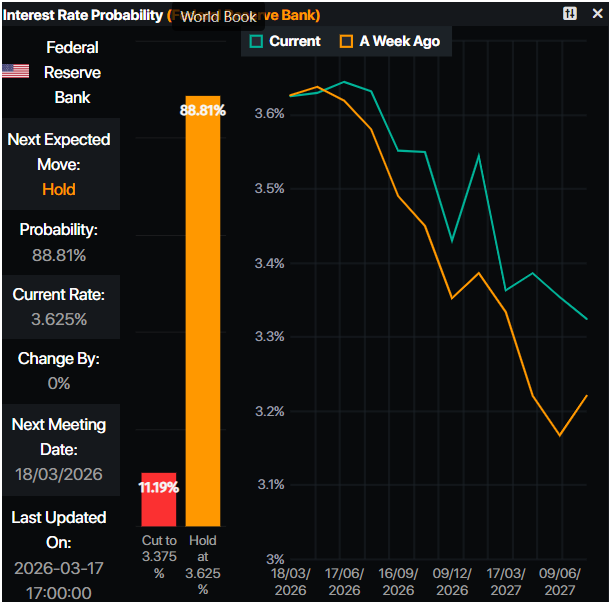
In the meantime, fears that inflation would rise due to the Iran war, alongside shipping disruptions in the Strait of Hormuz, prevented central banks from continuing to ease monetary policy.
XAU/USD Price Forecast: Gold tilted downwards, below $5,000
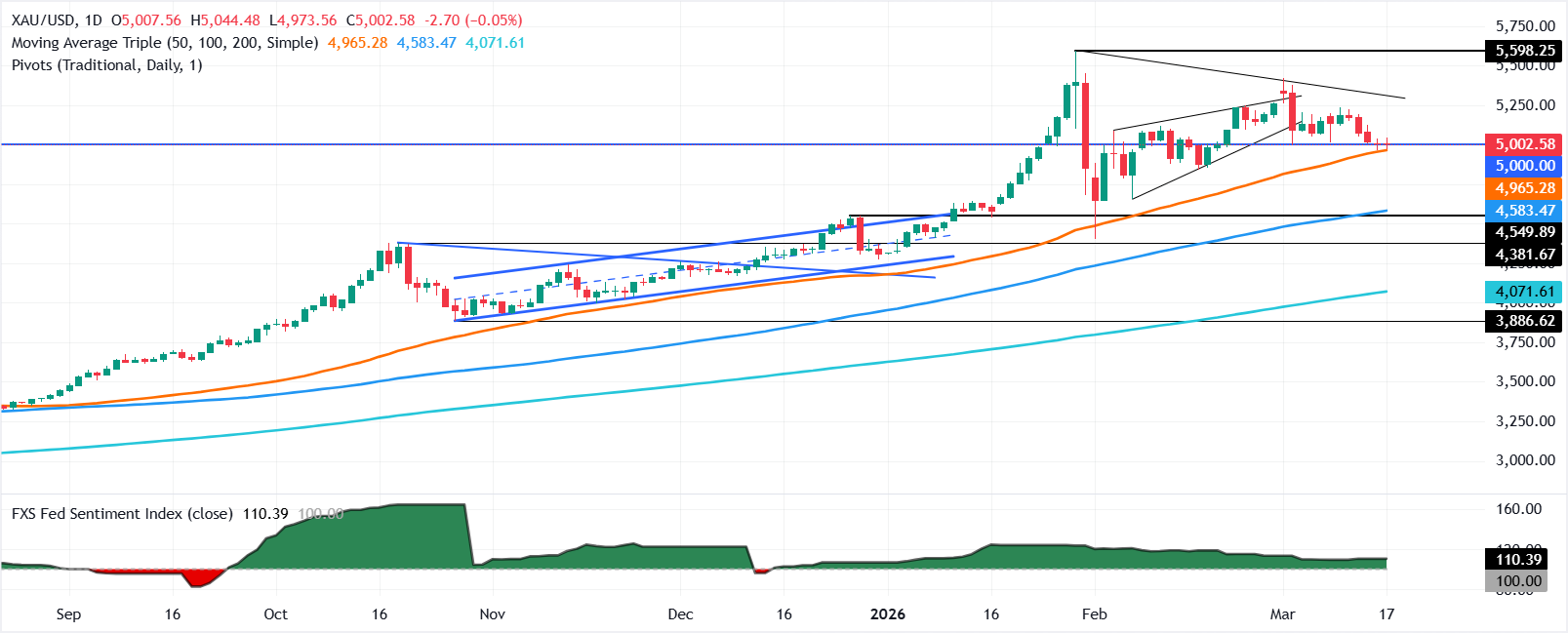
Gold price consolidates at around $5,000 ahead of the Federal Reserve’s meeting, with no signs of extending its gains past the $5,050 mark. On the downside, Bullion’s first key support level is the 50-day Simple Moving Average (SMA) at $4,952 before diving towards the $4,900 mark.
Momentum is tilted bearish, though the Relative Strength Index (RSI) is flattish, an indication of the lack of strength of buyers and sellers.
For a bullish resumption, XAU/USD must clear $5,050, followed by the March 10 daily high of $5,238. A breach of the latter will expose the $5,300 figure, with the next area of interest being $5,419, the March 2 cycle high.
Gold FAQs
Gold has played a key role in human’s history as it has been widely used as a store of value and medium of exchange. Currently, apart from its shine and usage for jewelry, the precious metal is widely seen as a safe-haven asset, meaning that it is considered a good investment during turbulent times. Gold is also widely seen as a hedge against inflation and against depreciating currencies as it doesn’t rely on any specific issuer or government.
Central banks are the biggest Gold holders. In their aim to support their currencies in turbulent times, central banks tend to diversify their reserves and buy Gold to improve the perceived strength of the economy and the currency. High Gold reserves can be a source of trust for a country’s solvency. Central banks added 1,136 tonnes of Gold worth around $70 billion to their reserves in 2022, according to data from the World Gold Council. This is the highest yearly purchase since records began. Central banks from emerging economies such as China, India and Turkey are quickly increasing their Gold reserves.
Gold has an inverse correlation with the US Dollar and US Treasuries, which are both major reserve and safe-haven assets. When the Dollar depreciates, Gold tends to rise, enabling investors and central banks to diversify their assets in turbulent times. Gold is also inversely correlated with risk assets. A rally in the stock market tends to weaken Gold price, while sell-offs in riskier markets tend to favor the precious metal.
The price can move due to a wide range of factors. Geopolitical instability or fears of a deep recession can quickly make Gold price escalate due to its safe-haven status. As a yield-less asset, Gold tends to rise with lower interest rates, while higher cost of money usually weighs down on the yellow metal. Still, most moves depend on how the US Dollar (USD) behaves as the asset is priced in dollars (XAU/USD). A strong Dollar tends to keep the price of Gold controlled, whereas a weaker Dollar is likely to push Gold prices up.
Author

Christian Borjon Valencia
FXStreet
Markets analyst, news editor, and trading instructor with over 14 years of experience across FX, commodities, US equity indices, and global macro markets.