Gold slides below $4,700 as Iran impasse lifts yields, Dollar bid
- Gold stays pressured as stalled US-Iran talks keep geopolitical uncertainty elevated.
- Higher Treasury yields and a firmer US Dollar capped bullion’s rebound.
- Traders now eye the Fed meeting, ADP, housing and confidence data.

Gold (XAU/USD) price drops during the North American session on Monday as the Greenback trims some of its earlier losses amid a mild deterioration in risk appetite, driven by the lack of progress in US-Iran negotiations. The XAU/USD pair trades at $4,673, down 0.75%.
Bullion weakens as higher-for-longer Fed bets outweigh haven role
Geopolitics keep the yellow metal pressured, even though Iran is poised to reopen the Strait of Hormuz if the US lifts the blockade on Iranian ports. Besides this, Tehran is proposing a three-stage process aimed at ending the war, the Strait of Hormuz issue, and discussing nuclear issues, reported Axios.
US President Donald Trump canceled his envoy’s trip to Pakistan over the weekend, calling it a waste of time. He added that although Iran sent a “much better” deal, it is not enough.
Expectations that interest rates would remain higher for longer trumped Gold’s inflation hedge. The US 10-year Treasury yield is up 3.5 basis points to 4.342%, a headwind for the non-yielding metal.
The swaps market had priced in the Federal Reserve (Fed) holding rates steady in 2026, according to Prime Terminal data.
Fed probability table
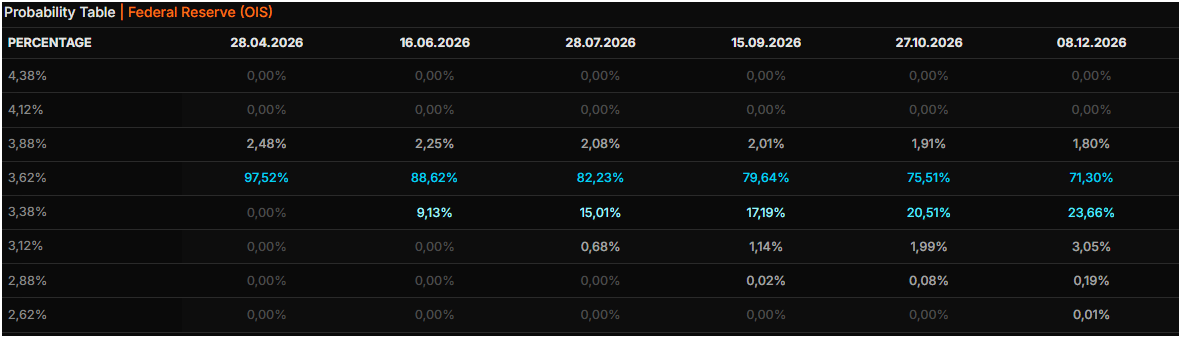
Aside from this, traders’ eyes are on the Federal Reserve monetary policy meeting, which begins on Tuesday and ends on Wednesday, with the unveiling of the monetary policy statement and the Fed Chair Jerome Powell’s last press conference as the chief of the US central bank.
Jerome Powell is expected to be asked about his future at the Fed. Although his tenure as the Chairman of the Board ends on May 15, his term at the Fed would end on January 31, 2028.
Analysts revised up Gold forecasts
Meanwhile, a Reuters poll showed analysts expect higher prices for the non-yielding metal, citing “strong central bank demand and economic uncertainty expected to offset risks from surging inflation and hawkish policy bets due to the Middle East conflict.”
Towards the end of the year, bullion is expected to end 2026 at $4,916, according to the median, upwards from $4,746.50 estimates three weeks ago.
On Tuesday, the economic docket will feature the ADP Employment Change 4-week average, housing data, and the Conference Board (CB) Consumer Confidence survey for April.
XAU/USD technical outlook: Further losses seen below $4,700
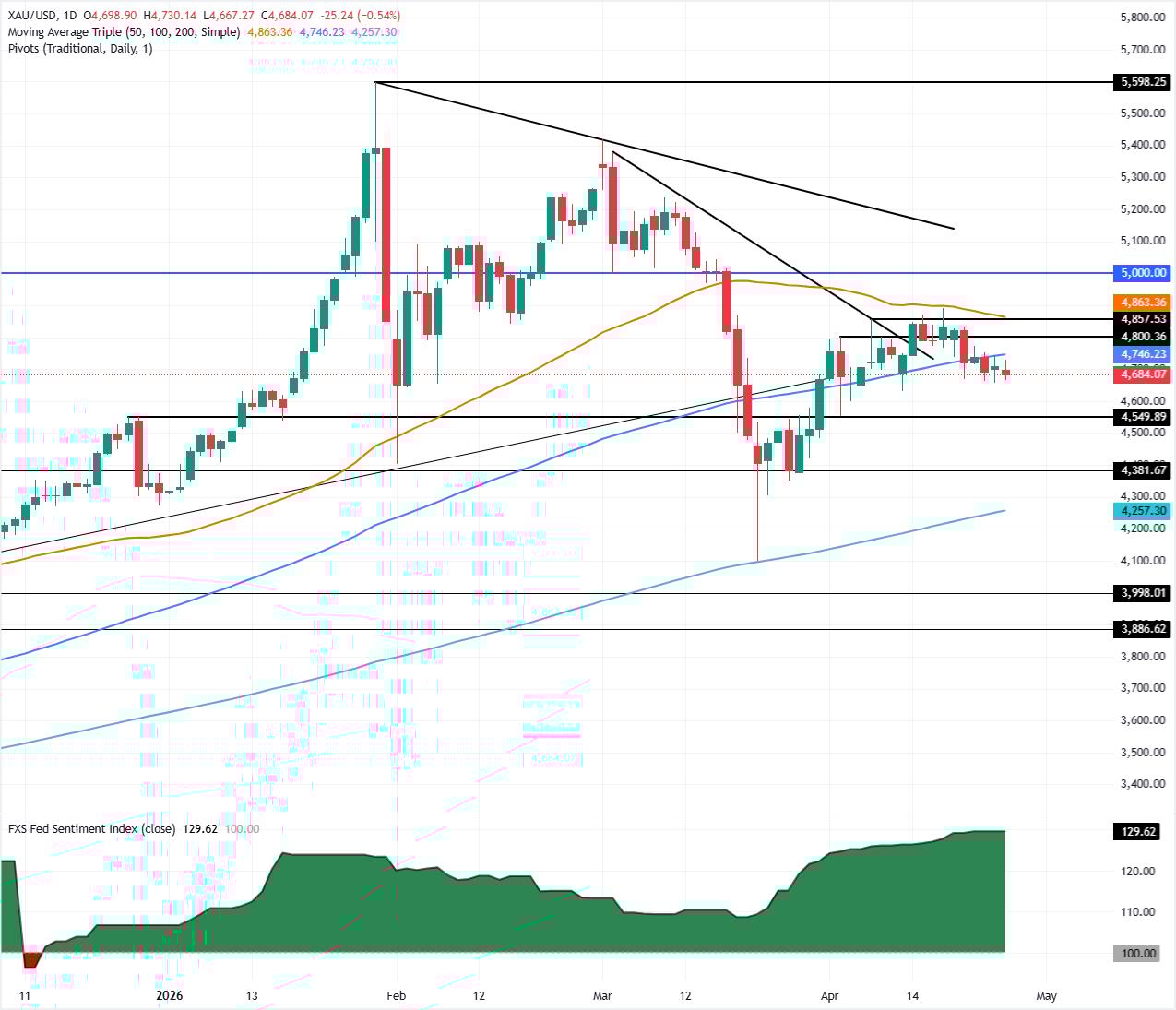
Gold price is consolidating below $4,700, with key resistance at the 20- and 100-day Simple Moving Averages (SMAs), both above $4,729 and $4,733, respectively. Over the last three trading days, although it has breached $4,700, bullion remains unable to clear key resistance levels, which could open the door to a recovery.
Momentum shows that bears are in charge, as depicted in the Relative Strength Index (RSI). Therefore, Middle East headlines that favor higher energy prices and a stronger US Dollar could pave the way for further downside.
The first support will be the $4,650 psychological level, ahead of $4,600. A breach of the latter will expose the April 2 daily low of $4,554.
On the flip side, if XAU/USD rises past $4,700, the 20- and 100-day SMAs are up next. A clearance of the $4,729/33 area will expose the $4,750 psychological level ahead of $4,800.
Gold FAQs
Gold has played a key role in human’s history as it has been widely used as a store of value and medium of exchange. Currently, apart from its shine and usage for jewelry, the precious metal is widely seen as a safe-haven asset, meaning that it is considered a good investment during turbulent times. Gold is also widely seen as a hedge against inflation and against depreciating currencies as it doesn’t rely on any specific issuer or government.
Central banks are the biggest Gold holders. In their aim to support their currencies in turbulent times, central banks tend to diversify their reserves and buy Gold to improve the perceived strength of the economy and the currency. High Gold reserves can be a source of trust for a country’s solvency. Central banks added 1,136 tonnes of Gold worth around $70 billion to their reserves in 2022, according to data from the World Gold Council. This is the highest yearly purchase since records began. Central banks from emerging economies such as China, India and Turkey are quickly increasing their Gold reserves.
Gold has an inverse correlation with the US Dollar and US Treasuries, which are both major reserve and safe-haven assets. When the Dollar depreciates, Gold tends to rise, enabling investors and central banks to diversify their assets in turbulent times. Gold is also inversely correlated with risk assets. A rally in the stock market tends to weaken Gold price, while sell-offs in riskier markets tend to favor the precious metal.
The price can move due to a wide range of factors. Geopolitical instability or fears of a deep recession can quickly make Gold price escalate due to its safe-haven status. As a yield-less asset, Gold tends to rise with lower interest rates, while higher cost of money usually weighs down on the yellow metal. Still, most moves depend on how the US Dollar (USD) behaves as the asset is priced in dollars (XAU/USD). A strong Dollar tends to keep the price of Gold controlled, whereas a weaker Dollar is likely to push Gold prices up.
Author

Christian Borjon Valencia
FXStreet
Markets analyst, news editor, and trading instructor with over 14 years of experience across FX, commodities, US equity indices, and global macro markets.

















