Gold corrects back about half a percent on Wednesday
- Gold pulls back after Tuesday’s rally on increased geopolitical risk stemming from Iran’s escalation in the Middle East.
- The macro backdrop remains positive, however, with falling interest rates globally making Gold shine.
- Technically, XAU/USD consolidates, providing a “buy-the-dip” opportunity for bulls.

Gold (XAU/USD) slides lower on Wednesday to trade in the $2,650s per troy ounce as traders do some backing and filling after the over 1.0% rally on Tuesday. Instability in the Middle East was the main driver behind the previous day’s recovery after Iran launched about 200 missiles, some of which were ballistic, at Israel’s capital Tel Aviv.
That, and the fact that interest rates are falling globally, continue to support the precious metal, which keeps trading just below its new all-time high of $2,685. Lower interest rates increase the attractiveness of non-interest bearing Gold as a portfolio item for investors.
Gold faces volatility from changing outlook for US rates
Gold has seen volatility over the past week from a rapidly changing outlook for interest rates in the US which has also impacted the strength of the US Dollar (USD), another factor driving valuations.
The precious metal pulsed higher last week as bets the Federal Reserve (Fed) would cut interest rates by another double-dose 50 basis points (0.50%) at its November meeting hit fever pitch. Expectations the bank would slash rates further also weighed on the USD, adding momentum to the yellow metal’s rise.
However, unexpectedly strong data – especially covering the fragile US jobs market – and a cautious speech from Fed Chairman Jerome Powell on Monday have since reduced bets of a double-whammy 50 bps cut, from over 60% last week to only 37% at the time of publication on Wednesday.
Gold to go higher say several big bank analysts
Gold has already gained over 28% in 2024 and reached new record highs but several analysts at large banks predict the uptrend is not over for the precious metal, especially in the medium and long term, according to Kitco News.
Goldman Sachs said in a note on Monday that it is revising up its forecasts for Gold from $2,700 to $2,900 by early 2025.
“We reiterate our long gold recommendation due to the gradual boost from lower global interest rates, structurally higher central bank demand and gold’s hedging benefits against geopolitical, financial, and recessionary risks,” the bank said.
In a recent interview with Bloomberg News, Joni Teves, Precious Metals Strategist at Swiss bank UBS, was also bullish about Gold.
“From a broader perspective I think the macro backdrop is supportive for Gold. The fact that real rates are coming down, the Fed is in easing mode. From a fundamental standpoint, we think physical demand is also quite resilient, even at higher Gold prices,” Teves said.
“The official sector (central banks) continues to add to Gold reserves, and positioning allows for more allocations to Gold to be built up over time. I think that continues to be the case, and the risk here is that because the market hasn't been providing a lot of pullbacks, that people will have to continue chasing the move higher,” he added.
The UBS strategist dismissed concerns that overweight long Gold derivatives positioning on exchanges might risk a prolonged market correction.
“There has been a pickup in positions in the short term,” she replied. “But actually, if you look back to historical data, we're still not at all-time highs, and broader market positioning, in our view, is still not stretched.”
When asked whether UBS saw investors continuing to buy the dips, Teves said that she expects they will because many who waited on the sidelines during the recent fast-moving rally are still looking for an entry.
Technical Analysis: Gold tracks the 50 SMA higher
Gold pulls back to the 50-period Simple Moving Average (SMA) on the 4-hour chart for the second time this week. The correction comes after Tuesday’s rebound from the $2,625 swing low.
The short-term trend is unclear after the rather deep decline seen on Friday and Monday. A break above the $2,673 October 1 high would probably see follow-through back up to the $2,680s and the region of the record high. A break above that would probably lead to a continuation up to the round-number target at $2,700.
XAU/USD 4-hour Chart
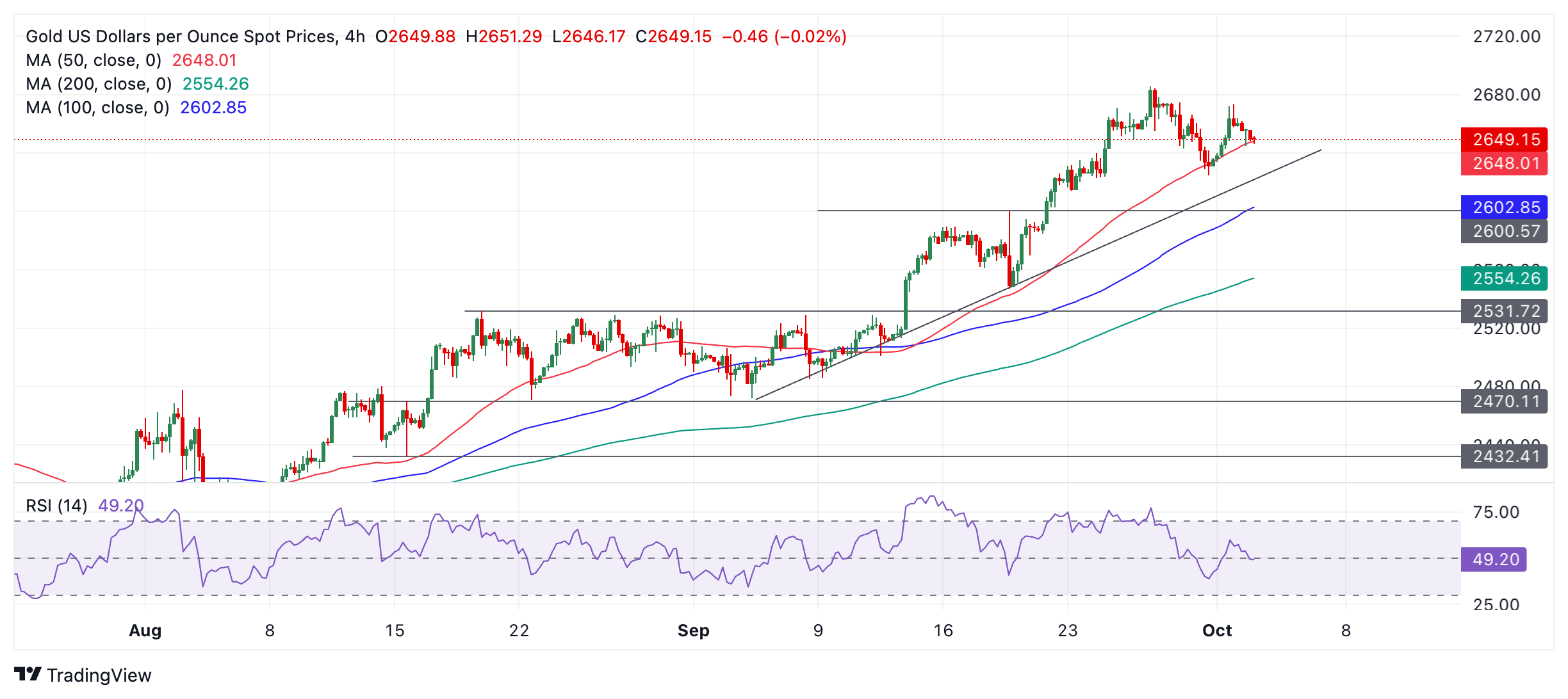
On a medium and long-term basis, Gold remains in an uptrend and since it is a foundational principle of technical analysis that “the trend is your friend,” the odds favor resumption higher eventually, once the current period of consolidation has ended.
A break below the trendline at about $2,615-$2,620, however, would be a bearish sign and suggest a complete reversal of the short-term uptrend.
(This story was corrected on October 2 at 09:55 GMT to say, in the headline, that Gold price falls on Wednesday after Tuesday's rally.)
Economic Indicator
Fed Interest Rate Decision
The Federal Reserve (Fed) deliberates on monetary policy and makes a decision on interest rates at eight pre-scheduled meetings per year. It has two mandates: to keep inflation at 2%, and to maintain full employment. Its main tool for achieving this is by setting interest rates – both at which it lends to banks and banks lend to each other. If it decides to hike rates, the US Dollar (USD) tends to strengthen as it attracts more foreign capital inflows. If it cuts rates, it tends to weaken the USD as capital drains out to countries offering higher returns. If rates are left unchanged, attention turns to the tone of the Federal Open Market Committee (FOMC) statement, and whether it is hawkish (expectant of higher future interest rates), or dovish (expectant of lower future rates).
Read more.Last release: Wed Sep 18, 2024 18:00
Frequency: Irregular
Actual: 5%
Consensus: 5.25%
Previous: 5.5%
Source: Federal Reserve
Author

Joaquin Monfort
FXStreet
Joaquin Monfort is a financial writer and analyst with over 10 years experience writing about financial markets and alt data. He holds a degree in Anthropology from London University and a Diploma in Technical analysis.