Gold price slips as Trump says Iran ceasefire is over
- Trump allows talks, but declares the US-Iran ceasefire officially over.
- Fed minutes show inflation worries and rate-hike debate.
- CPI and Warsh testimony drive the next Gold catalyst.

Gold (XAU/USD) price retreats on Friday during the North American session, pressured by US President Donald Trump's comments allowing the resumption of US-Iran talks, but reiterating that the ceasefire is “over.” The XAU/USD pair trades at around $4,103, down 0.48%.
XAU/USD falls as renewed war risks lift yields and Dollar
The yellow metal seems poised to end the week down 0.51%, driven by the escalation of the conflict. The Greenback erased its earlier losses, as the US Dollar Index (DXY), which measures the buck’s value against six currencies, holds firm at 100.94, unchanged.
In his Truth Social account, President Trump posted, “The Islamic Republic of Iran has asked us to continue 'talks.' We have agreed to do so, but the United States has stated to them, in no uncertain terms, that the Cease Fire is OVER! Thank you for your attention to this matter. President DONALD J. TRUMP.”
After the post, US Treasury yields surged, with the 10-year T-note up 2 basis points to 4.569%, amid fears that energy prices could rise, fueling fears of higher interest rates if hostilities continued.
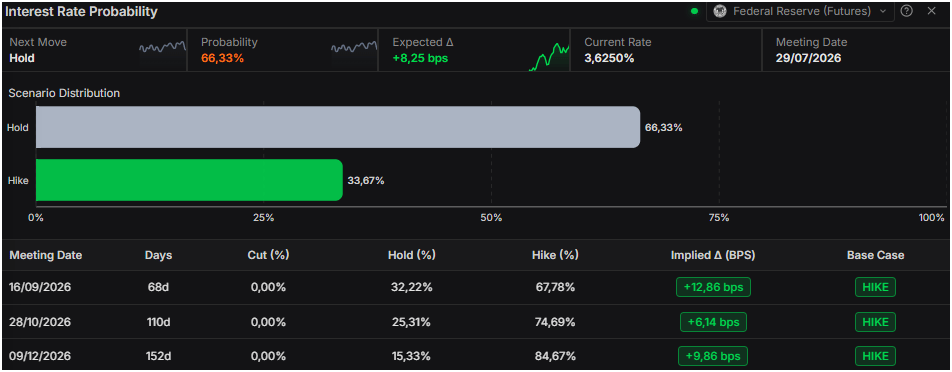
Money markets have priced in an 80% chance of a Federal Reserve (Fed) rate increase at the September meeting. Odds for the July 29 meeting suggest that the central bank will hold rates, with the chances for a hike being shy of 34%, according to Prime Terminal data.
The US economic docket was light this week, with the release of the FOMC's last meeting minutes, which were closely scrutinised for the absence of forward guidance. The minutes showed that officials are concerned about inflation, with a “few participants” seeing the case for a rate hike.
On Thursday, Initial Jobless Claims fell to 215K, below estimates of 218K and the previous reading of 217K, an indication that the labor market is stable.
Now eyes turn to next week's economic docket, with investors eyeing the release of US inflation data and Federal Reserve Chair Kevin Warsh's testimony before the US Congress.
XAU/USD technical outlook: Gold remains bearish below the 200-day SMA
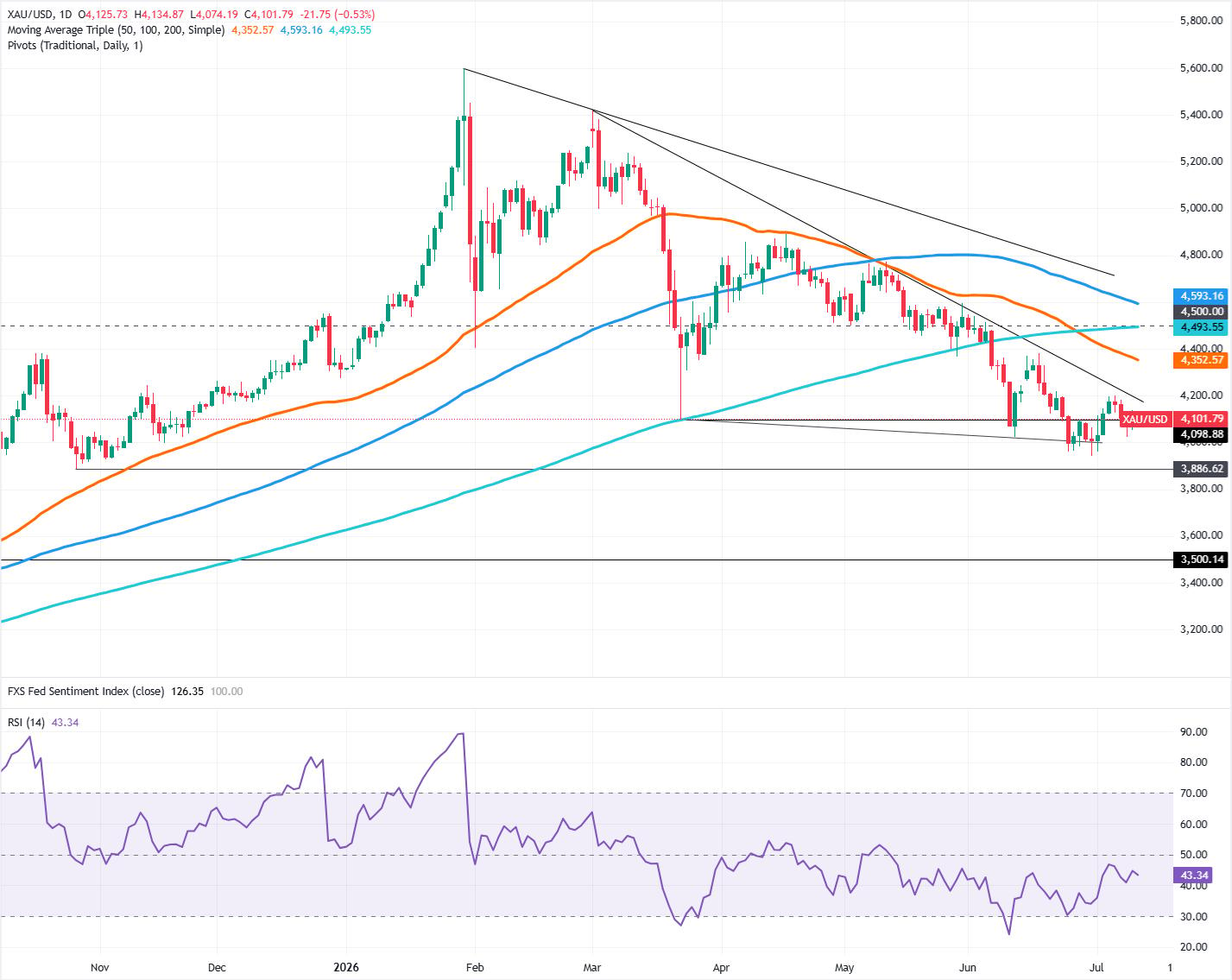
Gold’s downtrend remains in play, as the market structure of a successive series of lower highs and lower lows is intact. Alongside this, momentum, as measured by the Relative Strength Index (RSI), is declining and is now in bearish territory, and XAU’s spot price is below the 200-day Simple Moving Average (SMA) at $4,493.
With all three of those reasons in play, Bullion prices might continue to edge lower, so any leg-up could be an opportunity for sellers.
XAU/USD first support would be the July 8 swing low of $4,021. Beneath lies the June 30 swing low of $3,941, followed by the October 28, 2025, swing low of $3,886.
Going upwards, if Gold surpasses a downslope resistance trendline near $4,200, it opens the door for challenging the $4,300 milestone. Above this area, the next ceiling level is the 200-day Simple Moving Average (SMA) at $4,493.
Gold FAQs
Gold has played a key role in human’s history as it has been widely used as a store of value and medium of exchange. Currently, apart from its shine and usage for jewelry, the precious metal is widely seen as a safe-haven asset, meaning that it is considered a good investment during turbulent times. Gold is also widely seen as a hedge against inflation and against depreciating currencies as it doesn’t rely on any specific issuer or government.
Central banks are the biggest Gold holders. In their aim to support their currencies in turbulent times, central banks tend to diversify their reserves and buy Gold to improve the perceived strength of the economy and the currency. High Gold reserves can be a source of trust for a country’s solvency. Central banks added 1,136 tonnes of Gold worth around $70 billion to their reserves in 2022, according to data from the World Gold Council. This is the highest yearly purchase since records began. Central banks from emerging economies such as China, India and Turkey are quickly increasing their Gold reserves.
Gold has an inverse correlation with the US Dollar and US Treasuries, which are both major reserve and safe-haven assets. When the Dollar depreciates, Gold tends to rise, enabling investors and central banks to diversify their assets in turbulent times. Gold is also inversely correlated with risk assets. A rally in the stock market tends to weaken Gold price, while sell-offs in riskier markets tend to favor the precious metal.
The price can move due to a wide range of factors. Geopolitical instability or fears of a deep recession can quickly make Gold price escalate due to its safe-haven status. As a yield-less asset, Gold tends to rise with lower interest rates, while higher cost of money usually weighs down on the yellow metal. Still, most moves depend on how the US Dollar (USD) behaves as the asset is priced in dollars (XAU/USD). A strong Dollar tends to keep the price of Gold controlled, whereas a weaker Dollar is likely to push Gold prices up.
Author

Christian Borjon Valencia
FXStreet
Markets analyst, news editor, and trading instructor with over 14 years of experience across FX, commodities, US equity indices, and global macro markets.