Gold price rebounds above $3,200 as Moody’s downgrade spurs safe haven demand
- Gold gains on safe-haven flows as DXY falls 0.47% to 100.50; XAU/USD reclaims key $3,200 level.
- Moody’s cuts US credit rating to Aa1, citing long-term fiscal inaction; Treasury yields steady, USD weakens.
- Putin-Trump call adds geopolitical layer; traders brace for busy week of Fed speeches and key US data.

Gold price trimmed some of last Friday’s losses, climbing on safe haven demand following Moody’s downgrade of the United States' (US) creditworthiness. The rating agency's action undermined the US Dollar and sent XAU/USD above the $3,200 figure after bouncing off daily lows of $3,202.
On Friday, the international rating agency Moody’s modified its US government rating from AAA to Aa1. They highlighted that more than a decade of inaction by successive US administrations and Congress has contributed to the country’s worsening fiscal position, raising concerns over long-term debt sustainability.
The US Dollar Index (DXY), which tracks the performance of the US currency against six others, dropped 0.47% to 100.50. Although it remains off daily lows of 100.06, traders seeking safety have moved to the yellow metal.
US Treasury Secretary Scott Bessent said on Sunday that April 2 tariffs imposed in some countries could be reinstated if they do not negotiate on favorable terms.
Recently, Ria revealed that the phone call between Russian President Vladimir Putin and US President Donald Trump has concluded, lasting over two hours. Putin said the call was very informative and helpful.
This week, traders will eye Fed speeches, Flash PMIs, housing data and Initial Jobless Claims data.
Daily digest market movers: Gold climbs despite hawkish comments by Fed officials
- US Treasury bond yields had risen due to Moody’s actions, yet are off daily peaks, with the US 10-year Treasury note yield at around 4.481%, up almost four basis points (bps). Meanwhile, US real yields are also up four bps at 2.147%.
- Atlanta Fed President Raphael Bostic said the Treasury market is functioning well and that he favors one interest rate cut as it will take time to understand the impact of tariffs.
- New York Fed John Williams said that recent economic data has been excellent. Regarding monetary policy, he stated that they are at a good pace, adding that they can take time to make the appropriate monetary policy decision.
- Fed Vice-Chair Philip Jefferson said the impact on the Fed’s mandate is “top of mind” and added that risks to the Fed’s dual mandate are balanced. He noted that although tariffs could trigger a one-time price increase, the Fed needs to ensure this is not sustained.
- Major banks are convinced that the yellow metal will continue to rally heading into next year. Goldman Sachs forecasts bullion to average $3,700 an ounce by year-end, then reach $4,000 by mid-2026.
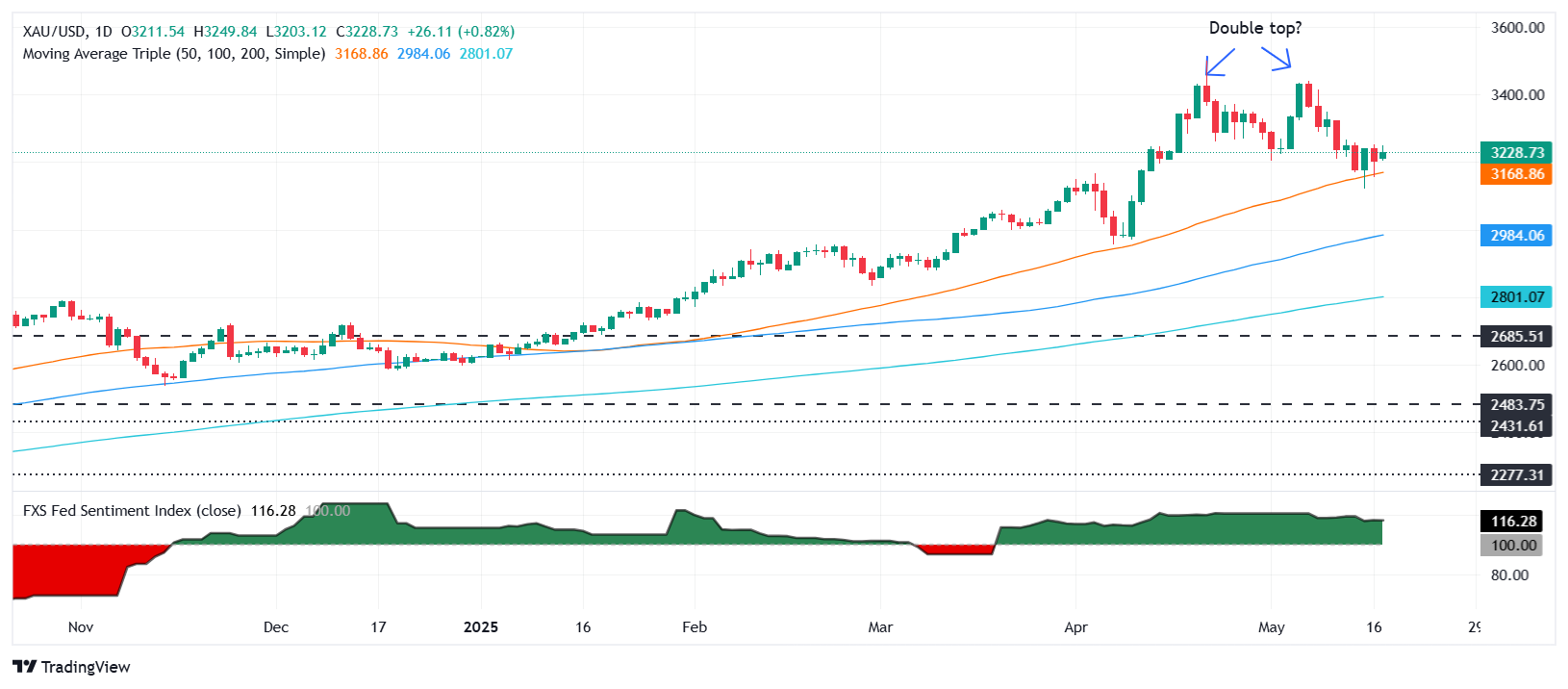
XAU/USD technical outlook: Double top at risk of being negated
Gold price is trading top/bottom of the $3,200 figure, unable to crack the $3,300 figure for the latest five trading days. On the downside, the scenario is the same, with XAU/USD remaining above $3,150 and also above the 50-day Simple Moving Average (SMA) of $3,168.
For a bullish continuation, Gold must clear the $3,300 figure, so buyers can challenge the latest swing high of $3,438, sustained on May 7. Further resistance lies around $3,500. Conversely, if XAU/USD holds below $3,250, the next support level would be $3,200, followed by the 50-day SMA. A breach of the latter will expose $3,100.
Gold FAQs
Gold has played a key role in human’s history as it has been widely used as a store of value and medium of exchange. Currently, apart from its shine and usage for jewelry, the precious metal is widely seen as a safe-haven asset, meaning that it is considered a good investment during turbulent times. Gold is also widely seen as a hedge against inflation and against depreciating currencies as it doesn’t rely on any specific issuer or government.
Central banks are the biggest Gold holders. In their aim to support their currencies in turbulent times, central banks tend to diversify their reserves and buy Gold to improve the perceived strength of the economy and the currency. High Gold reserves can be a source of trust for a country’s solvency. Central banks added 1,136 tonnes of Gold worth around $70 billion to their reserves in 2022, according to data from the World Gold Council. This is the highest yearly purchase since records began. Central banks from emerging economies such as China, India and Turkey are quickly increasing their Gold reserves.
Gold has an inverse correlation with the US Dollar and US Treasuries, which are both major reserve and safe-haven assets. When the Dollar depreciates, Gold tends to rise, enabling investors and central banks to diversify their assets in turbulent times. Gold is also inversely correlated with risk assets. A rally in the stock market tends to weaken Gold price, while sell-offs in riskier markets tend to favor the precious metal.
The price can move due to a wide range of factors. Geopolitical instability or fears of a deep recession can quickly make Gold price escalate due to its safe-haven status. As a yield-less asset, Gold tends to rise with lower interest rates, while higher cost of money usually weighs down on the yellow metal. Still, most moves depend on how the US Dollar (USD) behaves as the asset is priced in dollars (XAU/USD). A strong Dollar tends to keep the price of Gold controlled, whereas a weaker Dollar is likely to push Gold prices up.
Author

Christian Borjon Valencia
FXStreet
Markets analyst, news editor, and trading instructor with over 14 years of experience across FX, commodities, US equity indices, and global macro markets.

















