Gold price breaks below $4,000 as US Dollar hits 13-month high
- Gold hits seven-month low despite sharp Treasury yield decline.
- Strait of Hormuz reopening sinks Oil, but Fed hike bets persist.
- Core PCE, GDP and jobless claims drive the next catalyst.

Gold (XAU/USD) price collapses by over 3% on Wednesday during the North American session amid broad US Dollar strength, despite US Treasury yields tumble on speculation that the reopening of the Strait of Hormuz could ease inflationary pressures. At At the time of writing, the XAU/USD pair trades at $3,986, falling below the $4,000 mark for the first time since November 2025.
XAU/USD slides as Dollar strength overwhelms falling Treasury yields
The decline in Gold prices contrasts with the rise of the Greenback. The US Dollar Index (DXY), which tracks the buck's performance against a basket of six currencies, hit a 13-month high of 101.80. At the time of writing, the DXY is up 0.19% to 101.56, despite the fall of US Treasury yields.
The US 10-year T-note yield is down almost nine basis points to 4.410% due to falling Oil prices, sparked by the reopening of the Strait of Hormuz.
West Texas Intermediate (WTI) US Oil is down 3.40% in the day to $70.55 per barrel, as negotiations between the US and Iran progressed, according to US Vice President JD Vance and Iran’s ambassador to the UN. However, traders should be aware of conflicting remarks from both sides regarding inspections of Tehran’s nuclear installations.
The drop in Oil prices hasn’t tempered traders' pricing in a hawkish Federal Reserve (Fed), as the US central bank showed division on the board: with eight of the 19 forecasting a rate hike toward the end of 2026, while the majority are set to hold rates.
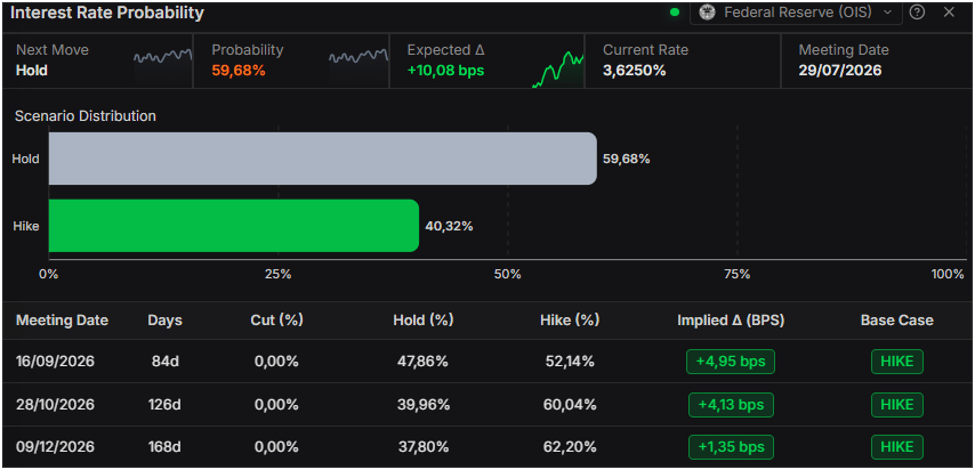
Prime Terminal data shows that the Fed is expected to keep interest rates unchanged at the next meeting, yet by a slim margin, with odds standing at 60% to hold and 40% for a rate hike.
For December, the chances for an increase are 82%, with traders pricing in 20 basis points of tightening.
Ahead, the US economic docket will be busy. Traders' focus shifts to the release of the Fed’s preferred inflation measure, the Core Personal Consumption Expenditures (PCE) Price Index, Gross Domestic Product (GDP) figures for the first quarter of 2026, Durable Goods Orders and jobless claims.
XAU/USD technical outlook:
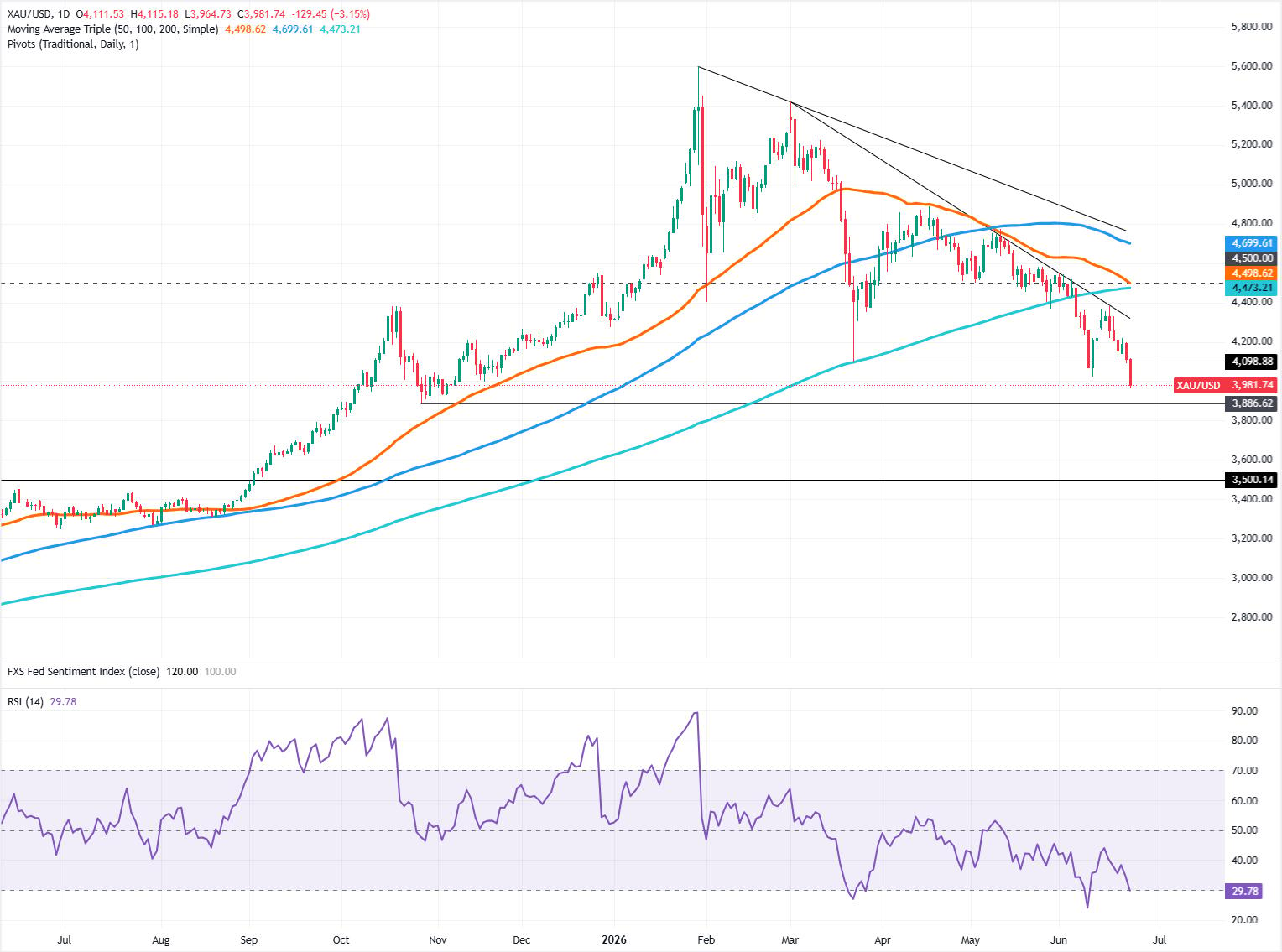
Gold’s trend shifted downward after clearing the 200-day Simple Moving Average (SMA) at $4,473, exacerbating the decline and pushing it towards breaking the $4,000 level.
Bearish momentum has increased since bullion retested $4,400. Buyers’ failure at that level sparked the sell-off.
The Relative Strength Index (RSI) just pierced oversold territory, though it remains shy of testing the most extreme 20-level. Hence, further downside in XAU is seen as sellers gain momentum.
If Gold drops below $3,950, the next support would be $3,900, ahead of the October 28, 2025 swing high of $3,886. Below this level, the next support is the April 22, 2025, daily high, which has turned into support at $3,500.
On the flip side, buyers must reclaim $4,000 before clearing $4,098, the March 23 daily low, to remain hopeful of higher prices.
Gold FAQs
Gold has played a key role in human’s history as it has been widely used as a store of value and medium of exchange. Currently, apart from its shine and usage for jewelry, the precious metal is widely seen as a safe-haven asset, meaning that it is considered a good investment during turbulent times. Gold is also widely seen as a hedge against inflation and against depreciating currencies as it doesn’t rely on any specific issuer or government.
Central banks are the biggest Gold holders. In their aim to support their currencies in turbulent times, central banks tend to diversify their reserves and buy Gold to improve the perceived strength of the economy and the currency. High Gold reserves can be a source of trust for a country’s solvency. Central banks added 1,136 tonnes of Gold worth around $70 billion to their reserves in 2022, according to data from the World Gold Council. This is the highest yearly purchase since records began. Central banks from emerging economies such as China, India and Turkey are quickly increasing their Gold reserves.
Gold has an inverse correlation with the US Dollar and US Treasuries, which are both major reserve and safe-haven assets. When the Dollar depreciates, Gold tends to rise, enabling investors and central banks to diversify their assets in turbulent times. Gold is also inversely correlated with risk assets. A rally in the stock market tends to weaken Gold price, while sell-offs in riskier markets tend to favor the precious metal.
The price can move due to a wide range of factors. Geopolitical instability or fears of a deep recession can quickly make Gold price escalate due to its safe-haven status. As a yield-less asset, Gold tends to rise with lower interest rates, while higher cost of money usually weighs down on the yellow metal. Still, most moves depend on how the US Dollar (USD) behaves as the asset is priced in dollars (XAU/USD). A strong Dollar tends to keep the price of Gold controlled, whereas a weaker Dollar is likely to push Gold prices up.
Author

Christian Borjon Valencia
FXStreet
Markets analyst, news editor, and trading instructor with over 14 years of experience across FX, commodities, US equity indices, and global macro markets.