GBP/USD surges past 1.3600 as Yen intervention batters Dollar
- Yen intervention speculation battered the Dollar for a second straight session.
- Iran’s proposal via Pakistan helped keep broader risk appetite supported.
- Fed hawks warned energy shocks could keep inflation pressures elevated.

GBP/USD clears the 1.3600 barrier, up over 0.50%, as the Greenback gets battered for the second straight day amid speculation that Japanese authorities continued an intervention in the FX space to prop up the Yen. At the time of writing, the pair trades at 1.3650, up 0.38% near a ten-week high.
Sterling climbs as Iran proposal and Fed hawks keep traders alert
Risk appetite remains positive as breaking news revealed that Iran presented a proposal to Washington via Pakistan. In the meantime, the US blockade continues to hit Iran’s economy as Iran’s Parliament Speaker Mohammad Bagher Ghalibaf moans about Washington decisions, posting on X, “Good luck blockading a country with those borders.”
Data from the US showed that manufacturing activity steadied, according to the ISM Manufacturing PMI report for April, which was unchanged at 52.7. Three of the four Federal Reserve dissenters expressed their views regarding the decision on Wednesday.
Beth Hammack of the Cleveland Fed said that inflationary pressures are broadening, due to “rising oil prices,” adding another source of pressure. She added that adding an easing bias in the statement is “no longer appropriate given the outlook,” she wrote in a statement.
Her colleague, Neel Kashkari of the Minneapolis Fed, said that a prolonged closure of the Strait of Hormuz and damage to energy facilities could spark a price shock, exerting pressure on the US central bank to tighten policy to keep inflation expectations in check.
Dallas Fed Lorie Logan stated that the Fed’s next move could be a cut or a hike.
Across the pond, Sterling remains boosted by sentiment. Also, business activity in the UK improved from 51.0 to 53.7 in April, while a measure of input prices rose to its highest level since mid-2022.
BoE expected to tighten further
The BoE’s Chief Economist Huw Pill commented that tightening in financial conditions “seems a reasonable response to inflation risk from the Iran war.” He added that the BoE’s MPC “is ready to act if necessary.”
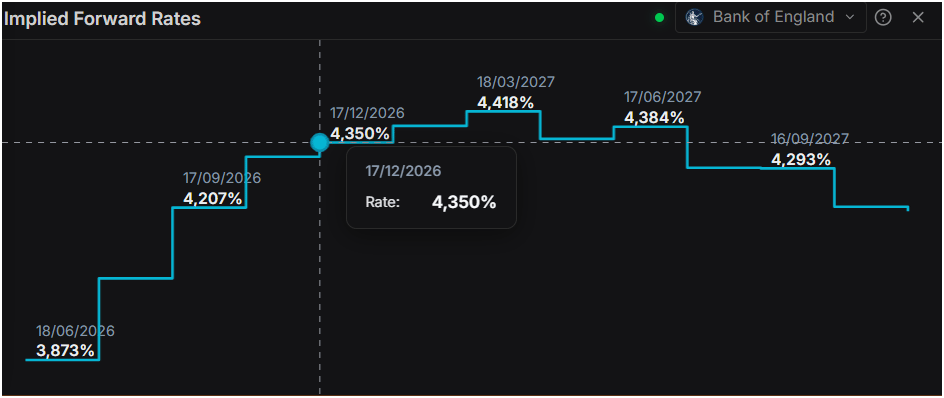
Given the fundamental backdrop, the GBP/USD is poised to extend its gains as markets continue to price in 60 basis points of rate hikes towards the end of the year. Meanwhile, the Fed is projected to hold rates unchanged throughout the full year, according to Prime Terminal data.
GBP/USD Price Forecast: Technical outlook
In the daily chart, GBP/USD trades at 1.3623, extending its rebound above the tightly packed 50-, 100- and 200-day simple moving average (SMA) cluster around 1.3413, which now underpins a constructive bias. The pair has also pushed clear of the former descending resistance trend line, last capping prices near 1.3436, while an established rising support line drawn from 1.3035 and most recently guiding higher lows around the 1.3490 area reinforces the notion of buyers being in control in the near term.
On the downside, initial support is seen at the rising trend line near 1.3490, ahead of the prior descending trend barrier turned floor around 1.3436. A deeper pullback would expose the major SMA cluster at 1.3413, where failure would be needed to undermine the bullish tone and reopen the broader range to the downside.
(The technical analysis of this story was written with the help of an AI tool.)
Pound Sterling FAQs
The Pound Sterling (GBP) is the oldest currency in the world (886 AD) and the official currency of the United Kingdom. It is the fourth most traded unit for foreign exchange (FX) in the world, accounting for 12% of all transactions, averaging $630 billion a day, according to 2022 data. Its key trading pairs are GBP/USD, also known as ‘Cable’, which accounts for 11% of FX, GBP/JPY, or the ‘Dragon’ as it is known by traders (3%), and EUR/GBP (2%). The Pound Sterling is issued by the Bank of England (BoE).
The single most important factor influencing the value of the Pound Sterling is monetary policy decided by the Bank of England. The BoE bases its decisions on whether it has achieved its primary goal of “price stability” – a steady inflation rate of around 2%. Its primary tool for achieving this is the adjustment of interest rates. When inflation is too high, the BoE will try to rein it in by raising interest rates, making it more expensive for people and businesses to access credit. This is generally positive for GBP, as higher interest rates make the UK a more attractive place for global investors to park their money. When inflation falls too low it is a sign economic growth is slowing. In this scenario, the BoE will consider lowering interest rates to cheapen credit so businesses will borrow more to invest in growth-generating projects.
Data releases gauge the health of the economy and can impact the value of the Pound Sterling. Indicators such as GDP, Manufacturing and Services PMIs, and employment can all influence the direction of the GBP. A strong economy is good for Sterling. Not only does it attract more foreign investment but it may encourage the BoE to put up interest rates, which will directly strengthen GBP. Otherwise, if economic data is weak, the Pound Sterling is likely to fall.
Another significant data release for the Pound Sterling is the Trade Balance. This indicator measures the difference between what a country earns from its exports and what it spends on imports over a given period. If a country produces highly sought-after exports, its currency will benefit purely from the extra demand created from foreign buyers seeking to purchase these goods. Therefore, a positive net Trade Balance strengthens a currency and vice versa for a negative balance.
Author

Christian Borjon Valencia
FXStreet
Markets analyst, news editor, and trading instructor with over 14 years of experience across FX, commodities, US equity indices, and global macro markets.














