GBP/USD rides high on US economic woes, breaks above 1.2700
- GBP/USD trades at 1.2710, up 0.58%, buoyed by weaker-than-expected US jobs data and a downward revision of Q2 GDP to 2.1%.
- US Dollar Index (DXY) fell 0.38% to 103.089, further boosting the Sterling, as US Treasury bond yields also slid.
- Bank of England’s expected rate hikes and a report showing restrained consumer borrowing in the UK further support the Pound.

Pound Sterling (GBP) advances for three consecutive days against the US Dollar (USD) amid a light economic calendar in the UK. A busy economic week for the United States (US), particularly leaning into jobs data, decreased the Federal Reserve’s odds of hiking rates for the remainder of the year. The GBP/USD is exchanging hands at around 1.2710 above its opening price by 0.58%.
GBP/USD gains for third straight day, on dismal US jobs data, GDP figures lowered Fed hikes expectations
Following last Tuesday’s worse-than-expected job openings report, August’s ADP National Employment report was no exception. The data showed companies hired less than estimates of 195K and added 177K jobs to the economy, indicating the labor market is losing traction. Speculation the Fed would not increase borrowing costs could be reflected in the CME FEdWatch Tool, with investors cutting their bets for a rate hike In November.
Other data showed the economy is deteriorating, with the second estimate of Q2 Gross Domestic Product (GDP) coming at 2.1%, below the previously reported 2.4%, signaling the economy is decelerating.
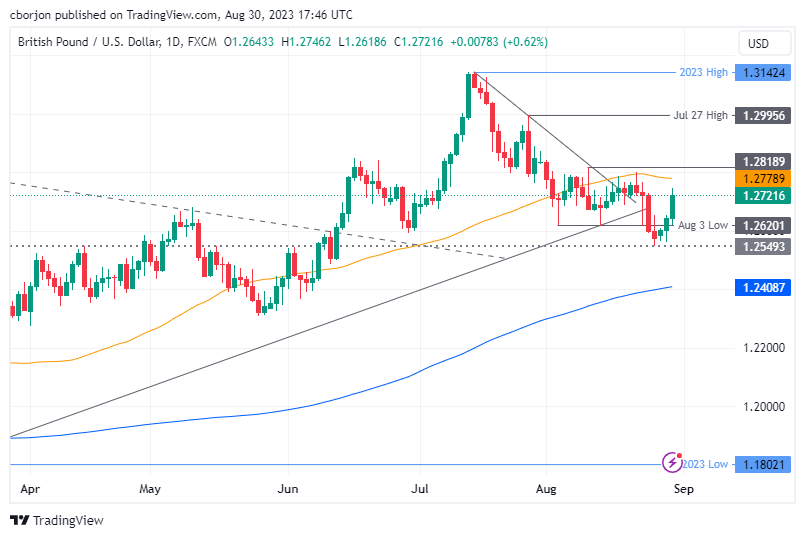
The GBP/USD reacted upwards and pierced the 1.2700 figure, which was broken to the downside on August 24, with the pair finishing the session at around 1.2591. Nevertheless, data in the last few days propelled the Sterling, while the Greenback bleeds as the US Treasury bond yield slides.
The US Dollar Index (DXY), which tracks the performance of six currencies vs. the US Dollar, prints losses of 0.38%, at 103.089.
Across the pond, additional rate hikes expected by the Bank of Englan (BoE) underpin the Cable. Market participants estimate the Bank Rate would peak at around 5.8%. In the meantime, a BoE report showed that British consumers increased their borrowing less than expected as higher rates bite its citizens.
Aside from this, upcoming data from the US, notably the Federal Reserve’s preferred gauge for inflation, the Personal Consumption Expenditures (PCE), and further labor market data would give direction to the GBP/USD pair.
GBP/USD Price Analysis: Technical outlook
Once the GBP/USD pair reclaimed 1.2700, the major is set to test the 50-day Moving Average (DMA) at 1.2779 in the short term, followed by the 1.2800 figure. If those two resistance levels are breached, the July 27 daily high, at 1.2995, could be up next. Conversely, if the pair slumps below 1.2700, further downside is expected at the current week’s low of 1.2548.
Author

Christian Borjon Valencia
FXStreet
Markets analyst, news editor, and trading instructor with over 14 years of experience across FX, commodities, US equity indices, and global macro markets.

















