GBP/USD regains footing above 1.2600, amid mixed US data, Labor Day holiday
- GBP/USD pair rebounds to 1.2630, recovering from last Friday’s low of 1.2580s, as Wall Street observes Labor Day and liquidity thins.
- Mixed US jobs data and a higher-than-expected manufacturing PMI of 47.6 dampen prospects for further Fed tightening, keeping September rate hike odds at 92%.
- High expectations for a 25 bps rate hike by the Bank of England in September contrast with deteriorating economic conditions, adding uncertainty to the currency pair’s direction.

The British Pound (GBP) rebounds at around last Friday’s low of 1.2580s against the Greenback (GBP) and recovered the 1.2600 figure on Monday amid thin liquidity conditions in observance of the US Labor Day. The GBP/USD is trading at 1.2630
British Pound recovers as investors reassess Fed tightening; eyes on upcoming BoE decision and economic indicators
Wall Street is closed today in observance of Labor Day. Last week’s US job data presented a mixed picture, with Nonfarm Payrolls reaching 187,000, surpassing the projected 177,000 in August. However, this didn’t bolster the US Dollar, as the Unemployment Rate also ticked higher as anticipated. Subsequently, the Institute for Supply Management (ISM) reported that US business activity, as indicated by the manufacturing PMI, scored 47.6, exceeding analysts’ estimates of 47.0 and the previous reading of 46.4.
As a result, investors significantly reduced their expectations for the US Federal Reserve’s further tightening of monetary policy. The likelihood of interest rate increases staying unchanged for the September meeting remains at 92%. Additionally, the first-rate reduction is projected for May 1, with traders anticipating rate cut odds around 5.14%, 19 basis points lower than the current effective Federal Funds Rate (FFR) of 5.33%.
In addition, news from China improved investors’ sentiment as the country established measures to boost its property market, which is at the brisk of a crisis. As the Government easied measures, home sales rose, as reported by Bloomberg.
Across the Atlantic, expectations of the Bank of England (BoE) to raise rates by 25 bps remained high at 90% for the September 21 meeting. Nevertheless, traders remain cautious about the approach the BoE could make regarding future tightening as economic conditions continue to deteriorate, suggesting that growth could decelerate.
GBP/USD traders would take direction from economic activity in the agenda. The UK would reveal their BRC Retail Sales, S&P Global/CIPS Services, and Composite PMIs. On the US front, the calendar would feature the ISM Non-Manufacturing PMI, Initial Jobless Claims, and Fed speakers.
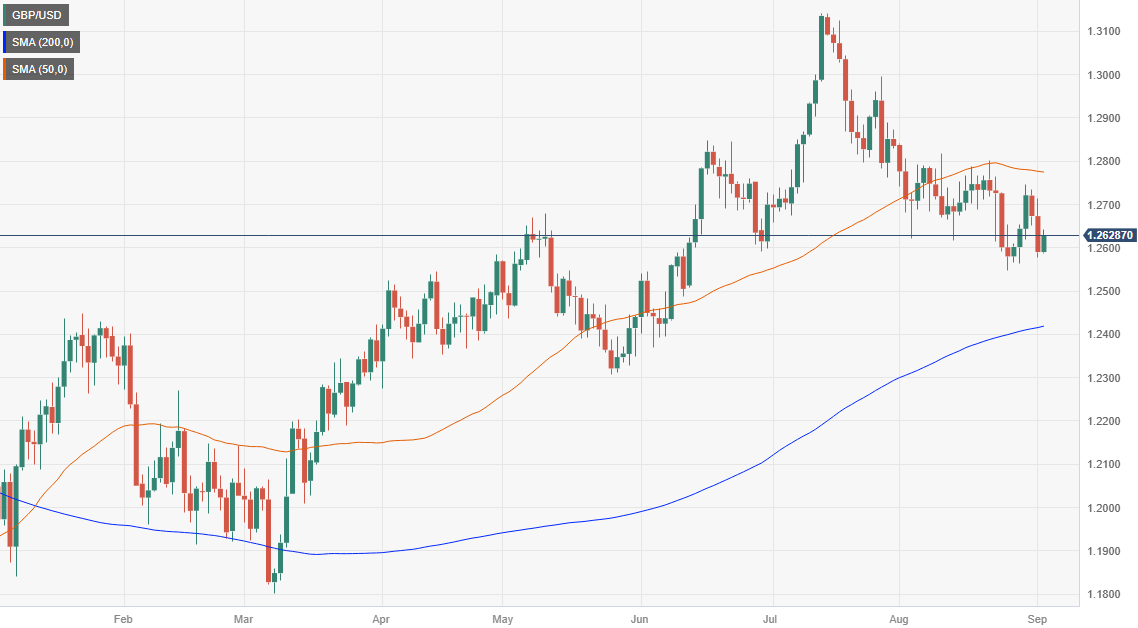
GBP/USD Price Analysis: Technical outlook
From a daily chart perspective, the GBP/USD is neutral to downward biased, even though it remains above its 200-day Moving Average (DMA), at 1.2417. Nevertheless, the pair has achieved successive series of lower highs and lows, as shown by market structure, with the major seeing testing the 1.2500 figure if growth economic conditions in the UK faltered. The next support emerges at the 200-DMA at 1.2417 before testing May’s low of 1.2308. Conversely, the major would test 1.2700 if the exchange rate stays above the 1.26 handle.
Author

Christian Borjon Valencia
FXStreet
Markets analyst, news editor, and trading instructor with over 14 years of experience across FX, commodities, US equity indices, and global macro markets.

















