GBP/USD rebounds as traders twist strong NFP into fresh Fed-cut hopes
- US economy adds 119K jobs in September, pushing Fed cut odds to 43% despite unemployment ticking up to 4.4%.
- Hawkish Fed officials warn against easing prematurely, while UK inflation and confidence slump bolster BoE cut bets.
- Diverging December policy paths—Fed on hold, BoE cutting—suggest GBP/USD may resume its broader downtrend.

The Pound Sterling (GBP) advances during the North American session on Thursday following the release of a stellar Nonfarm Payrolls (NFP) report for September, which revealed the economy added more people to the workforce than expected. At the time of writing, GBP/USD trades at 1.3117 after reaching a daily low of 1.3038.
Sterling trims losses as robust NFP and firmer labor signals lift December Fed cut expectations, while softer UK data weighs
The US Bureau of Labor Statistics (BLS) revealed that 119K jobs were created in September. At the same time, the Unemployment Rate edged up from 4.3% to 4.4%, though it remained below the Federal Reserve’s projection of 4.5% for 2025. The Department of Labor also revealed Jobless Claims for the week ending November 15 came at 220K, its lowest level since September, an indication that the labor market, despite softening, remains stable.
After the data, the CME FedWatch Tool showed that investors priced a 43% chance of a 25-basis-point rate cut, up from 29% before the NFP release.
Cleveland Federal Reserve (Fed) Beth Hammack said that easing monetary policy now could encourage financial risk-taking. “Cutting rates risks prolonging high inflation,” she said, and added that “financial conditions are quite accommodative right now.”
Recently, Fed Governor Michael Barr said that he is concerned about inflation still at 3%, leaning hawkish.
In the UK, headline and core inflation edged lower and could push Bank of England (BoE) Governor Andrew Bailey to opt for a rate cut at the December meeting. Data-wise, UK Consumer Confidence tumbled ahead of Chancellor Rachel Reeves’ budget.
The British Retail Consortium said that as the government hints at higher income tax in this month’s budget, people are worried about the economy and their personal finances, according to Bloomberg.
Therefore, further GBP/USD downside is expected, as central banks are expected to diverge in December. If the Fed holds and the BoE cuts, the exchange rate could resume its downtrend.
GBP/USD Price Forecast: Technical outlook
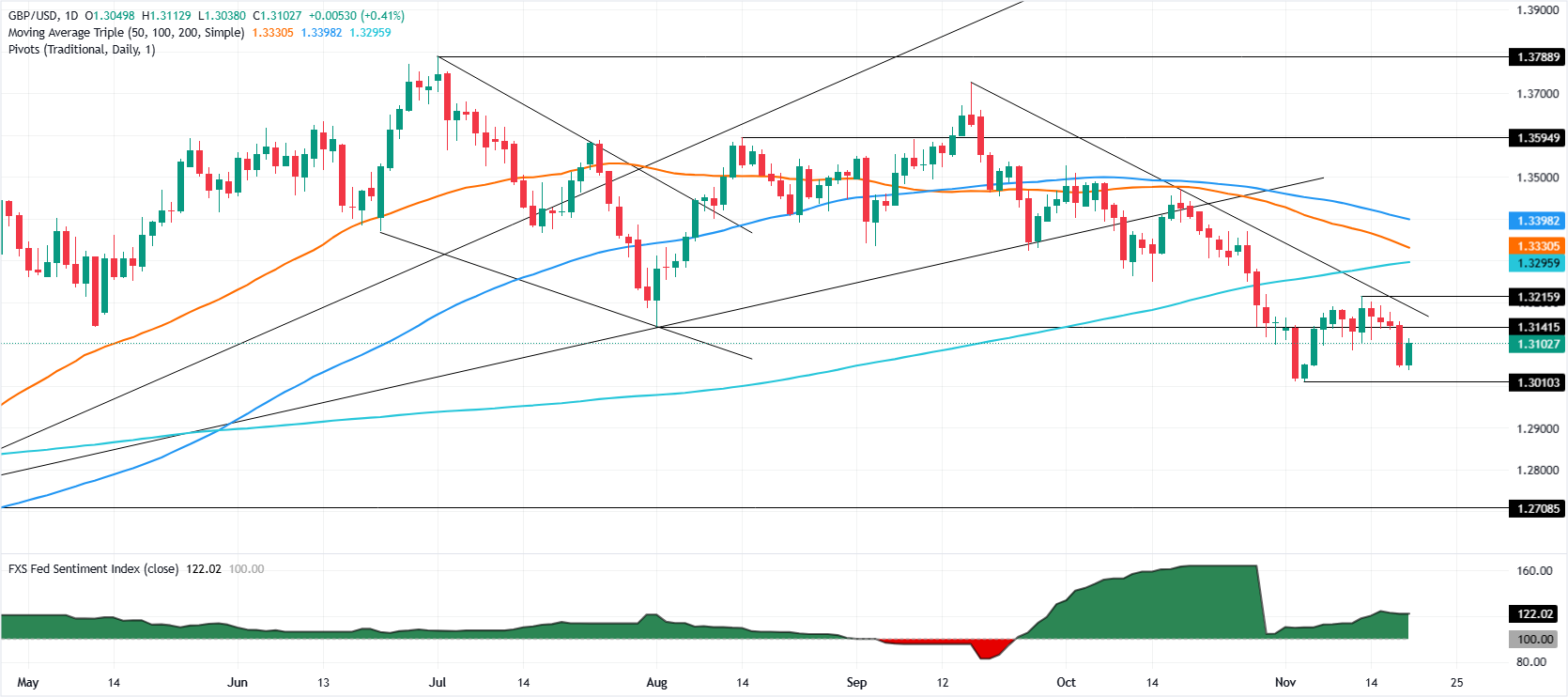
The GBP/USD pair trims some of Wednesday’s losses, yet the trend remains downward-biased. Although the FXS Fed Sentiment Index remains above 100, indicating that the BoE remains slightly hawkish and suggesting further Sterling strength, it has edged lower. Therefore, the ongoing leg-up could be short-lived, unless buyers clear key resistance at 1.3215, the November 13 high.
On the flip side, if GBP/USD drops below 1.3100, sellers could challenge the November 5 swing low of 1.3010.
Economic Indicator
Nonfarm Payrolls
The Nonfarm Payrolls release presents the number of new jobs created in the US during the previous month in all non-agricultural businesses; it is released by the US Bureau of Labor Statistics (BLS). The monthly changes in payrolls can be extremely volatile. The number is also subject to strong reviews, which can also trigger volatility in the Forex board. Generally speaking, a high reading is seen as bullish for the US Dollar (USD), while a low reading is seen as bearish, although previous months' reviews and the Unemployment Rate are as relevant as the headline figure. The market's reaction, therefore, depends on how the market assesses all the data contained in the BLS report as a whole.
Read more.Last release: Thu Nov 20, 2025 13:30
Frequency: Monthly
Actual: 119K
Consensus: 50K
Previous: 22K
Source: US Bureau of Labor Statistics
America’s monthly jobs report is considered the most important economic indicator for forex traders. Released on the first Friday following the reported month, the change in the number of positions is closely correlated with the overall performance of the economy and is monitored by policymakers. Full employment is one of the Federal Reserve’s mandates and it considers developments in the labor market when setting its policies, thus impacting currencies. Despite several leading indicators shaping estimates, Nonfarm Payrolls tend to surprise markets and trigger substantial volatility. Actual figures beating the consensus tend to be USD bullish.
Author

Christian Borjon Valencia
FXStreet
Markets analyst, news editor, and trading instructor with over 14 years of experience across FX, commodities, US equity indices, and global macro markets.
















