GBP/USD Price Forecast: Holds onto gains near 1.3500 amid risk-on mood
- GBP/USD remains firm near 1.3500 as the appeal of risk-sensitive assets remain upbeat.
- US President Trump said that agreement with Iran has “largely negotiates”.
- Iran said that it is not close to reaching a deal with the US.

The British Pound (GBP) clings to opening gains around 1.3500 against the US Dollar (USD) during the late European trading session on Monday. The GBP/USD pair trades higher as the market sentiment remains risk-on due to expectations that the United States (US) and Iran will reach a deal soon.
At the press time, S&P 500 futures are up almost 1% around 7,550, reflecting strong demand for riskier assets. The US Dollar Index (DXY), which tracks the Greenback’s value against six major currencies, trades 0.33% lower to near 99.00.
The market sentiment remains favorable for riskier assets as US President Donald Trump stated over the weekend that the agreement with Iran is “largely negotiated”. However, comments from Iran appear to be in contrast with Trump’s statement.
“We've reached conclusions on many topics discussed, but that does not mean we're close to signing an agreement,” a spokesperson from Iranian Foreign Ministry said during the European trade.
GBP/USD technical analysis
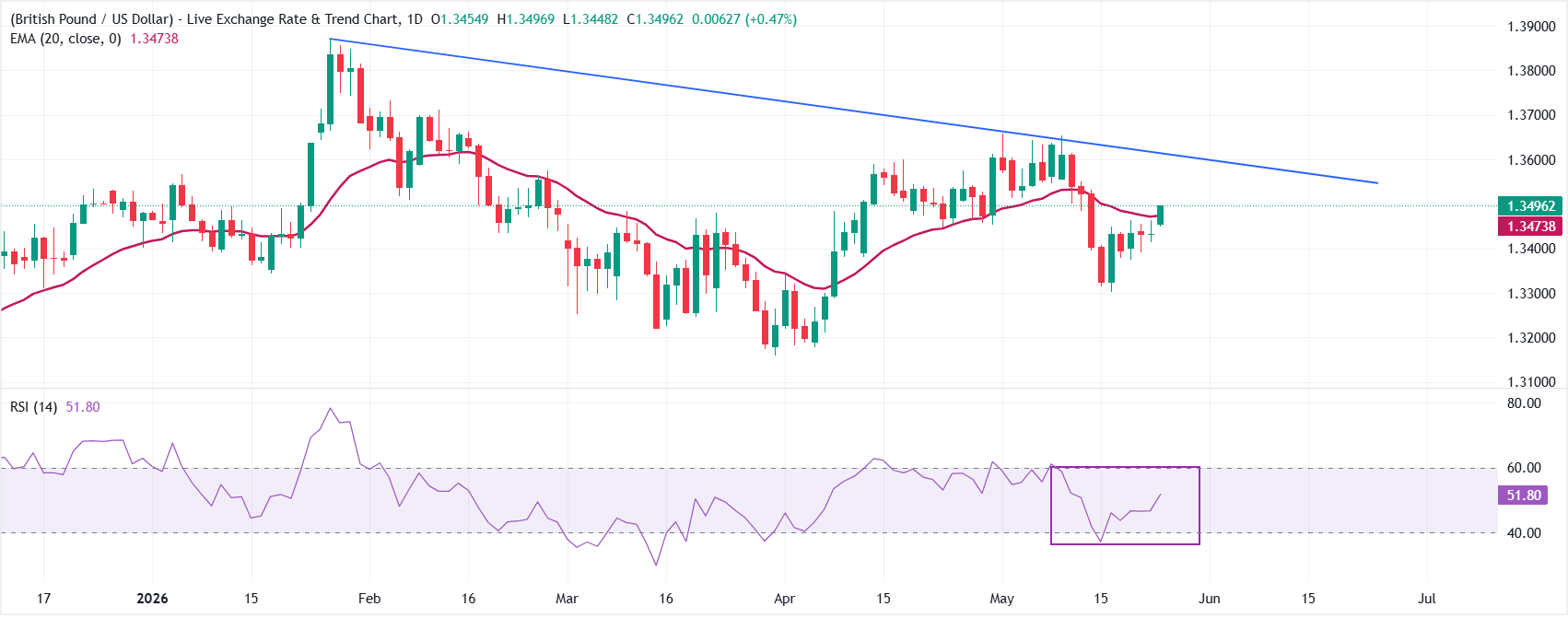
GBP/USD trades firmly at around 1.3500 as of writing. The near-term tone of the pair turns modestly bullish bias as it has returned above the 20-day Exponential Moving Average (EMA), which is at 1.3474. The reclaimed short-term EMA suggests underlying demand is attempting to stabilize the recent advance, while the Relative Strength Index (RSI) around 52 aligns with a neutral-to-firm tone rather than overextended conditions.
On the topside, immediate resistance is located at the former downward resistance trend-line break level around 1.3612, and a sustained push through this barrier would open the way for further recovery towards 1.3700. Looking down, the pair could slide to 1.3400 if it fails to hold the 20-day EMA. The pair could witness more downside towards the May 18 low of 1.3302 once it breaks below 1.3400.
(The technical analysis of this story was written with the help of an AI tool.)
Risk sentiment FAQs
In the world of financial jargon the two widely used terms “risk-on” and “risk off'' refer to the level of risk that investors are willing to stomach during the period referenced. In a “risk-on” market, investors are optimistic about the future and more willing to buy risky assets. In a “risk-off” market investors start to ‘play it safe’ because they are worried about the future, and therefore buy less risky assets that are more certain of bringing a return, even if it is relatively modest.
Typically, during periods of “risk-on”, stock markets will rise, most commodities – except Gold – will also gain in value, since they benefit from a positive growth outlook. The currencies of nations that are heavy commodity exporters strengthen because of increased demand, and Cryptocurrencies rise. In a “risk-off” market, Bonds go up – especially major government Bonds – Gold shines, and safe-haven currencies such as the Japanese Yen, Swiss Franc and US Dollar all benefit.
The Australian Dollar (AUD), the Canadian Dollar (CAD), the New Zealand Dollar (NZD) and minor FX like the Ruble (RUB) and the South African Rand (ZAR), all tend to rise in markets that are “risk-on”. This is because the economies of these currencies are heavily reliant on commodity exports for growth, and commodities tend to rise in price during risk-on periods. This is because investors foresee greater demand for raw materials in the future due to heightened economic activity.
The major currencies that tend to rise during periods of “risk-off” are the US Dollar (USD), the Japanese Yen (JPY) and the Swiss Franc (CHF). The US Dollar, because it is the world’s reserve currency, and because in times of crisis investors buy US government debt, which is seen as safe because the largest economy in the world is unlikely to default. The Yen, from increased demand for Japanese government bonds, because a high proportion are held by domestic investors who are unlikely to dump them – even in a crisis. The Swiss Franc, because strict Swiss banking laws offer investors enhanced capital protection.
Author

Sagar Dua
FXStreet
Sagar Dua is associated with the financial markets from his college days. Along with pursuing post-graduation in Commerce in 2014, he started his markets training with chart analysis.
















