GBP/JPY Price Forecasts: Pound retreats to 213.20, lacking a clear bias
- GBP/JPY pulls back to 213.20 lows but remains trading within Monday's range.
- Weak UK business activity figures have put moderate pressure on the British Pound on Tuesday.
- The Yen is trimming some losses, as a Katayama-Bessent meeting has boosted speculation about a joint intervention.

The British Pound (GBP) pares Monday’s gains against the Japanese Yen (JPY) on Tuesday, weighed down by higher intervention risks and downbeat UK business activity figures. The GBP/JPY pair pulled back to session lows of 213.20 during the European Trading session, from Monday's 214.70 highs, but remains wavering without a clear bias within the last four weeks’ range.
The Pound came under moderate bearish pressure on Tuesday after softer-than-expected preliminary S&P Global Purchasing Managers' Index (PMI) data. The UK manufacturing PMI slowed down to 53.1 from 53.9 in May, below the 53.6 market consensus, while services activity accelerated its contraction to 48.7 in June from 49.3 in May, missing expectations of an improvement to 50.
Beyond that, an online meeting between Japanese Finance Minister Satsuki Katayama and the US Treasury Secretary Scot Bessent has boosted speculation about a potential coordinated action as the USD/JPY pair hit levels a few pips shy of the 40-year low, at 162.95.
Technical Analysis: Choppy, sideways price action
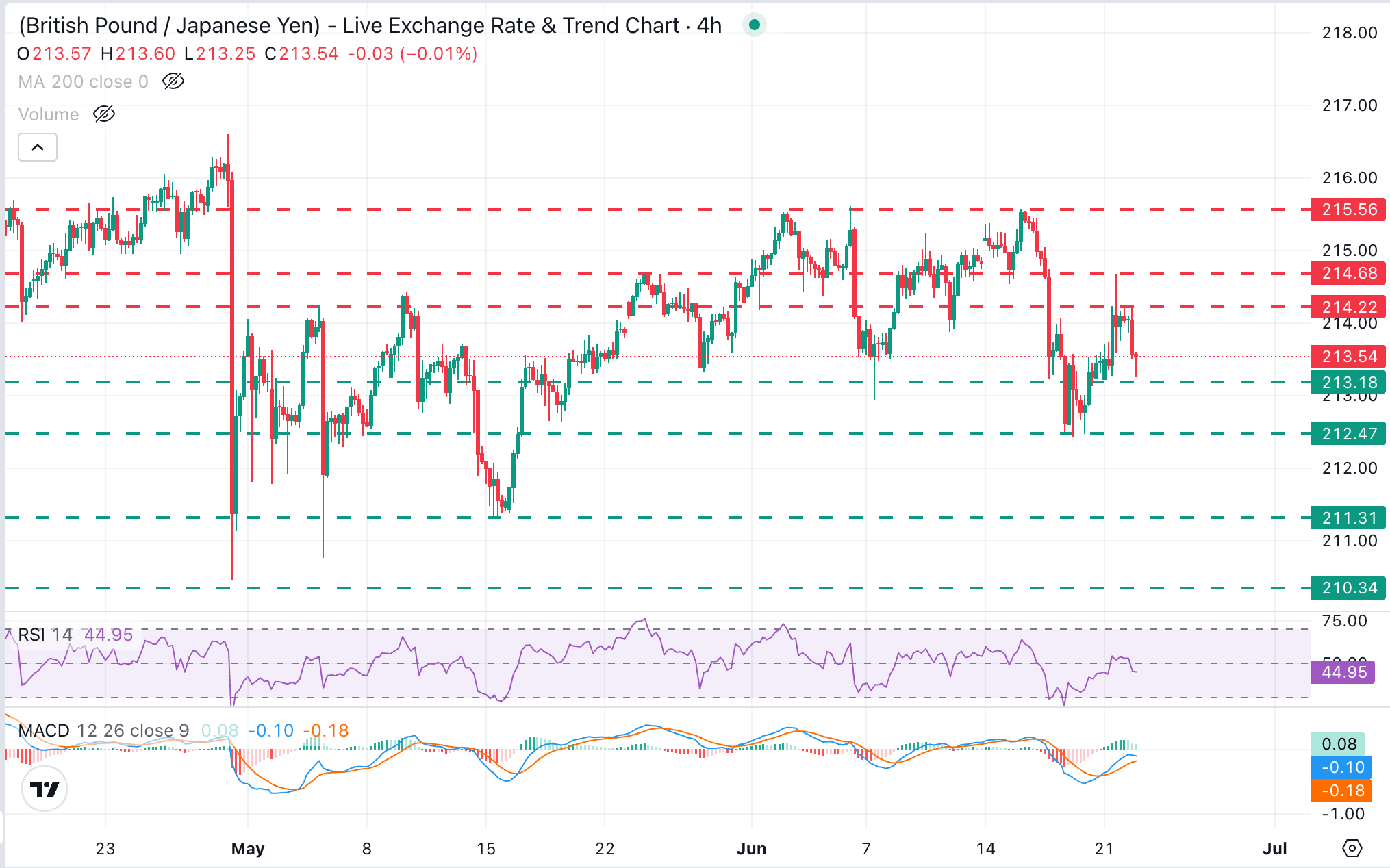
GBP/JPY trades at 213.54, holding a neutral to slightly bearish near-term stance. Momentum is mixed: the Relative Strength Index (14) has slipped back toward the mid-40s, hinting at waning bullish pressure, while the Moving Average Convergence Divergence (MACD) has turned modestly positive, hinting at a mild recovery attempt rather than a decisive trend resumption.
Bears remain contained above Monday's low, in the 213.30 area so far, which is closing the path towards the bottom of the monthly trading range, near 212.40. Bulls, on the contrary, would need a clear close above session highs, at the 214.20 area, and ideally above Monday's high, at 214.75, to ease the current cap and open the way towards June's top, in the 215.50-215.60 area.
(The technical analysis of this story was written with the help of an AI tool.)
(This story was corrected on June 23 at 10:18 GMT to say that the USD/JPY was near a 40-year high, instead of low, as previously reported.)
Pound Sterling Price Today
The table below shows the percentage change of British Pound (GBP) against listed major currencies today. British Pound was the strongest against the Australian Dollar.
| USD | EUR | GBP | JPY | CAD | AUD | NZD | CHF | |
|---|---|---|---|---|---|---|---|---|
| USD | 0.14% | 0.21% | -0.11% | 0.17% | 0.65% | 0.35% | 0.17% | |
| EUR | -0.14% | 0.05% | -0.29% | -0.00% | 0.48% | 0.18% | 0.01% | |
| GBP | -0.21% | -0.05% | -0.30% | -0.03% | 0.45% | 0.14% | -0.03% | |
| JPY | 0.11% | 0.29% | 0.30% | 0.27% | 0.76% | 0.45% | 0.27% | |
| CAD | -0.17% | 0.00% | 0.03% | -0.27% | 0.50% | 0.19% | 0.00% | |
| AUD | -0.65% | -0.48% | -0.45% | -0.76% | -0.50% | -0.28% | -0.48% | |
| NZD | -0.35% | -0.18% | -0.14% | -0.45% | -0.19% | 0.28% | -0.20% | |
| CHF | -0.17% | -0.01% | 0.03% | -0.27% | -0.01% | 0.48% | 0.20% |
The heat map shows percentage changes of major currencies against each other. The base currency is picked from the left column, while the quote currency is picked from the top row. For example, if you pick the British Pound from the left column and move along the horizontal line to the US Dollar, the percentage change displayed in the box will represent GBP (base)/USD (quote).
Author

Guillermo Alcala
FXStreet
Graduated in Communication Sciences at the Universidad del Pais Vasco and Universiteit van Amsterdam, Guillermo has been working as financial news editor and copywriter in diverse Forex-related firms, like FXStreet and Kantox.