Euro rebounds as Iran-US talks weigh on the US Dollar
- Hopes for a US-Iran deal weigh on Oil and US Dollar demand.
- Fed minutes show officials preparing for possible rate hikes.
- ECB June hike bets rise as inflation tops target.

The Euro (EUR) seems to have bottomed below 1.1600 and edges higher on Wednesday amid growing speculation of a US-Iran deal and a hawkish Federal Reserve (Fed) outlook at April’s monetary policy meeting. At the time of writing, EUR/USD exchange rate is trading at 1.1622, up 0.19%.
EUR/USD rises as softer oil offsets hawkish Fed minutes
Sentiment improved on news that the US is about to get a deal with Iran. US President Donald Trump said that negotiations were in the final stages, but warned Iran that failing to reach a deal would open the door for attacks on the Islamic Republic.
Oil prices sank on the news, extending their losses by more than 5%, with the US crude Oil benchmark, WTI, trading around $98.45 per barrel. The positive correlation between WTI and the US Dollar pushed the Greenback lower, as shown by the US Dollar Index (DXY).
The DXY, which measures the buck’s value against six currencies, is down 0.19% at 99.11.
Recently, the Financial Times reported that “two China-bound supertankers crossed the Strait of Hormuz.” This adds to speculation that an opening of the Strait of Hormuz could alleviate inflationary pressures, driving energy prices lower and reducing the risk of a global stagflationary scenario.
In the US, the Fed's last meeting minutes showed that the majority of the FOMC leaned hawkish, supporting some policy tightening if inflation remains persistently above the 2% goal.
April’s meeting was the second in which more officials said that increasing the borrowing costs could be appropriate if prices remain high. The minutes showed that “participants generally observed Middle East conflict could have significant implications for balance of risks and appropriate policy path.”
Traders had priced in nearly 50% odds for a rate hike at the Fed’s December meeting.
ECB expected to hike at June meeting
Across the pond, the latest inflation reading in the Eurozone (EZ) surpassing the 3% threshold is further confirmation by several European Central Bank (ECB) policymakers that they need to act in the June meeting.
At the April meeting, the ECB debated raising rates, signaling that the June 11 meeting could be the first to increase the ECB’s Deposit Rate.
Prime Terminal data showed a nearly 82% chance the ECB would increase rates by 25 basis points.
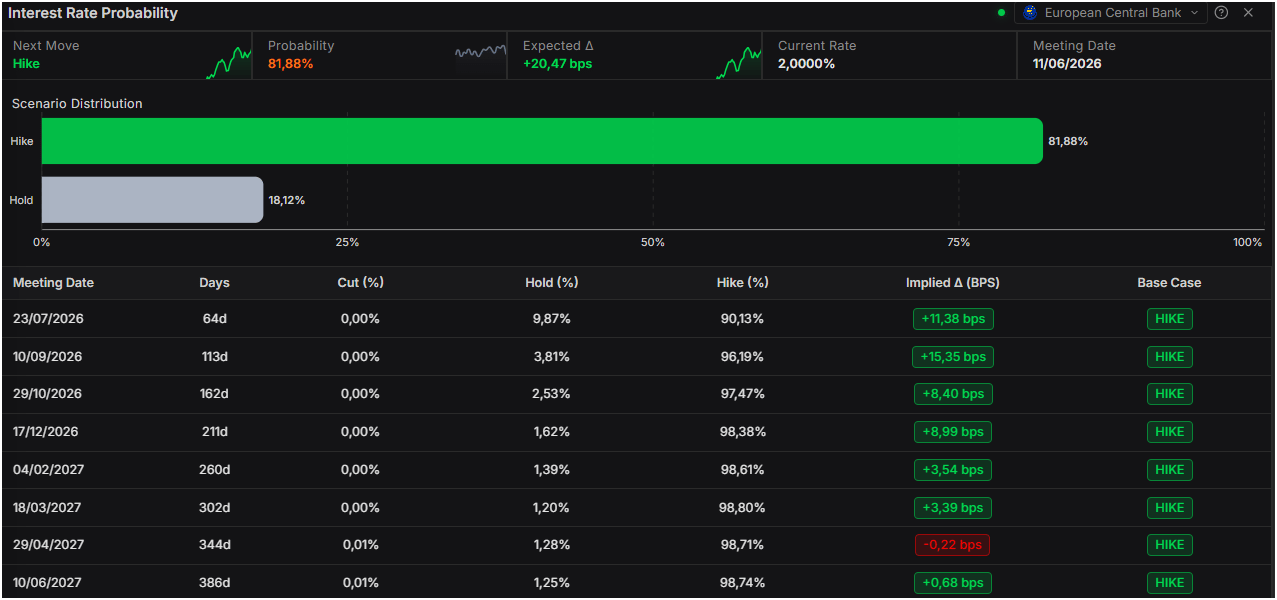
On Tuesday, ECB’s Kocher said a June rate hike remains possible if there is “no improvement in the Iran war.” Joachim Nagel of the Bundesbank echoed that view, saying the ECB is moving away from its baseline scenario and that “we may need to act in June.”
Francois Villeroy of the Banque de France said that the central bank “will be ready to act as needed” and that the Iran conflict created risks to growth and inflation.
EUR/USD Price Forecast: Technical outlook
In the daily chart, EUR/USD trades at 1.1623. The pair holds a mildly bearish near-term bias as it lingers under the latest triple simple moving average around 1.1649, keeping price capped beneath a key dynamic barrier. The broader structure still respects the downward resistance trend line projected from 1.1929, while the Relative Strength Index (14) near 42 suggests fading upside momentum rather than outright oversold conditions.
On the topside, initial resistance is seen at the triple simple moving average near 1.1649, with the descending trend line from 1.1929 reinforcing a higher cap if buyers attempt a recovery. On the downside, support emerges first around the former upward trend-line break region near 1.1578, ahead of the more structural uptrend origin around 1.1411, where buyers would be expected to show stronger interest if the correction deepens.
(The technical analysis of this story was written with the help of an AI tool.)
Euro Price This week
The table below shows the percentage change of Euro (EUR) against listed major currencies this week. Euro was the strongest against the Japanese Yen.
| USD | EUR | GBP | JPY | CAD | AUD | NZD | CHF | |
|---|---|---|---|---|---|---|---|---|
| USD | -0.03% | -0.84% | 0.08% | -0.07% | 0.01% | -0.31% | 0.05% | |
| EUR | 0.03% | -0.82% | 0.17% | -0.05% | 0.03% | -0.21% | 0.05% | |
| GBP | 0.84% | 0.82% | 0.94% | 0.77% | 0.86% | 0.62% | 0.86% | |
| JPY | -0.08% | -0.17% | -0.94% | -0.22% | -0.14% | -0.41% | -0.10% | |
| CAD | 0.07% | 0.05% | -0.77% | 0.22% | 0.01% | -0.20% | 0.08% | |
| AUD | -0.01% | -0.03% | -0.86% | 0.14% | -0.01% | -0.24% | 0.11% | |
| NZD | 0.31% | 0.21% | -0.62% | 0.41% | 0.20% | 0.24% | 0.24% | |
| CHF | -0.05% | -0.05% | -0.86% | 0.10% | -0.08% | -0.11% | -0.24% |
The heat map shows percentage changes of major currencies against each other. The base currency is picked from the left column, while the quote currency is picked from the top row. For example, if you pick the Euro from the left column and move along the horizontal line to the US Dollar, the percentage change displayed in the box will represent EUR (base)/USD (quote).
Author

Christian Borjon Valencia
FXStreet
Markets analyst, news editor, and trading instructor with over 14 years of experience across FX, commodities, US equity indices, and global macro markets.
















