Euro stands near weekly highs, US Dollar weakens with US jobs data on tap
- EUR/USD holds gains above 1.1750, but remains trapped within recent ranges.
- News that the US and Iran exchanged fire in the Strait of Hormuz is keeping risk appetite subdued.
- Markets are bracing for a significant slowdown in job creation in the US in April.

The Euro (EUR) posts moderate gains against the US Dollar (USD) on Friday, trading near session highs at the 1.1770 level at the time of writing, although it remains capped below the top of the last three weeks' trading range, in the 1.1800 area. The Euro has shrugged off weak German industrial and trade data and is drawing support from a weaker US Dollar, ahead of the US Nonfarm Payrolls release.
The US economy is forecasted to have created 62K new jobs in April, well below the 178K jobs reported in March, although the Unemployment Rate is seen remaining steady at 4.3%. The risk is on a weaker-than-expected report, which would undermine last week's hawkish tweak at the Federal Reserve’s monetary policy meeting, when some committee members called to remove the “easing bias” line from the statement.
On the geopolitical front, reports of fire exchange between the US and Iran in the Strait of Hormuz clouded hopes of an upcoming peace deal. US President Donald Trump, however, affirmed that the ceasefire remains standing and urged Tehran to sign a deal. Iranian authorities, meanwhile, are studying a 14-point US proposal to end the conflict.
Data from Germany released on Friday was not particularly supportive. Industrial Production contracted for the second consecutive month in March against market expectations of a rebound, and the Trade Balance shrank beyond forecast, also in March, as an unexpected increase in exports was offset by a sharp rise in imports.
Technical Analysis: The key resistance level remains at 1.1800
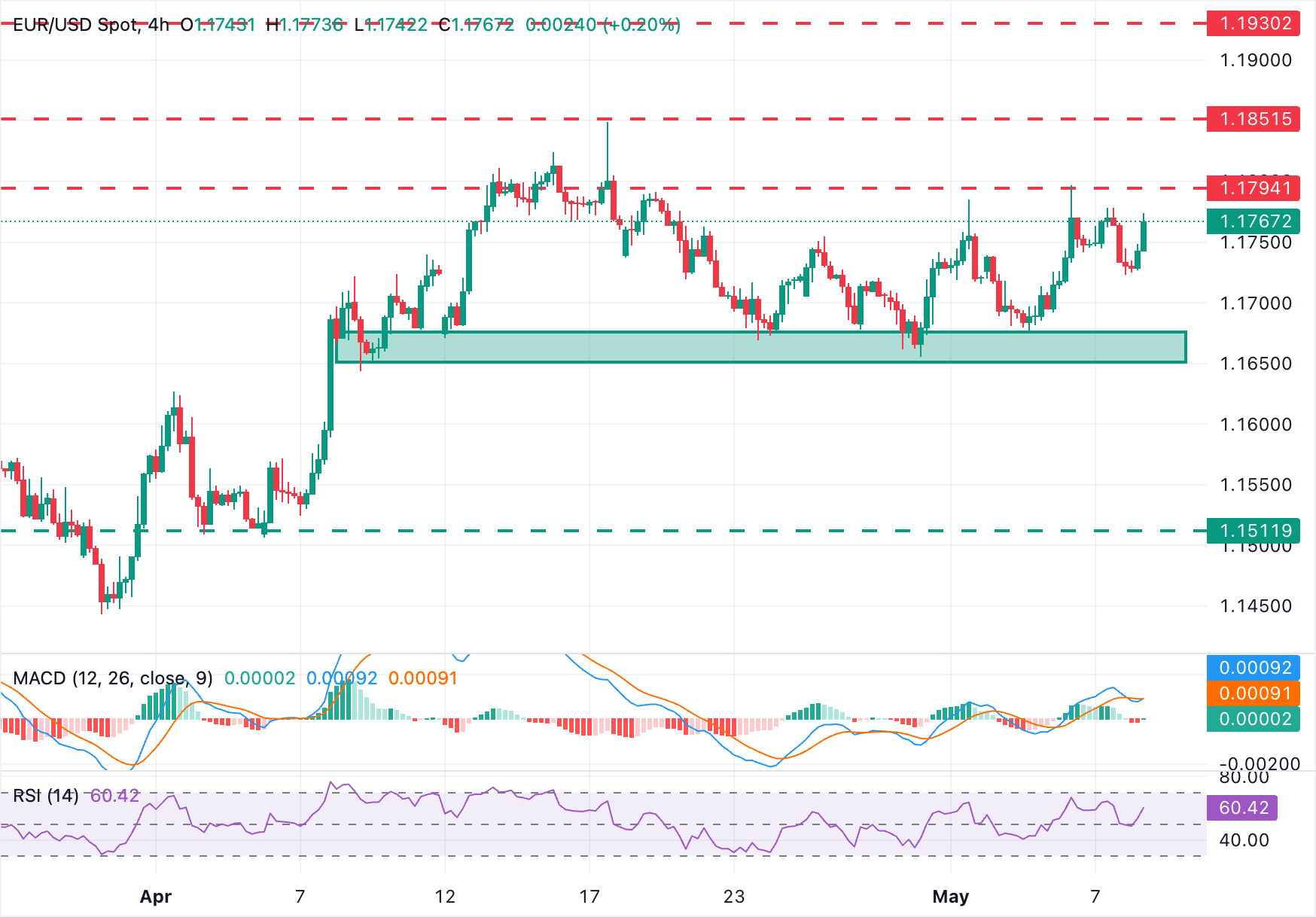
EUR/USD has rallied about 0.35% on the day so far, with momentum indicators showing a neutral-to-bullish bias. The 4-hour Relative Strength Index (RSI) is nearing the 60 level, hinting at a moderate upside momentum, although the Moving Average Convergence Divergence (MACD) line keeps wavering around the signal line.
Bulls, however, need a fresh catalyst to break the resistance area between 1.1790 and 1.1800 (April 20, May 6 highs) and set the focus on April's high, in the 1.1850 area. Further appreciation seems off the point at the moment.
On the downside, session lows, just above 1.1720, are likely to provide support for a potential bearish reversal, although the key area for bears lies between 1.1645 and 1.1675, which halted sellers several times in April.
(The technical analysis of this story was written with the help of an AI tool.)
Economic Indicator
Nonfarm Payrolls
The Nonfarm Payrolls release presents the number of new jobs created in the US during the previous month in all non-agricultural businesses; it is released by the US Bureau of Labor Statistics (BLS). The monthly changes in payrolls can be extremely volatile. The number is also subject to strong reviews, which can also trigger volatility in the Forex board. Generally speaking, a high reading is seen as bullish for the US Dollar (USD), while a low reading is seen as bearish, although previous months' reviews and the Unemployment Rate are as relevant as the headline figure. The market's reaction, therefore, depends on how the market assesses all the data contained in the BLS report as a whole.
Read more.Next release: Fri May 08, 2026 12:30
Frequency: Monthly
Consensus: 62K
Previous: 178K
Source: US Bureau of Labor Statistics
America’s monthly jobs report is considered the most important economic indicator for forex traders. Released on the first Friday following the reported month, the change in the number of positions is closely correlated with the overall performance of the economy and is monitored by policymakers. Full employment is one of the Federal Reserve’s mandates and it considers developments in the labor market when setting its policies, thus impacting currencies. Despite several leading indicators shaping estimates, Nonfarm Payrolls tend to surprise markets and trigger substantial volatility. Actual figures beating the consensus tend to be USD bullish.
Economic Indicator
Unemployment Rate
The Unemployment Rate, released by the US Bureau of Labor Statistics (BLS), is the percentage of the total civilian labor force that is not in paid employment but is actively seeking employment. The rate is usually higher in recessionary economies compared to economies that are growing. Generally, a decrease in the Unemployment Rate is seen as bullish for the US Dollar (USD), while an increase is seen as bearish. That said, the number by itself usually can't determine the direction of the next market move, as this will also depend on the headline Nonfarm Payroll reading, and the other data in the BLS report.
Read more.Author

Guillermo Alcala
FXStreet
Graduated in Communication Sciences at the Universidad del Pais Vasco and Universiteit van Amsterdam, Guillermo has been working as financial news editor and copywriter in diverse Forex-related firms, like FXStreet and Kantox.