Euro hits low of the day and bounces but 1.1000 remains out of reach
- Euro comes under pressure versus the US Dollar on Wednesday despite an upwards revision to Euro area inflation data.
- USD is supported by strong US banking results, persistent inflation and hawkish Fed commentary.
- Upside for Euro dependent on April inflation data and ECB Bank Lending Survey.

The Euro (EUR) trades in the mid 1.09s against the US Dollar (USD) during the late European session on Wednesday. EUR/USD has pulled back over recent days after briefly making year-to-date highs of 1.1075 on April 14. The correction comes on the back of a strengthening US Dollar as bets crystalize that the Federal Reserve (Fed) will continue raising interest rates.
From a technical perspective the pair is broadly in a medium-term uptrend which is biased to extend.
EUR/USD market movers
- EUR quickly pares back small gains made after Core Harmonized Index of Consumer Prices (HICP) is revised up to 1.3% from 1.2% in the final estimate for March.
- USD gains a boost from St. Louis Fed President James Bullard’s comments that the Fed should continue raising rates due to persistent inflation and overblown recession fears.
- Unexpectedly strong first quarter earnings from the likes of JP Morgan and Bank of America indicate resilience in the crisis-hit US banking sector, further supporting the Greenback.
- Data showing a sharp rise in inflation expectations in Friday’s Michigan Consumer Confidence Survey resuscitate the inflation narrative.
- Recent US employment data continues to show a strong labor market further putting pay to recession fears.
- Euro remains supported by expectations that the ECB will continue with interest rate hikes, though their size will be data-dependent.
- European Central Bank’s chief economist Philip Lane says interest rates are likely to rise in the near term at a speech in Ireland on Wednesday.
- Previously Lane said the health of the region’s banks, as reported in the ECB Bank Lending Survey (BLS), will be a key determinant of whether the ECB hikes aggressively or not, as well as April HICP inflation.
- From the US, the main data release is the Fed’s Beige Book out at 18:00 GMT.
EUR/USD technical analysis: Uptrend intact and likely to extend
EUR/USD is in a medium-term uptrend since recovering from the September 2022 lows and the established trend is expected to continue. After a pullback in February 2023, EUR/USD recouped its losses during March and made new year-to-date highs above 1.10 on April 13.
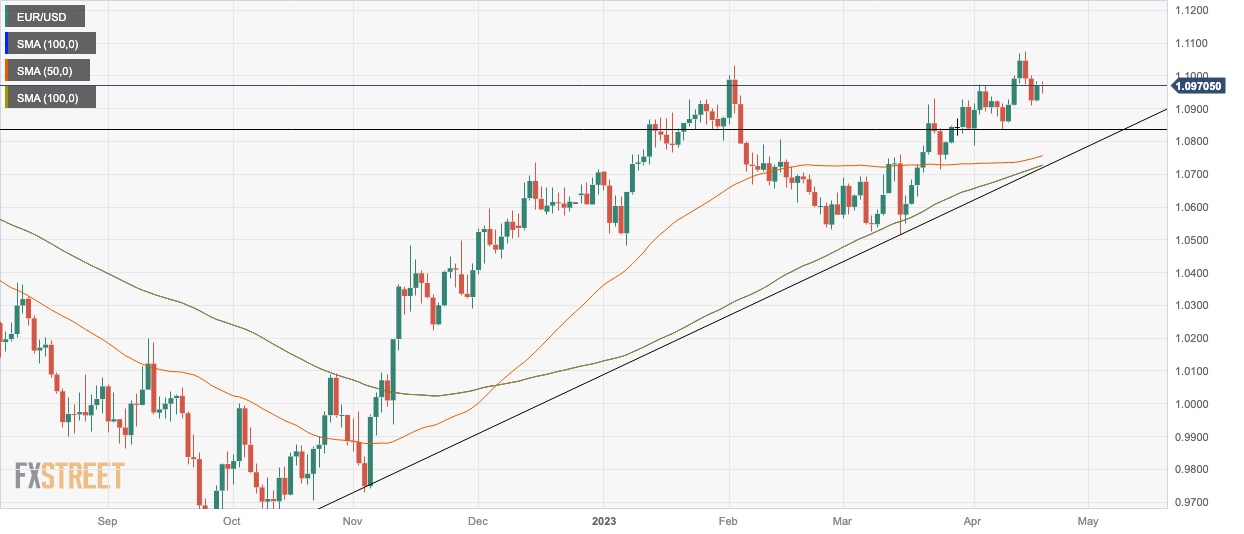
EUR/USD: Daily Chart
During this week the pair has pulled back down into the mid 1.09s, however, where it currently trades at the time of writing. Given the strength of the overall uptrend, however, it is expected to recover and continue extending higher.
A break and daily close above the 1.1075 year-to-date highs of April 14 would provide bulls with fresh confidence to push higher and the pair could rise up to the next target at around 1.1190 where the 200-week Simple Moving Average (SMA) is situated and likely to provide pushback.
A break and close below the lower high at 1.0830, on the other hand, would bring into the question the strength and validity of the uptrend and could see losses extend down to a confluence of support at 1.0750.
Euro FAQs
What is the Euro?
The Euro is the currency for the 20 European Union countries that belong to the Eurozone. It is the second most heavily traded currency in the world behind the US Dollar. In 2022, it accounted for 31% of all foreign exchange transactions, with an average daily turnover of over $2.2 trillion a day.
EUR/USD is the most heavily traded currency pair in the world, accounting for an estimated 30% off all transactions, followed by EUR/JPY (4%), EUR/GBP (3%) and EUR/AUD (2%).
What is the ECB and how does it impact the Euro?
The European Central Bank (ECB) in Frankfurt, Germany, is the reserve bank for the Eurozone. The ECB sets interest rates and manages monetary policy.
The ECB’s primary mandate is to maintain price stability, which means either controlling inflation or stimulating growth. Its primary tool is the raising or lowering of interest rates. Relatively high interest rates – or the expectation of higher rates – will usually benefit the Euro and vice versa.
The ECB Governing Council makes monetary policy decisions at meetings held eight times a year. Decisions are made by heads of the Eurozone national banks and six permanent members, including the President of the ECB, Christine Lagarde.
How does inflation data impact the value of the Euro?
Eurozone inflation data, measured by the Harmonized Index of Consumer Prices (HICP), is an important econometric for the Euro. If inflation rises more than expected, especially if above the ECB’s 2% target, it obliges the ECB to raise interest rates to bring it back under control.
Relatively high interest rates compared to its counterparts will usually benefit the Euro, as it makes the region more attractive as a place for global investors to park their money.
How does economic data influence the value of the Euro?
Data releases gauge the health of the economy and can impact on the Euro. Indicators such as GDP, Manufacturing and Services PMIs, employment, and consumer sentiment surveys can all influence the direction of the single currency.
A strong economy is good for the Euro. Not only does it attract more foreign investment but it may encourage the ECB to put up interest rates, which will directly strengthen the Euro. Otherwise, if economic data is weak, the Euro is likely to fall.
Economic data for the four largest economies in the euro area (Germany, France, Italy and Spain) are especially significant, as they account for 75% of the Eurozone’s economy.
How does the Trade Balance impact the Euro?
Another significant data release for the Euro is the Trade Balance. This indicator measures the difference between what a country earns from its exports and what it spends on imports over a given period.
If a country produces highly sought after exports then its currency will gain in value purely from the extra demand created from foreign buyers seeking to purchase these goods. Therefore, a positive net Trade Balance strengthens a currency and vice versa for a negative balance.
Author

Joaquin Monfort
FXStreet
Joaquin Monfort is a financial writer and analyst with over 10 years experience writing about financial markets and alt data. He holds a degree in Anthropology from London University and a Diploma in Technical analysis.

















