EUR/USD dips below 1.1780 as Eurozone inflation boosts stagflation fears
- EUR/USD reversal from session highs at 1.1825 extends to 1.1775 so far.
- Eurozone consumer inflation figures from March have been revised higher on Thursday
- The US Dollar picks up as the US-Iran standoff in Hormuz dampens risk appetite.

The Euro (EUR) has given away previous gains against the US Dollar (USD) on Thursday, trading around 1.1775 at the time of writing after peaking at 1.1824 earlier in the day. The upward revision of Eurozone consumer inflation figures for March has failed to support the Euro, while the safe-haven USD has been boosted by US-Iran frictions in the Strait of Hormuz.
Eurozone's final Harmonised Index of Consumer Prices (HICP) reading has been revised up to a 1.3% month-over-month increase in March, from previous estimations of 1.2%, and to a 2.6% year-on-year gain, after the 2.5% gain posted in the preliminary readings.
These figures show a higher-than-expected uptick in price pressures; the HICP was at 1.9% year-on-year in February before the US attack on Iran, and back comments from European Central Bank (ECB) President, Christine Lagarde, who warned that the Eurozone economy is nearing adverse scenarios, afraid of having to cope with boosting inflation and a weakening activity, a nightmare for central banks.
On the geopolitical front, threats by Iranian authorities to shut traffic in the Red Sea and the Gulf of Oman if the US blockade of Iran’s ports continues have dampened optimism following US President Donald Trump's comments about a new round of negotiations with Iran.
Technical Analysis: Resistance at 1.1825 keeps holding bulls
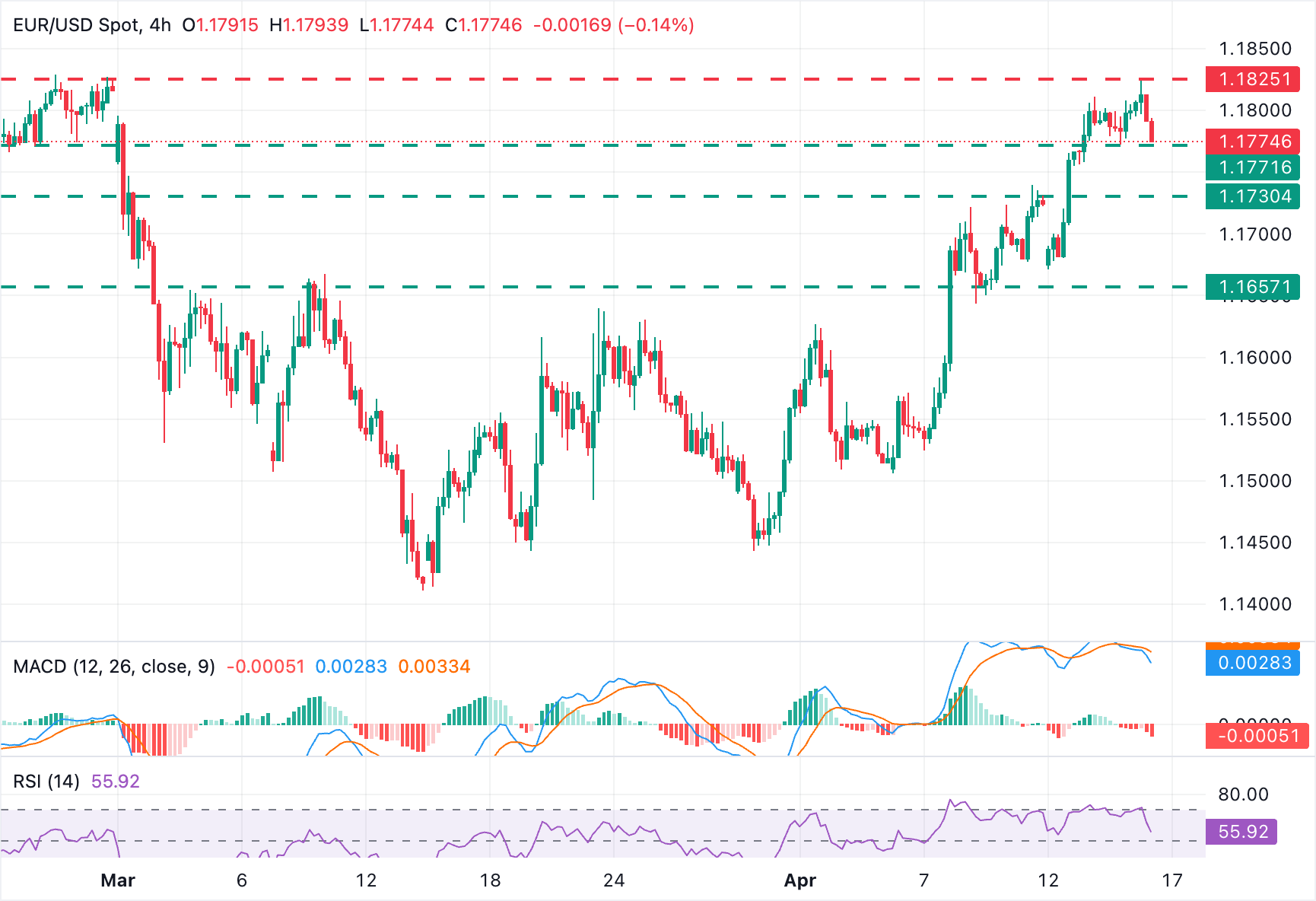
EUR/USD maintains a constructive near-term bias, although technical indicators show a waning upside momentum. The Relative Strength Index (RSI) in the four-hour chart has retreated to levels near the key 50 line, and the Moving Average Convergence Divergence (MACD) histogram is showing widening red bars.
Bears are testing support at Wednesday's low, right above 1.1770, which so far is closing the path towards the previous tops, between 1.1720 and 1.1740. Further down, a breach of the support area around 1.1650 (April 8, 12 lows) would put the current bullish trend into question.
On the upside, resistance around the late February lows in the 1.1825 area is likely to challenge bulls, ahead of the February 10 and 11 highs, near 1.1930.
(The technical analysis of this story was written with the help of an AI tool.)
Economic Indicator
Harmonized Index of Consumer Prices (MoM)
The Harmonized Index of Consumer Prices (HICP) measures changes in the prices of a representative basket of goods and services in the European Monetary Union. The HICP, released by Eurostat on a monthly basis, is harmonized because the same methodology is used across all member states and their contribution is weighted. The MoM figure compares the prices of goods in the reference month to the previous month. Generally, a high reading is seen as bullish for the Euro (EUR), while a low reading is seen as bearish.
Read more.Last release: Thu Apr 16, 2026 09:00
Frequency: Monthly
Actual: 1.3%
Consensus: 1.2%
Previous: 1.2%
Source: Eurostat
Economic Indicator
Harmonized Index of Consumer Prices (YoY)
The Harmonized Index of Consumer Prices (HICP) measures changes in the prices of a representative basket of goods and services in the European Monetary Union. The HICP, released by Eurostat on a monthly basis, is harmonized because the same methodology is used across all member states and their contribution is weighted. The YoY reading compares prices in the reference month to a year earlier. Generally, a high reading is seen as bullish for the Euro (EUR), while a low reading is seen as bearish.
Read more.Last release: Thu Apr 16, 2026 09:00
Frequency: Monthly
Actual: 2.6%
Consensus: 2.5%
Previous: 2.5%
Source: Eurostat
Author

Guillermo Alcala
FXStreet
Graduated in Communication Sciences at the Universidad del Pais Vasco and Universiteit van Amsterdam, Guillermo has been working as financial news editor and copywriter in diverse Forex-related firms, like FXStreet and Kantox.

















