EUR/USD rebounds toward 1.1500 as US Dollar pauses; Fed and ECB decisions in focus
- EUR/USD rebounds from seven-month lows as the US Dollar eases.
- Rising Oil prices linked to Strait of Hormuz disruptions revive global inflation concerns.
- Traders focus on ECB and Fed forward guidance later this week.

The Euro (EUR) rebounds against the US Dollar (USD) on Monday as the Greenback eases following its recent rally, allowing EUR/USD to rebound from the seven-month lows touched on Friday. The move appears largely technical, with traders repositioning ahead of the Federal Reserve (Fed) and European Central Bank (ECB) policy decisions due later this week.
At the time of writing, EUR/USD is trading around 1.1497, up nearly 0.70% on the day. Meanwhile, the US Dollar Index (DXY), which measures the Greenback against a basket of six major currencies, trades near 99.85, easing from the 10-month high of 100.54 reached on Friday.
However, EUR/USD gains may remain limited as fragile market sentiment amid the ongoing US-Iran war underpins demand for the US Dollar as traders seek liquidity and safety during periods of market stress.
Both the ECB and the Fed are widely expected to keep interest rates unchanged this week, leaving markets focused on forward guidance from ECB President Christine Lagarde and Fed Chair Jerome Powell on the future policy path amid renewed inflation concerns driven by elevated Oil prices linked to supply disruptions in the Strait of Hormuz.
Before the conflict, markets expected the ECB to keep interest rates unchanged through 2026. Now, traders are increasingly betting on potential rate hikes later this year, with a move fully priced in by July. However, high Oil prices create a dilemma for the central bank, as they could weigh on Eurozone economic growth given the region’s heavy reliance on imported energy.
Across the Atlantic, traders are also scaling back expectations for Fed interest rate cuts this year. Markets now price in only one rate cut, compared with at least two expected before the conflict. Investors will closely watch the updated Dot Plot and Summary of Economic Projections (SEP) for further clues on the Fed’s monetary policy outlook.
Technical analysis: Sellers remain in control below the 1.1600 resistance
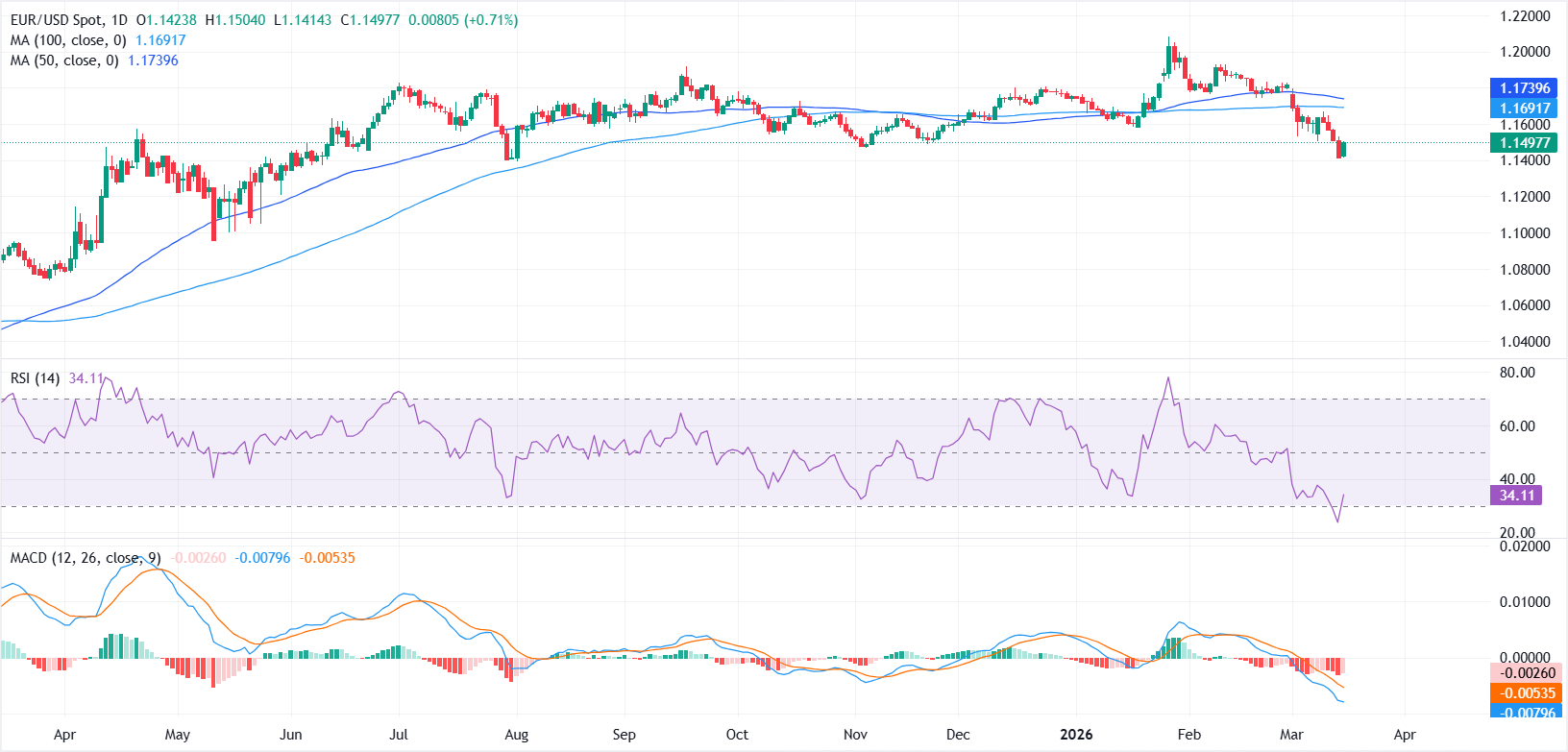
From a technical perspective, EUR/USD remains in a clear downtrend after peaking at 1.2082 on January 27, its highest level since June 2021. The pair continues to form lower highs and lower lows and trades well below the 50-day and 100-day Simple Moving Averages (SMAs), near 1.1740 and 1.1690, respectively, keeping the broader bearish bias intact.
Momentum indicators suggest selling pressure has eased slightly but remains dominant. The Relative Strength Index (RSI) has rebounded from oversold levels near 24 to around 34, indicating fading downside momentum but still staying below the neutral 50 mark. Meanwhile, the Moving Average Convergence Divergence (MACD) remains in negative territory below the signal line, with a slightly narrowing histogram pointing to slowing but persistent bearish pressure.
On the upside, a sustained move above 1.1500 could open the door toward the 1.1600 resistance area, followed by the 1.1700 zone where recent highs converge with the 100-day SMA. On the downside, Friday’s low at 1.1411 acts as immediate support. A break below this level could expose the 1.1350 area.
Inflation FAQs
Inflation measures the rise in the price of a representative basket of goods and services. Headline inflation is usually expressed as a percentage change on a month-on-month (MoM) and year-on-year (YoY) basis. Core inflation excludes more volatile elements such as food and fuel which can fluctuate because of geopolitical and seasonal factors. Core inflation is the figure economists focus on and is the level targeted by central banks, which are mandated to keep inflation at a manageable level, usually around 2%.
The Consumer Price Index (CPI) measures the change in prices of a basket of goods and services over a period of time. It is usually expressed as a percentage change on a month-on-month (MoM) and year-on-year (YoY) basis. Core CPI is the figure targeted by central banks as it excludes volatile food and fuel inputs. When Core CPI rises above 2% it usually results in higher interest rates and vice versa when it falls below 2%. Since higher interest rates are positive for a currency, higher inflation usually results in a stronger currency. The opposite is true when inflation falls.
Although it may seem counter-intuitive, high inflation in a country pushes up the value of its currency and vice versa for lower inflation. This is because the central bank will normally raise interest rates to combat the higher inflation, which attract more global capital inflows from investors looking for a lucrative place to park their money.
Formerly, Gold was the asset investors turned to in times of high inflation because it preserved its value, and whilst investors will often still buy Gold for its safe-haven properties in times of extreme market turmoil, this is not the case most of the time. This is because when inflation is high, central banks will put up interest rates to combat it. Higher interest rates are negative for Gold because they increase the opportunity-cost of holding Gold vis-a-vis an interest-bearing asset or placing the money in a cash deposit account. On the flipside, lower inflation tends to be positive for Gold as it brings interest rates down, making the bright metal a more viable investment alternative.
Author

Vishal Chaturvedi
FXStreet
I am a macro-focused research analyst with over four years of experience covering forex and commodities market. I enjoy breaking down complex economic trends and turning them into clear, actionable insights that help traders stay ahead of the curve.