EUR/USD Price Forecast: Turns broadly sideways below 20-day EMA
- EUR/USD edges down to near 1.1433 as the US Dollar ticks higher.
- The FOMC Minutes of the June meeting will be the major driver for the US Dollar this week.
- The ECB seems to be following the Fed’s footsteps, refusing to deliver remarks on the monetary policy outlook.

The EUR/USD pair trades marginally lower at around 1.1433 during the European trading session on Tuesday. The major currency pair faces slight selling pressure as the US Dollar (USD) edges up, while investors await the release of the Federal Open Market Committee (FOMC) minutes of the June policy meeting on Wednesday.
At press time, the US Dollar Index (DXY), which gauges the Greenback’s value against six major currencies, trades slightly higher to near 100.92.
Investors keep an eye on the FOMC Minutes to identify reasons probably responsible for restricting policymakers from delivering forward guidance on monetary policy decisions.
In the June monetary policy press conference, Fed Chairman Kevin Warsh said that policymakers agreed that the “so-called forward guidance is not well suited to the current policy conjuncture.
Like the Fed, officials from the European Central Bank (ECB) also appear not in favor of delivering remarks regarding the monetary policy outlook.
Over the weekend, ECB Governing Council member Emmanuel Moulin also denied providing cues regarding the central bank’s decision in July, while speaking at the Rencontres Economiques conference in Aix-en-Provence. “We are not doing forward guidance so I won’t say what we will do in July,” Moulin said.
EUR/USD technical analysis
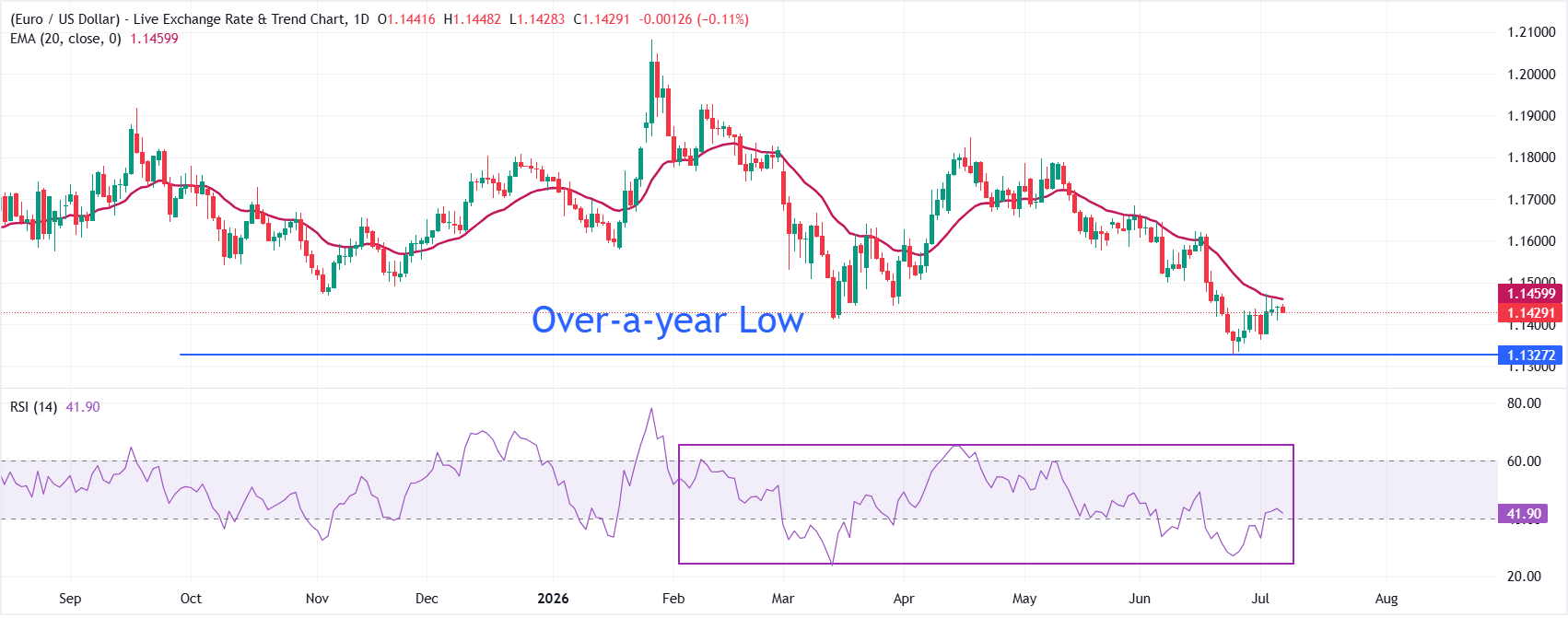
EUR/USD trades lower at around 1.1430, keeping a bearish near-term tone as the pair holds beneath the 20-day exponential moving average (EMA) at 1.1460. The fact that price remains under this short-term trend gauge suggests rallies are still being capped, while the Relative Strength Index (14) at 41.9 stays below the neutral 50 line, hinting at lingering downside pressure rather than a decisive recovery.
On the topside, immediate resistance is located at the 20-day EMA around 1.1460, and a sustained break above this level would be needed to ease the current bearish bias and open the way for a stronger rebound. Looking up, the pair could advance to the psychological level of 1.1500 if it breaks above the moving average.
On the downside, the yearly low around 1.1330 will be the key support zone; a break below it would expose the pair to the 29 May 2025 low at 1.1210.
(The technical analysis of this story was written with the help of an AI tool. Know more.)
Euro FAQs
The Euro is the currency for the 20 European Union countries that belong to the Eurozone. It is the second most heavily traded currency in the world behind the US Dollar. In 2022, it accounted for 31% of all foreign exchange transactions, with an average daily turnover of over $2.2 trillion a day. EUR/USD is the most heavily traded currency pair in the world, accounting for an estimated 30% off all transactions, followed by EUR/JPY (4%), EUR/GBP (3%) and EUR/AUD (2%).
The European Central Bank (ECB) in Frankfurt, Germany, is the reserve bank for the Eurozone. The ECB sets interest rates and manages monetary policy. The ECB’s primary mandate is to maintain price stability, which means either controlling inflation or stimulating growth. Its primary tool is the raising or lowering of interest rates. Relatively high interest rates – or the expectation of higher rates – will usually benefit the Euro and vice versa. The ECB Governing Council makes monetary policy decisions at meetings held eight times a year. Decisions are made by heads of the Eurozone national banks and six permanent members, including the President of the ECB, Christine Lagarde.
Eurozone inflation data, measured by the Harmonized Index of Consumer Prices (HICP), is an important econometric for the Euro. If inflation rises more than expected, especially if above the ECB’s 2% target, it obliges the ECB to raise interest rates to bring it back under control. Relatively high interest rates compared to its counterparts will usually benefit the Euro, as it makes the region more attractive as a place for global investors to park their money.
Data releases gauge the health of the economy and can impact on the Euro. Indicators such as GDP, Manufacturing and Services PMIs, employment, and consumer sentiment surveys can all influence the direction of the single currency. A strong economy is good for the Euro. Not only does it attract more foreign investment but it may encourage the ECB to put up interest rates, which will directly strengthen the Euro. Otherwise, if economic data is weak, the Euro is likely to fall. Economic data for the four largest economies in the euro area (Germany, France, Italy and Spain) are especially significant, as they account for 75% of the Eurozone’s economy.
Another significant data release for the Euro is the Trade Balance. This indicator measures the difference between what a country earns from its exports and what it spends on imports over a given period. If a country produces highly sought after exports then its currency will gain in value purely from the extra demand created from foreign buyers seeking to purchase these goods. Therefore, a positive net Trade Balance strengthens a currency and vice versa for a negative balance.
Author

Sagar Dua
FXStreet
Sagar Dua is associated with the financial markets from his college days. Along with pursuing post-graduation in Commerce in 2014, he started his markets training with chart analysis.