EUR/USD Price Forecast: Holds losses near 1.1550 as bearish bias prevails
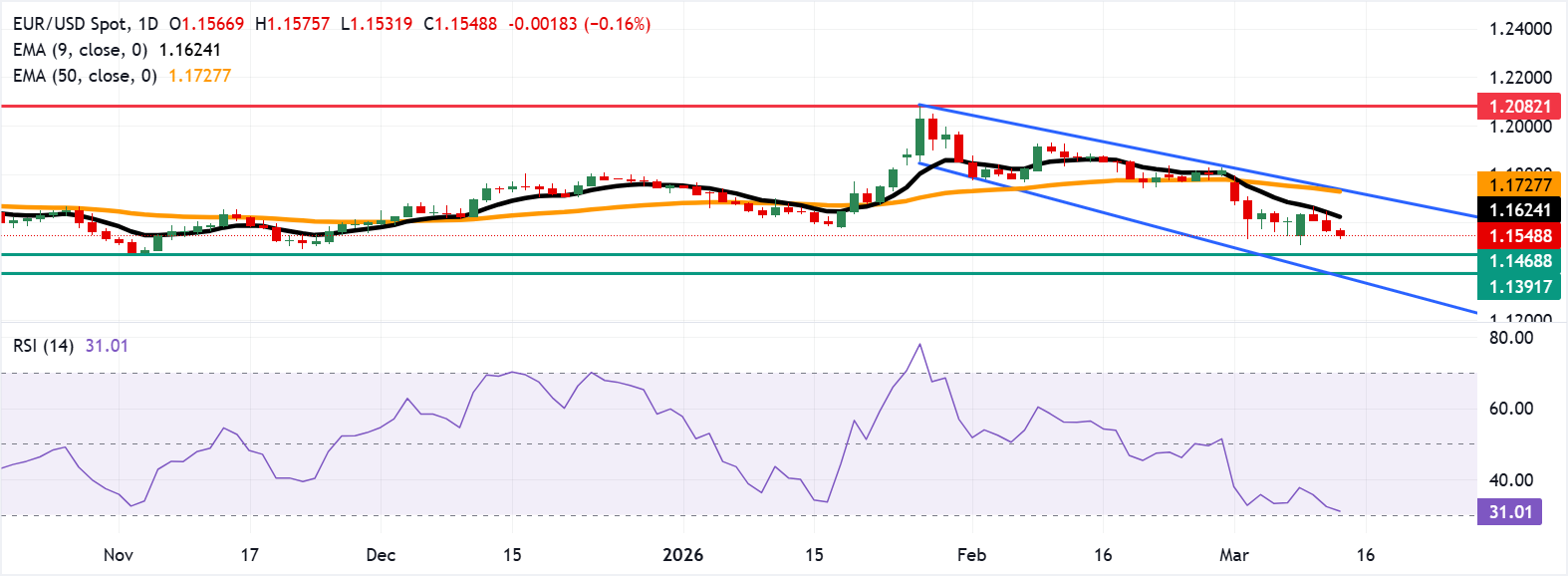
- EUR/USD may extend losses toward the seven-month low near 1.1468.
- The 14-day Relative Strength Index at 31 signals persistent bearish pressure near oversold territory.
- The initial resistance lies at the nine-day EMA of 1.1624.

EUR/USD continues to lose ground for the third consecutive day, trading around 1.1550 during the European hours on Thursday. Daily chart technical analysis indicates a persistent bearish bias as the pair moves downwards within a descending channel pattern.
The near-term bias is mildly bearish as price holds beneath the nine-day Exponential Moving Average (EMA) and extends its slide away from the flattened 50-day average, confirming fading upside momentum seen over recent weeks.
The 14-day Relative Strength Index (RSI) momentum indicator at 31 signals persistent bearish pressure near oversold territory, aligning with the decisive break below the short-term moving average cluster and pointing to sellers retaining control unless the pair recovers back above the 1.1600 area.
The EUR/USD pair may further depreciate toward the seven-month low of 1.1468, recorded on November 5, 2025. Further support lies at the nine-month low of 1.1391, aligned with the lower boundary of the descending channel.
On the upside, the initial resistance lies at the nine-day EMA of 1.1624. A break above the short-term average would improve the market bias and support the pair to test the 50-day EMA at 1.1727, followed by the upper descending channel boundary around 1.1750.
(The technical analysis of this story was written with the help of an AI tool.)
Euro FAQs
The Euro is the currency for the 20 European Union countries that belong to the Eurozone. It is the second most heavily traded currency in the world behind the US Dollar. In 2022, it accounted for 31% of all foreign exchange transactions, with an average daily turnover of over $2.2 trillion a day. EUR/USD is the most heavily traded currency pair in the world, accounting for an estimated 30% off all transactions, followed by EUR/JPY (4%), EUR/GBP (3%) and EUR/AUD (2%).
The European Central Bank (ECB) in Frankfurt, Germany, is the reserve bank for the Eurozone. The ECB sets interest rates and manages monetary policy. The ECB’s primary mandate is to maintain price stability, which means either controlling inflation or stimulating growth. Its primary tool is the raising or lowering of interest rates. Relatively high interest rates – or the expectation of higher rates – will usually benefit the Euro and vice versa. The ECB Governing Council makes monetary policy decisions at meetings held eight times a year. Decisions are made by heads of the Eurozone national banks and six permanent members, including the President of the ECB, Christine Lagarde.
Eurozone inflation data, measured by the Harmonized Index of Consumer Prices (HICP), is an important econometric for the Euro. If inflation rises more than expected, especially if above the ECB’s 2% target, it obliges the ECB to raise interest rates to bring it back under control. Relatively high interest rates compared to its counterparts will usually benefit the Euro, as it makes the region more attractive as a place for global investors to park their money.
Data releases gauge the health of the economy and can impact on the Euro. Indicators such as GDP, Manufacturing and Services PMIs, employment, and consumer sentiment surveys can all influence the direction of the single currency. A strong economy is good for the Euro. Not only does it attract more foreign investment but it may encourage the ECB to put up interest rates, which will directly strengthen the Euro. Otherwise, if economic data is weak, the Euro is likely to fall. Economic data for the four largest economies in the euro area (Germany, France, Italy and Spain) are especially significant, as they account for 75% of the Eurozone’s economy.
Another significant data release for the Euro is the Trade Balance. This indicator measures the difference between what a country earns from its exports and what it spends on imports over a given period. If a country produces highly sought after exports then its currency will gain in value purely from the extra demand created from foreign buyers seeking to purchase these goods. Therefore, a positive net Trade Balance strengthens a currency and vice versa for a negative balance.
Author

Akhtar Faruqui
FXStreet
Akhtar Faruqui is a Forex Analyst based in New Delhi, India. With a keen eye for market trends and a passion for dissecting complex financial dynamics, he is dedicated to delivering accurate and insightful Forex news and analysis.














