EUR/USD advances as ECB holds rates steady, USD eases from post-Fed highs
- EUR/USD rises as the ECB interest rate decision boosts the Euro, and the USD softens across the board.
- ECB holds rates steady, flags higher inflation risks and weaker growth outlook.
- Middle East conflict adds uncertainty as rising energy prices fuel inflation risks

EUR/USD edges higher on Thursday as the Euro (EUR) strengthens following the European Central Bank’s (ECB) monetary policy decision, while the US Dollar (USD) weakens broadly after a series of central bank decisions, with both the Bank of Japan (BoJ) and the Bank of England (BoE) delivering hawkish holds, helping reverse the previous day’s USD gains driven by the Federal Reserve’s (Fed) policy announcement.
At the time of writing, the pair is trading around 1.1529, up nearly 0.67% on the day. Meanwhile, the US Dollar Index (DXY), which tracks the Greenback against a basket of six major currencies, slips to around 99.60 after peaking at 100.31 earlier in the day.
The ECB left its key interest rates unchanged, with the deposit facility at 2.00%, the main refinancing rate at 2.15%, and the marginal lending rate at 2.40%. In its statement, the ECB warned that the ongoing conflict in the Middle East has significantly increased uncertainty, posing upside risks to inflation and downside risks to economic growth.
The Governing Council said it is well-positioned to navigate this uncertainty and remains determined to ensure that inflation stabilises at the 2% target over the medium term.
The central bank reiterated that it will continue to follow a data-dependent and meeting-by-meeting approach in determining the appropriate monetary policy stance. It stressed that interest rate decisions will be guided by its assessment of the inflation outlook and the risks surrounding it, while emphasizing that it is not pre-committing to any particular rate path.
ECB President Christine Lagarde said fiscal support to address the energy shock should be temporary and targeted, warning that rising energy prices will lift inflation above 2% in the near term. She added that weaker market sentiment could dampen demand, while noting that risks to the growth outlook remain skewed to the downside.
Despite this cautious tone, markets are increasingly pricing in a potential rate hike by July, with the possibility of another move by year-end if inflation pressure remains elevated.
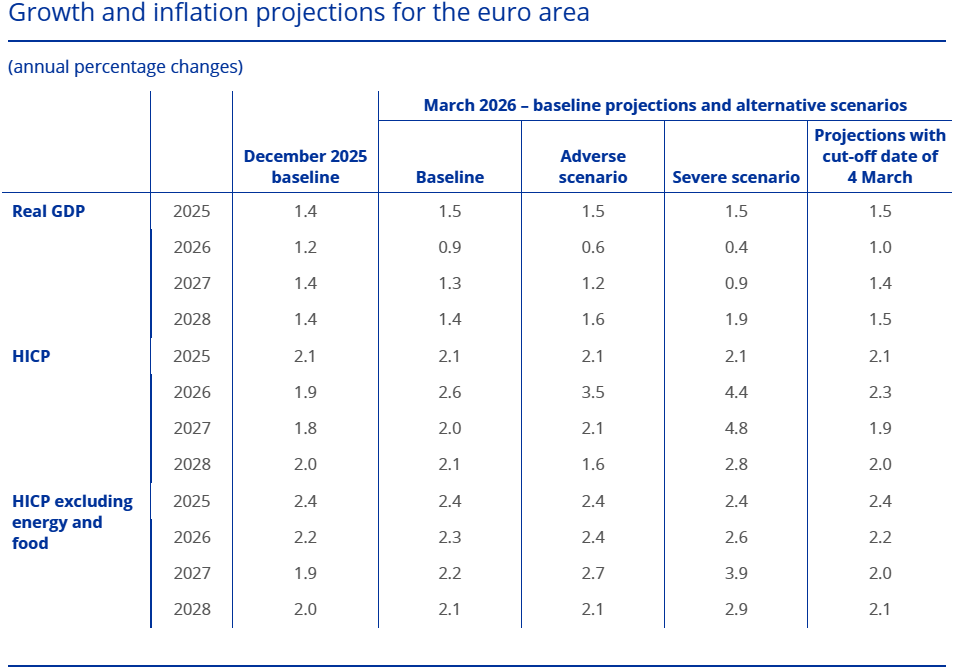
ECB projections show a clear deterioration in the macro outlook, with weaker growth and higher inflation under both baseline and adverse scenarios.
Author

Vishal Chaturvedi
FXStreet
I am a macro-focused research analyst with over four years of experience covering forex and commodities market. I enjoy breaking down complex economic trends and turning them into clear, actionable insights that help traders stay ahead of the curve.














